Cambodia’s Military Strength: Tanks, Aircraft and Rocket Artillery in the Inventory (2026)

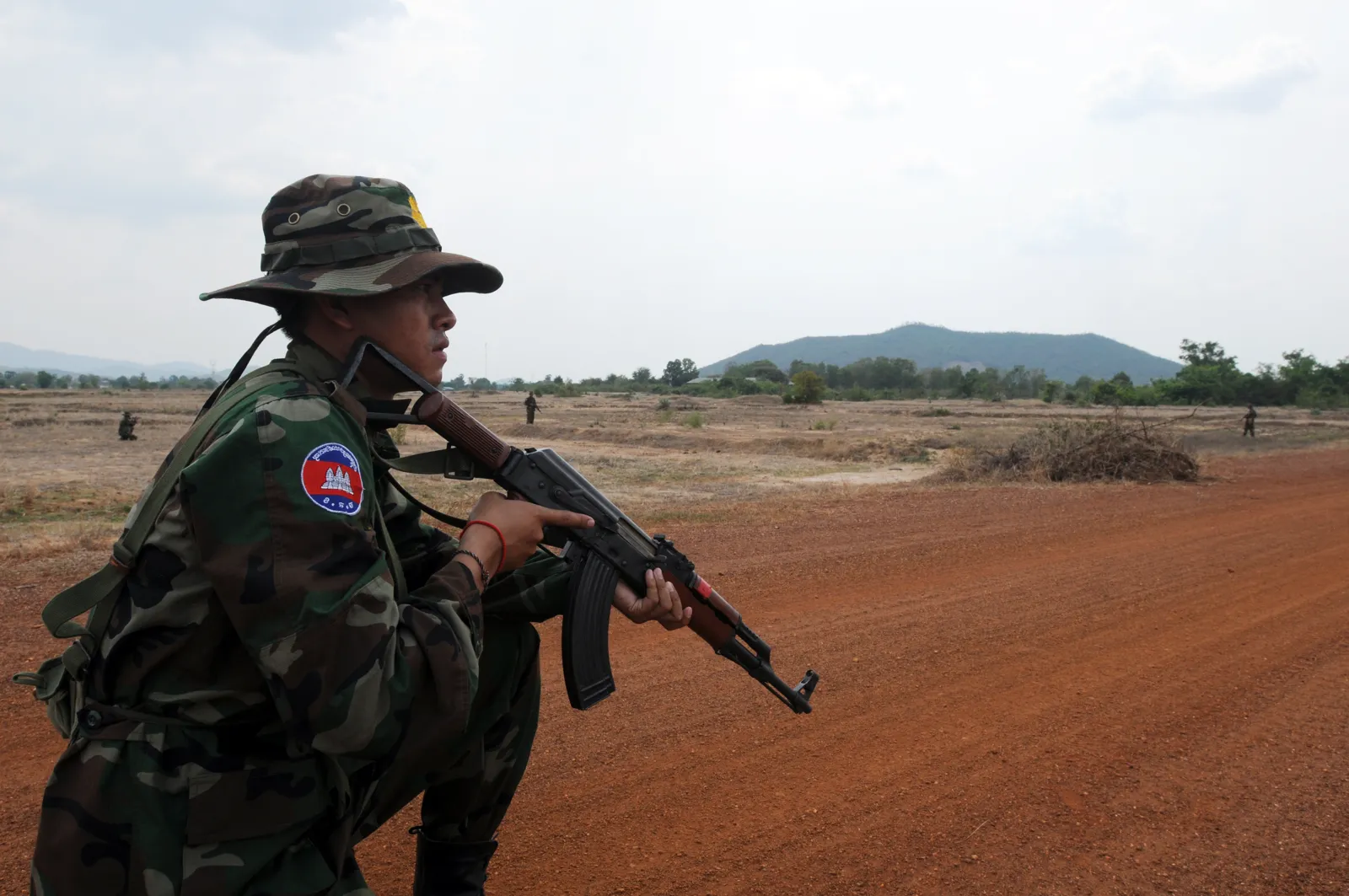
Cambodia’s military inventory is one of the clearest cases of supply dependence in Southeast Asia. Global Firepower’s 2026 list places the country 83rd among 145 militaries, showing 520 tanks and 520 rocket-artillery systems — and zero fighters. The July 2025 clash on the Thai border also revealed which parts of this inventory are actually usable. This article works line by line through the land, air, air-defence and naval holdings of the Royal Cambodian Armed Forces, based on open sources.
At a Glance
- Active personnel: ≈ 124,300 active troops (total military personnel ≈ 134,300)
- Main battle tanks: ≈ 520 (T-54/T-55 and Chinese Type 59 generation)
- Military aircraft (total): ≈ 24; fighters: 0
- Rocket artillery: ≈ 520; the longest-reaching are 6 PHL-03 systems (300 mm, ≈ 130 km)
- Navy: ≈ 20 platforms; the first corvette was received from China in April 2026
- Defence budget: ≈ $750 million (Global Firepower 2026)
Note: The inventory figures below are approximate values drawn from open sources such as Global Firepower, the IISS Military Balance and SIPRI.
About the Cambodia Armed Forces
The Royal Cambodian Armed Forces comprise four components: the Army, the Navy, the Air Force and the Royal Gendarmerie deployed across the provinces. King Norodom Sihamoni is constitutionally the supreme commander; operational command has rested since 2018 with Commander-in-Chief Gen. Vong Pisen. Of the personnel, roughly 75,000 serve in the army, 2,800 in the navy and 1,500 in the air force, while the gendarmerie numbers about 30,000.
According to Global Firepower’s 2026 data, Cambodia ranks 83rd of 145 countries, with 124,300 active and 134,300 total military personnel and a defence budget of about $750 million. The country’s 2025 defence expenditure was announced as 2.9 trillion riel, roughly $739 million, or about 1.5 percent of GDP. That budget ceiling explains why the inventory has been shaped so heavily by donations, grants and second-hand transfers.
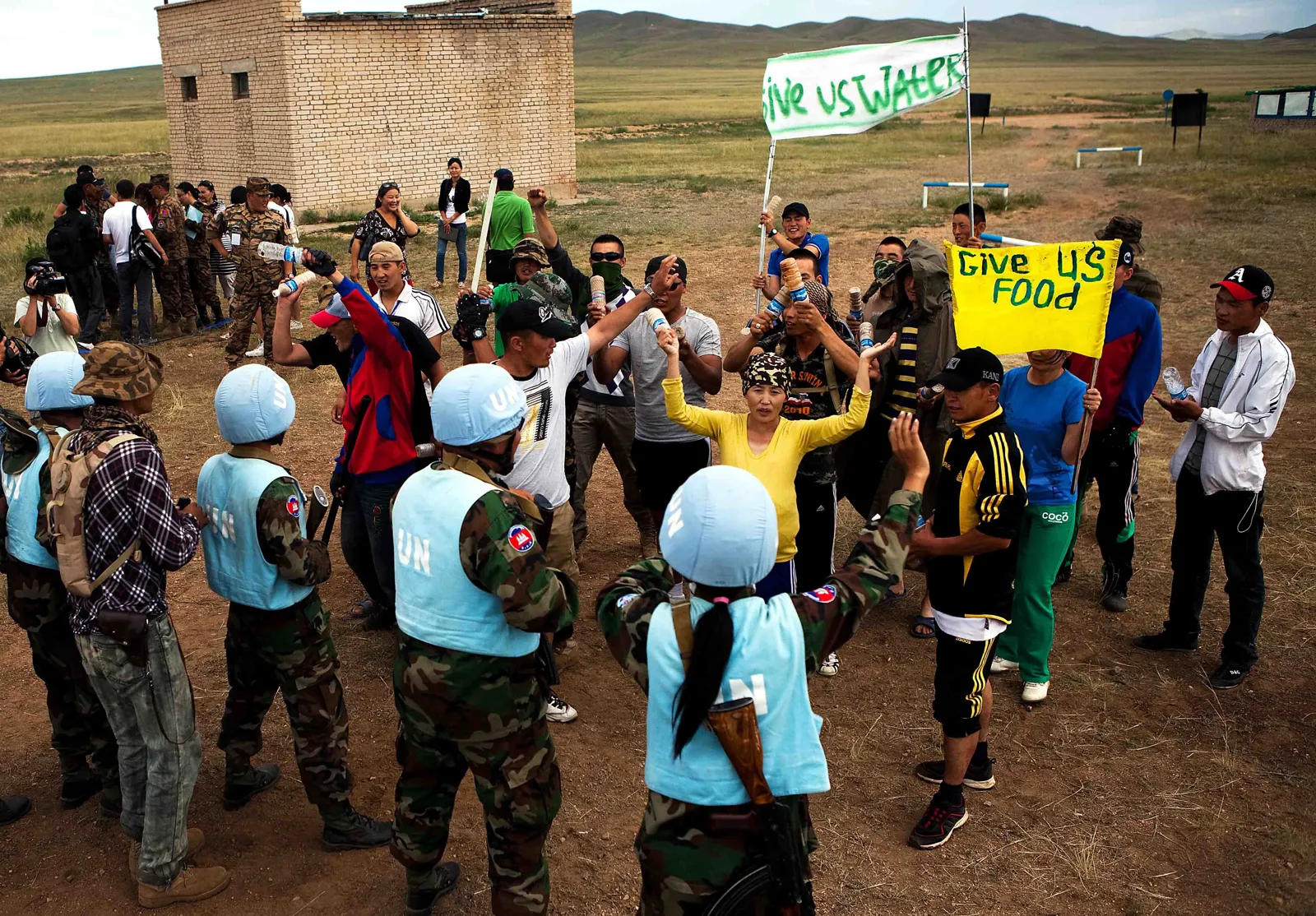
The weight of the land inventory sits in the Cold War generation. Of the roughly 520 main battle tanks, about 300 are Soviet-built T-54s and T-55s, 100 are Czechoslovak-sourced T-55AM1s and 143 belong to the Chinese Type 59-II family, 93 of them upgraded to Type 59D standard. Type 62-I and Type 63-I light tanks sit alongside them. The armoured fleet includes BMP-1 infantry fighting vehicles, BTR-60 and Chinese YW531 personnel carriers, Czechoslovak OT-64 SKOTs, ZFB-05 wheeled vehicles and BRDM-2 scout cars.
Artillery is the most numerous and, in practice, the most functional part of the inventory. The 525 towed pieces consist of 122 mm M-30s and D-30s, 130 mm M-46s and 152 mm Type 66s. The self-propelled column holds some 30 truck-mounted SH-1 (PCL-09) systems acquired from China. Rocket artillery is particularly crowded: BM-21 Grads, Czechoslovak RM-70s, Chinese PHL-81s and Type-90Bs and 107 mm Type 63s add up to about 520 systems.
One line stands out in that table: the six PHL-03 systems bought from China. With a range approaching 130 kilometres, this 300 mm launcher is the longest-reaching weapon Cambodia owns. During the July 2025 border fighting the Thai government stated that Cambodian forces had used Type-90B and PHL-03 systems for cross-border fire, and repeated the assessment when the fighting reignited in December 2025.
In the air the picture inverts. Although Global Firepower’s 2026 list shows 24 aircraft in total, the fighter and attack columns read zero. The MiG-21bis, L-39C Albatros and J-6C aircraft on the books have all been non-airworthy since 2023. Today the fleet consists of Xian MA60 and Harbin Y-12 transports, a Britten-Norman BN-2, an Airbus A320 in the VIP role and Mi-8, Mi-17, Harbin Z-9, AS355 and AW109 helicopters. No attack helicopter or in-service unmanned aerial vehicle is confirmed in open sources, and reports of Su-25 or Su-27 purchases from Russia rest on no confirmed contract.
The defining item in air defence is the KS-1C system delivered by China in 2023. An export derivative of the HQ-12, this medium-range missile entered service in four batteries and forms the only modern layer Cambodia has for point defence. During the July 2025 fighting Thai authorities claimed the system had been moved to Oddar Meanchey province. Beyond it, air defence rests on roughly 500 man-portable missiles of four types — HN-5, FN-6, FN-16 and QW-3 — and on Soviet-generation anti-aircraft guns. The ballistic and cruise missile column is empty.
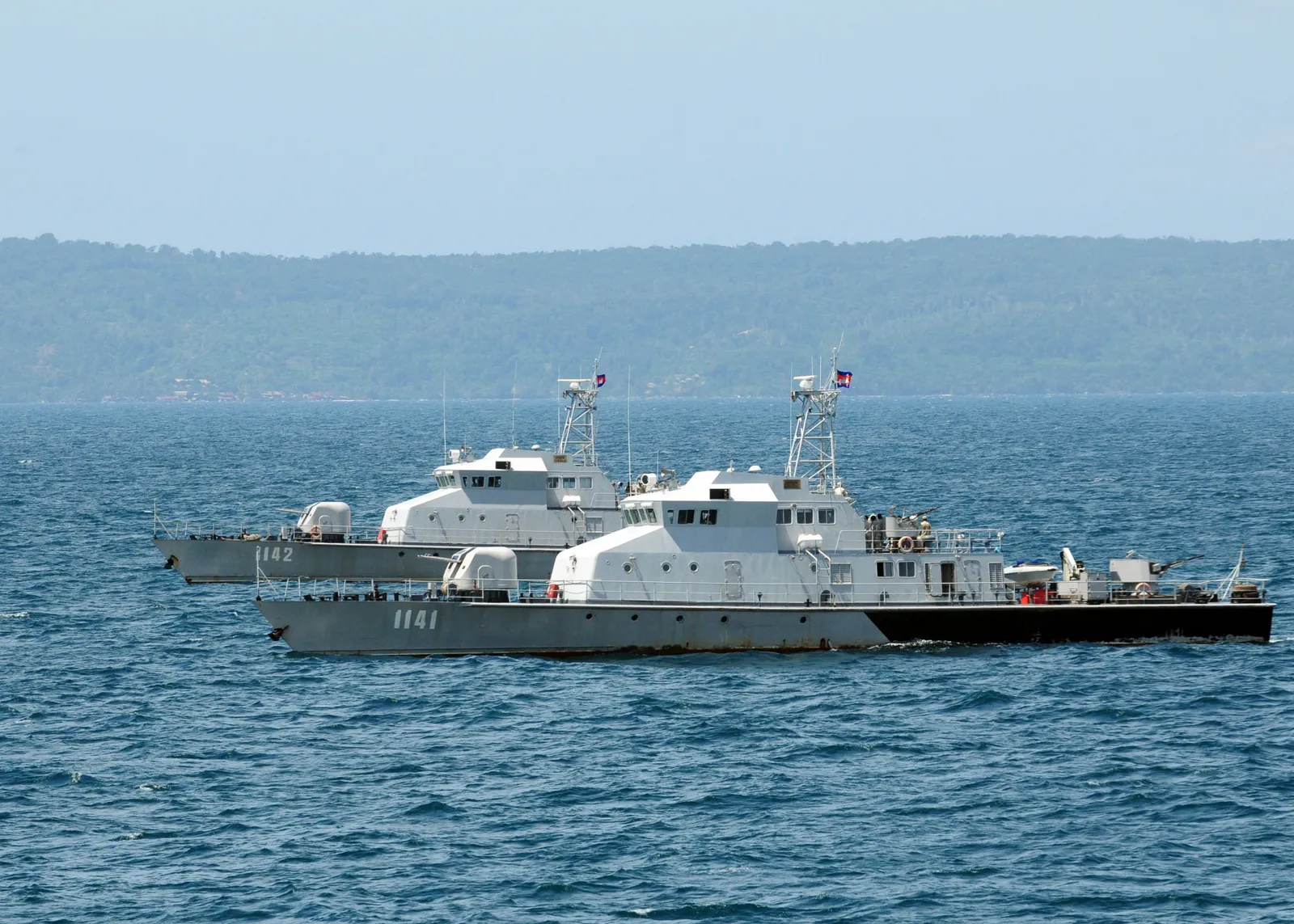
The navy is where 2026 brought the most concrete change. With about 2,800 personnel including a 1,500-strong marine component, the service operated for years on patrol craft alone. On 4 April 2026 the first Type 056C corvette donated by China arrived at Ream Naval Base and was formally transferred on 8 April. Carrying pennant number 622, the ship is armed with an H/PJ-26 76 mm gun and two H/PJ-17 30 mm close-in weapon systems, and its hull is roughly five metres longer than a standard Type 056. A second ship was expected to be delivered in June 2026.
The rest of the fleet consists of Koh Chhlam, Koh Ruesay, Koh Polowai, Koh Svay and Koh Kong-class patrol craft, most of them Chinese-sourced and some European-built. The force is deployed in two flotillas: the Mekong flotilla is run from Chroy Changvar base in Phnom Penh and the Gulf of Thailand flotilla from Ream near Sihanoukville. Modernised with Chinese financing, Ream reopened in April 2025 and has since sat at the centre of the country’s naval transformation.
Land Forces Inventory
| System type | Est. quantity |
|---|---|
| Main battle tanks (T-54/T-55, T-55AM1, Type 59-II/59D) | ≈ 520 |
| Light tanks (Type 62-I, Type 63-I) | ≈ 70 |
| Armoured vehicles (BMP-1, BTR-60, OT-64 SKOT, YW531, ZFB-05, BRDM-2) | ≈ 5.400 |
| Towed howitzers (M-30 and D-30 122 mm, M-46 130 mm, Type 66 152 mm) | ≈ 525 |
| MLRS (BM-21, RM-70, PHL-81, Type-90B, PHL-03) | ≈ 520 |
Air Force Inventory
| Platform | Est. quantity |
|---|---|
| Total military aircraft | ≈ 24 |
| Fighters / attack aircraft | 0 — the MiG-21, L-39 and J-6 fleet is grounded |
| Transport aircraft (Xian MA60, Harbin Y-12, BN-2, VIP A320) | ≈ 5 |
| Helicopters (Mi-8, Mi-17, Harbin Z-9, AS355, AW109) | ≈ 20 |
| Attack helicopters / UAVs | Not confirmed in open sources |
Missile and Air-Defence Systems
| System | Type / Note |
|---|---|
| KS-1C (export variant of the HQ-12, China) | 4 batteries; entered service in 2023, the only medium-range SAM |
| Man-portable air-defence missiles (HN-5, FN-6, FN-16, QW-3) | ≈ 500 |
| PHL-03 (300 mm MLRS) | 6 systems; with ≈ 130 km range, the longest-reaching weapon in the inventory |
| Anti-aircraft guns (Soviet generation) | Backbone of the low-altitude layer |
| Ballistic or cruise missiles | None |
Naval Power
| Class / Type | Est. quantity |
|---|---|
| Total naval platforms | ≈ 20 |
| Corvette (Type 056C, donated by China) | 1 — received in April 2026, a second is expected |
| Patrol craft (Koh Chhlam, Koh Ruesay, Koh Polowai, Koh Svay, Koh Kong) | ≈ 16 |
| Naval personnel including marines | ≈ 2.800 |
| Bases and coastline | Ream and Chroy Changvar; 443 km of coastline |
The Turkey Angle: Turkish Defence Industry
Cambodia is one of the markets the Turkish defence industry has yet to enter. Open sources record no Turkish-built platform in the Royal Cambodian Armed Forces inventory and no defence-industry cooperation agreement between the two countries. This section should therefore be read not as an account of deliveries made, but as a market reading of where the existing relationship stands and where it could touch.
The diplomatic basis is old. Relations between Turkey and Cambodia were established at legation level in 1947 and raised to ambassadorial rank in 1959, though Turkey did not open a resident embassy in Phnom Penh until 2013. In October 2018 then-Prime Minister Hun Sen visited Ankara and met President Recep Tayyip Erdoğan; in 2019 the two sides set a bilateral trade target of $1 billion. Trade reached $152 million in 2022 after a 67 percent rise — still well short of that target.
The most concrete step on the security file came in 2026. During an official visit to Turkey in February 2026, Deputy Prime Minister and Interior Minister Sar Sokha signed a Memorandum of Understanding on Law Enforcement Training Cooperation with the Turkish Ministry of Interior. It covers the exchange of expertise against technology-enabled fraud and cybercrime, cooperation on investigating and repatriating offenders, and scholarships in Turkey for Cambodian interior ministry personnel. It is worth underlining that this is not a defence-industry agreement; its scope is limited to law-enforcement training and digital policing technology.
On the development side, the Turkish Cooperation and Coordination Agency (TIKA) has run road and infrastructure works along with agricultural equipment and food support projects in Cambodia. In other words, contact between the two countries has so far stayed on the diplomatic, commercial, development-aid and — most recently — law-enforcement tracks. A military supply line has never opened.
In procurement terms the picture holds both an opening and an obstacle for Turkish industry. The gaps in Cambodia’s inventory are clear enough: no combat aircraft, no confirmed unmanned aerial vehicle, an armoured fleet largely of Cold War vintage, and an air defence squeezed between a single four-battery medium-range system and shoulder-fired missiles. Most of those headings overlap with areas where Turkish industry is strong: tactical-class UAVs, mine-resistant armoured vehicles, 155 mm artillery systems and coastal patrol boats.
Cambodia’s purchasing behaviour, however, is governed by price and grants. The first corvette was donated by China, the modernisation of Ream Naval Base was financed by China, and the only modern layer of air defence likewise came from China — a supply chain concentrated on a single source. Turkish industry’s ability to compete in this market appears to depend less on product quality than on the financing model on offer.
Regional precedent shows Turkish industry can enter South and Southeast Asia. Bangladesh contracted with Roketsan for the TRG-230 and TRG-300 guided rocket systems and moved to buy Bayraktar TB2 drones in 2022, while cooperation with Indonesia and Malaysia has built lasting footholds in the region. In Cambodia’s case there is no contract on the table today; but the fact that the map of gaps in its inventory overlaps with the Turkish product range makes a relationship currently worth zero worth recording for the future.
Frequently Asked Questions
How many tanks does Cambodia have? Global Firepower’s 2026 list shows around 520 main battle tanks. About 300 are Soviet-built T-54/T-55s, 100 are Czechoslovak-sourced T-55AM1s and 143 belong to the Chinese Type 59-II family; Type 62-I and Type 63-I light tanks are also in service.
Does Cambodia have fighter aircraft? No. The MiG-21bis, L-39C and J-6C aircraft on the books have all been non-airworthy since 2023. The air arm today consists of transports and helicopters, and the fighter and attack columns read zero.
What is Cambodia’s air defence? The only modern layer is the four-battery KS-1C medium-range missile system delivered by China in 2023. Beyond it, the country relies on HN-5, FN-6, FN-16 and QW-3 man-portable missiles and Soviet-generation anti-aircraft guns; there are no ballistic or cruise missiles.
Does the Cambodian navy have a corvette? Yes. The first Type 056C corvette donated by China arrived at Ream Naval Base on 4 April 2026 and was formally transferred on 8 April. Pennant 622 carries a 76 mm gun and two close-in weapon systems, and a second ship was expected in June 2026.
Is there any Turkish-made system in Cambodia’s inventory? Open sources confirm no Turkish platform in the Royal Cambodian Armed Forces inventory, and there is no defence-industry cooperation agreement between the two countries. The document signed in February 2026 concerns law-enforcement training and has no bearing on military procurement.
Bottom Line
Cambodia’s inventory is a good example of how misleading raw numbers can be. On paper, 520 tanks and 520 rocket launchers suggest a serious land force; in practice the backbone of that inventory is made up of 1950s and 1960s platforms, with nothing to match it in the air. The army’s real firepower is concentrated less in tank numbers than in the mass of tube and rocket artillery — as the July 2025 border fighting showed. The second defining feature is the concentration of the supply chain: the only modern layer of air defence, all of the self-propelled artillery, a large share of the rocket launchers and the navy’s first corvette all come from China. With its limited budget, Cambodia modernises according to the balance of grants and loans it is offered rather than its own purchasing power. What will define this inventory in the coming period is not a new tank or a new aircraft but three questions: what maintenance and training capacity the navy will build after the second corvette, whether air defence will move beyond four batteries, and whether the reconnaissance requirement will be met by unmanned aircraft. That these three headings fall precisely where Turkish defence industry is strong makes a relationship currently worth zero worth watching.