Turkey’s Newest Sea Drone Is Built to Be Expended: ASELSAN’s TUFAN Hits the Water

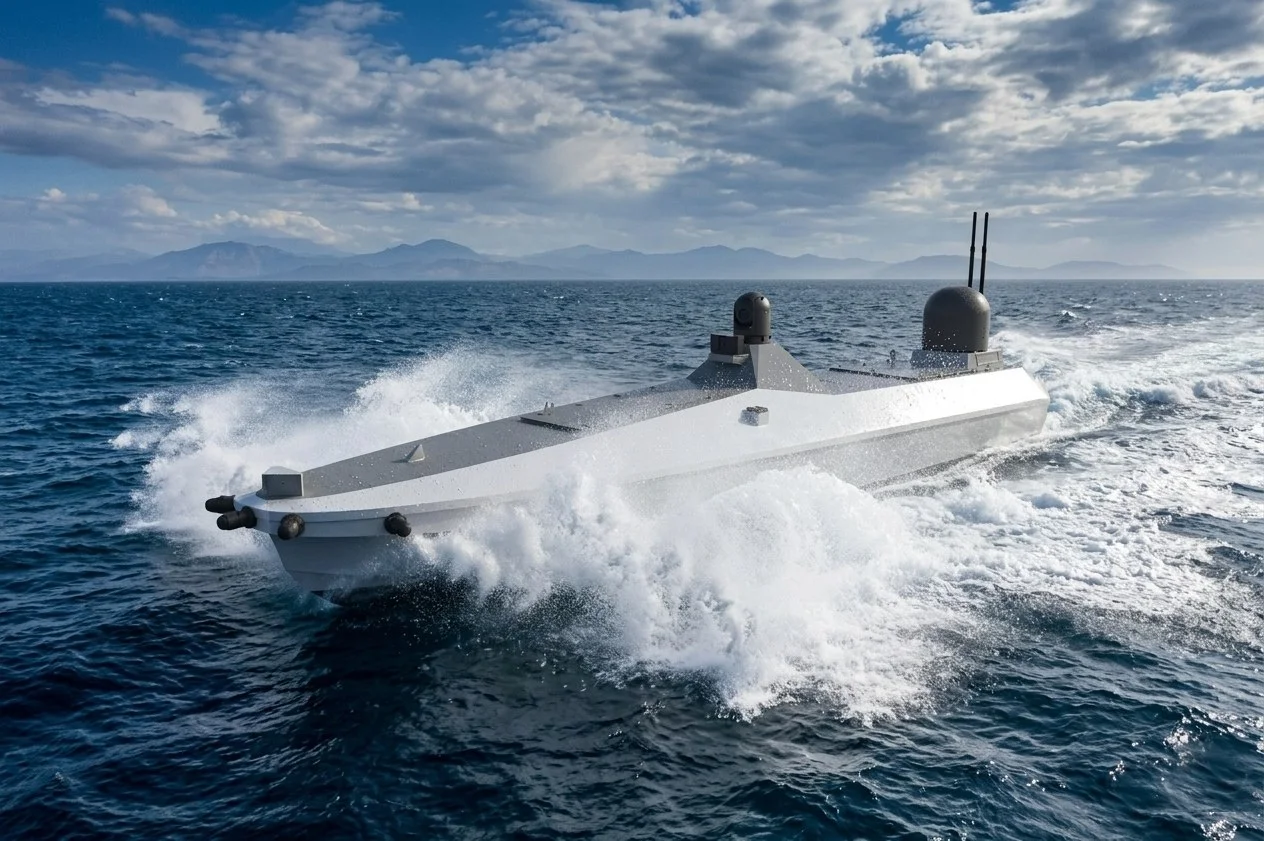
For three years the Black Sea has been teaching navies an uncomfortable lesson: a small boat that costs almost nothing can ruin a warship’s day. Turkey has now put its own answer in the water. TUFAN, a one-way attack unmanned surface vessel developed by ASELSAN with hulls built by ARES Shipyard, was floated for the first time during TEKNOFEST Mavi Vatan 2026, held at the Golcuk naval shipyard in Kocaeli between 20 and 23 August. The craft had been shown statically at SAHA EXPO 2026 in Istanbul; Golcuk was the first time anyone saw it at sea.
What the numbers say
TUFAN is 8.1 metres long, petrol-powered and waterjet-driven. ASELSAN quotes a top speed of more than 50 knots and a range of 200 nautical miles at a 35-knot cruise. Those two figures describe the design compromise at the heart of this whole vehicle class — fast enough in the final run to compress a defender’s engagement window, long-legged enough to be launched well away from the target.
The warhead is described as high-explosive and of the insensitive type. That is not marketing language. Insensitive munitions are formulated to resist accidental detonation from impact, fire or fragment strike, and when your concept of operations involves handling a dozen of these things on a pier or a mother ship’s deck, that property stops being a nicety.
The swarm is the point
ASELSAN’s pitch is not really about one boat. The company describes TUFAN as operating under “distributed swarm intelligence,” with several craft forming mission sub-groups that split reconnaissance, surveillance and strike duties between them. The word that matters there is distributed: a swarm that does not depend on a single command link keeps working when the link is jammed or when one member is shot away.
Navigation and obstacle avoidance are handled by vision-based systems rather than satellite positioning alone. Anyone following operations in the Black Sea or the Red Sea will recognise why. Electronic warfare, not gunfire, has become the primary killer of unmanned surface vessels, and a boat that can still find its way with a camera when the satellite signal is spoofed is a boat that still completes its mission. A multi-layer communications suite is intended to plug the vehicle into the wider naval network.
Where it fits in Turkey’s fleet of unmanned boats
Turkey entered this field with ULAQ, an armed reusable USV, and expanded it with the MARLIN family — reconnaissance and surveillance, and more recently mine warfare — and with SALVO. TUFAN belongs in a different box from all of them. It is not a weapons platform that comes home. It is the weapon.
That distinction drives the economics. An armed USV carries the cost of its guided munitions and its fire control system on every sortie. A one-way attack USV is the munition, which pushes unit cost down far enough that using twenty of them at once stops being absurd. Ukraine’s Magura campaign against the Russian Black Sea Fleet demonstrated exactly how far that arithmetic can be pushed against major surface units.
What 200 nautical miles buys
Range is what separates a harbour-defence toy from an operational weapon. Two hundred nautical miles lets a craft launched from the Turkish coast reach across the Aegean or well into the Eastern Mediterranean, and gives meaningful north-south depth in the Black Sea. Launched from a mother ship instead, the same figure becomes standoff distance for the launching platform — which is the entire point of putting the crew somewhere else.
The limits nobody advertises
An 8-metre hull is at the mercy of the sea state. As wave height rises, both navigational accuracy and achievable speed fall, and the operational window narrows with the weather. Targeting is the second constraint: the craft’s own sensors see only to the horizon, so anything beyond that requires an external detection and tracking chain — usually a UAV, a coastal radar or a maritime patrol aircraft. The emphasis ASELSAN places on network integration is an acknowledgement of precisely this. TUFAN is a shooter in someone else’s sensor architecture.
No orders announced
Neither ASELSAN nor ARES has announced procurement quantities, a delivery schedule or an in-service date. TUFAN appeared as an industry exhibit; there is no publicly confirmed Turkish Navy order. Claims that the vehicle is already in serial production are not supported by official statements.
Sources
- ASELSAN product briefing material and TEKNOFEST Mavi Vatan 2026 exhibition presentation
- ARES Shipyard statements on platform construction
- Naval News, “TUFAN Kamikaze USV Launched at TEKNOFEST Mavi Vatan 2026,” 24 August 2026
Image note: the cover photograph shows the ULAQ armed unmanned surface vessel and is used as a representative image for TUFAN.