Australia Fields First Operational AS9 Huntsman Battery
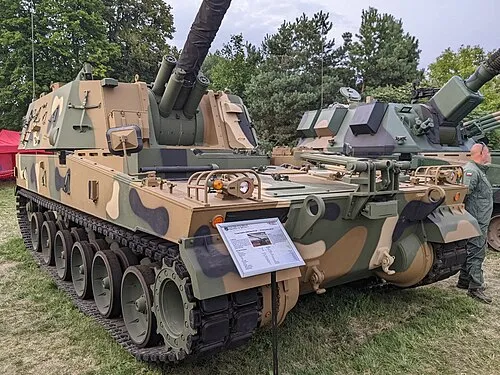
The Australian Army has stood up its first operational battery of AS9 Huntsman self-propelled howitzers, marking a milestone for a program built around a new domestic production line. 106 Battery, part of the 4th Regiment, Royal Australian Artillery, has received six AS9 Huntsman 155mm howitzers and one AS10 armoured ammunition resupply vehicle at Lavarack Barracks in Townsville, Queensland.
At a Glance
- Unit: 106 Battery, 4th Regiment, Royal Australian Artillery
- Delivered: 6 AS9 Huntsman howitzers, 1 AS10 armoured resupply vehicle
- Delivery site: Lavarack Barracks, Townsville, Queensland
- Training site: School of Artillery, Puckapunyal, Victoria
- Builder: Hanwha Defence Australia, at a new facility next to Avalon Airport, Geelong — Australia’s first domestic self-propelled howitzer line
- Planned fleet: 30 AS9 Huntsman and 15 AS10 vehicles, with Full Operational Capability targeted for 2028
Background: From K9 Thunder to Sovereign Production
The AS9 Huntsman is an Australian-built derivative of the South Korean Hanwha K9 Thunder self-propelled howitzer, produced locally under a licensed and localized arrangement rather than imported outright. The K9 lineage is already fielded by a wide range of operators internationally, giving Canberra a design with an established production and support base to build on. Rather than purchase the platform off the shelf, Australia opted to establish sovereign manufacturing capacity, reducing reliance on offshore supply chains for long-term maintenance, spares and future upgrades.
That capacity now exists at a new Hanwha Defence Australia facility next to Avalon Airport in Geelong, Victoria — the country’s first production line for self-propelled howitzers. In May 2026, 30 gunners completed a six-week AS9 operator course, followed by the type’s first live-fire activity at Puckapunyal, where roughly 150 rounds were fired across multiple vehicles.
Australian Army officials described the pace of the program as notable: “To move from an Australian production line to trained crews conducting live fire in a short timeframe is a significant achievement.” Officials framed the broader intent behind the acquisition in similar terms: “This is about warfighting advantage and making our soldiers more lethal, more mobile and more survivable,” and pointed to the system’s responsiveness in the field: “We can come into action in about 30 seconds, fire our missions and move quickly.”
The battery’s next steps include collective training during Exercise Pozieres Run, followed by integration into brigade-level operations later in 2026.
Regional Impact
The AS9’s arrival lands within a broader push to modernize artillery across the Indo-Pacific, where allied militaries have been investing in longer-range, more mobile fire support. Australia’s move to stand up sovereign self-propelled howitzer production also reinforces a wider trend toward 155mm standardization among NATO and allied forces, a category the K9 family already serves in numerous inventories worldwide. Other NATO and allied nations are likewise in the process of modernizing their own 155mm self-propelled artillery fleets, underscoring that the shift is part of a broader allied trend rather than a step unique to Australia, South Korea or Hanwha.
FAQ
What is the AS9 Huntsman? It is an Australian-built 155mm self-propelled howitzer derived from the South Korean Hanwha K9 Thunder, produced locally by Hanwha Defence Australia.
How many vehicles has the Army received so far? 106 Battery has taken delivery of six AS9 Huntsman howitzers and one AS10 resupply vehicle, out of a planned fleet of 30 AS9 and 15 AS10 vehicles.
When is the program expected to reach full capability? The Australian Army is targeting Full Operational Capability for the AS9 Huntsman fleet in 2028.
Sources
Defence Industry Europe, Janes, Army Recognition, Australian Department of Defence