US Army Funds Drone-Based Mine Warning for Abrams Tanks

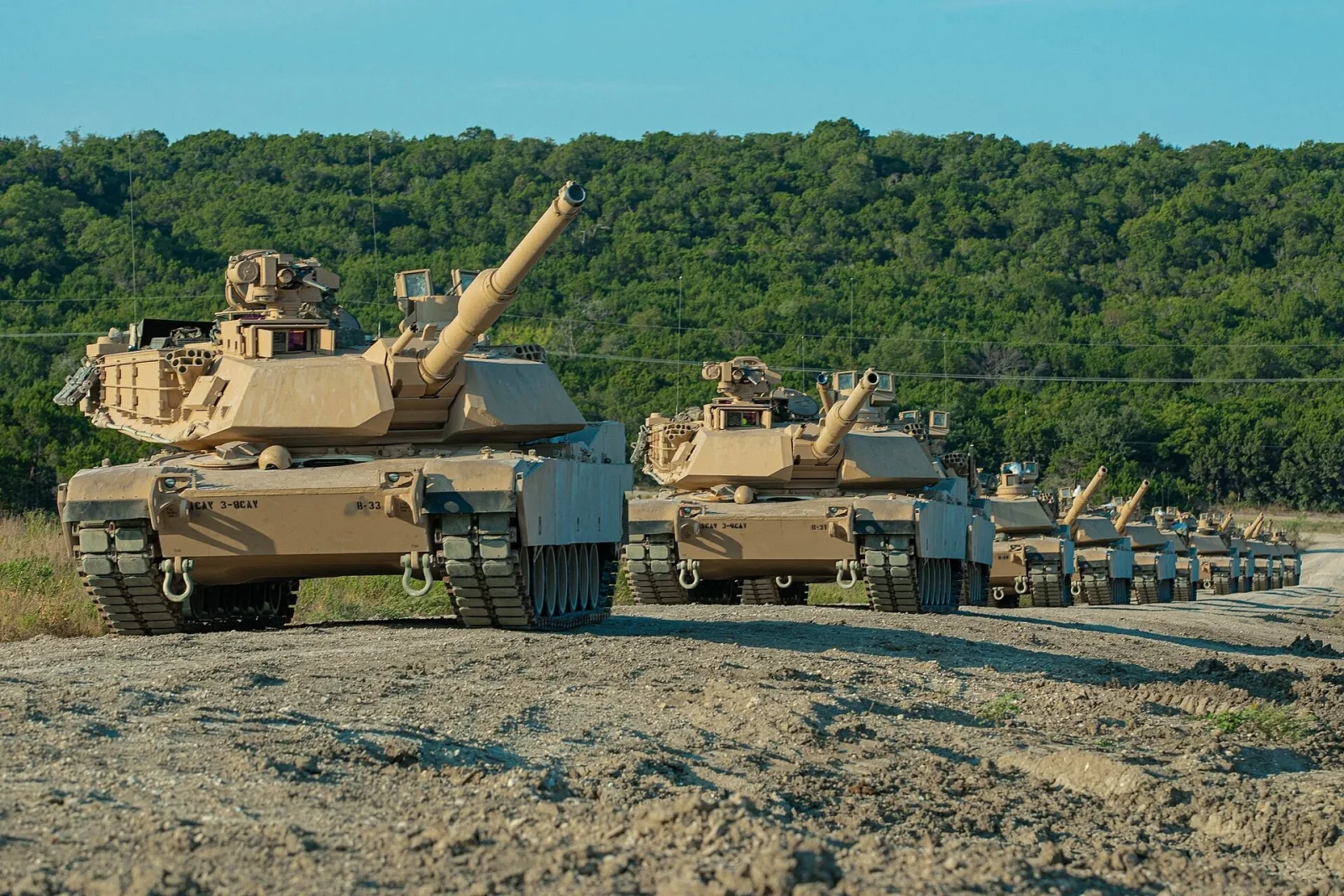
The US Army is funding a software integration meant to give M1A2 Abrams crews earlier warning of mines and aerial drone threats before their tanks reach them. Safe Pro Group announced on 10 November that a $2.5 million contract will fund the integration of its “Ground Truth Air” software with Anduril’s Ghost-X reconnaissance drone.
The award funds a software integration effort, not a fielded capability: there is no confirmation that Abrams units are currently using or have received the combined system. In other words, the announcement points to work still underway rather than a system proven in the field.
What the software does — and doesn’t do
Ground Truth Air uses machine-learning algorithms to analyze imagery captured by the drone in order to identify and geolocate potential explosive hazards. Safe Pro claims the software can recognize more than 150 threat types, including landmines, anti-personnel mines, cluster munitions and ambush-oriented FPV drones — figures that are company-reported and have not been independently verified for this specific Ghost-X integration. Detected hazard locations are meant to be shared with ground units through ATAK and Anduril’s Lattice software.
The goal is an early-warning layer that lets formations reroute, investigate, or call in engineer support before exposing vehicles to a hazard. The system itself does not clear mines or defeat an incoming FPV drone. As the reporting on the contract put it, detecting a suspected mine “does not create a cleared lane.” No independently verified data on detection accuracy, false-alarm rates or real-world performance on the Ghost-X platform has been released, and the capability has not been confirmed as fielded with tank units.
Part of a broader push to protect Abrams from above
The integration fits into a wider US Army effort to harden armored vehicles against overhead drone attack. The service’s fiscal year 2026 budget justification references Top Attack Protection kits intended for all combat vehicles, with future expansion to other vehicle systems. The Trophy active protection system, fitted to some Abrams tanks since 2017, has also been updated by manufacturer Rafael with a version that adds capability against top-down threats.
Work is also underway on the offensive side of the same platform. The Army has separately purchased three PERCH 2.0 launcher prototypes to give M1A2 Abrams the ability to fire Switchblade 300 loitering munitions — a distinct program from the Ground Truth Air integration. It is also testing Allen Control Systems’ Bullfrog counter-drone weapon station on Abrams and Bradley vehicles. Together, these efforts point toward a layered protection architecture that combines detection and countermeasures around the tank fleet.
The companies behind it
Safe Pro Group built its business around mine and explosive-hazard detection using image analytics, and has more recently moved to pair that software with unmanned aerial platforms. Ground Truth Air represents the migration of that detection stack onto Anduril’s Ghost-X, a tactical reconnaissance drone within Anduril’s broader Ghost family; Anduril’s Lattice software is designed to fuse data from multiple sensors and platforms into a single operating picture for units in the field. Measured against the Army’s much larger armor and active-protection budgets, the $2.5 million contract value is modest, suggesting this is an early integration or proof-of-concept step rather than an operational rollout.
Why it matters
One of the clearest lessons from the war in Ukraine is that armored vehicles now need protection not just from frontal threats, but from cheap, abundant drones attacking from above. Whether Ground Truth Air delivers will ultimately be settled in the field, but this contract shows the Army continuing to fund comparatively small, software-based early-warning tools alongside its much larger armor and active-protection programs.
Sources
- Army Recognition, “U.S. Army Funds New Drone-Based Protection for M1A2 Abrams Against Mines and Aerial Drone Threats”, 13 November 2026 — armyrecognition.com — primary source for the contract details and technical description used in this article.