From HRS to MTN X90: 3E’s reflex sight family

Quick answer: 3E Elektro-Optik’s largest product group is its close-range sights: the holographic HRS, the enclosed-emitter CRS and A1X, the rifle-type ARS, the machine-gun-specific MTN X90, and the pistol-class S1x, V1x, VW1x and R1x. The series is completed by the M3x, M5x and MGM 3x magnifiers and the REFLEXLINK interface, which accepts four footprints on a single mount. The common choice is compatibility with the mounting standards established in the world market (ACRO, RMR, RMS).
The holographic end: HRS Gen I
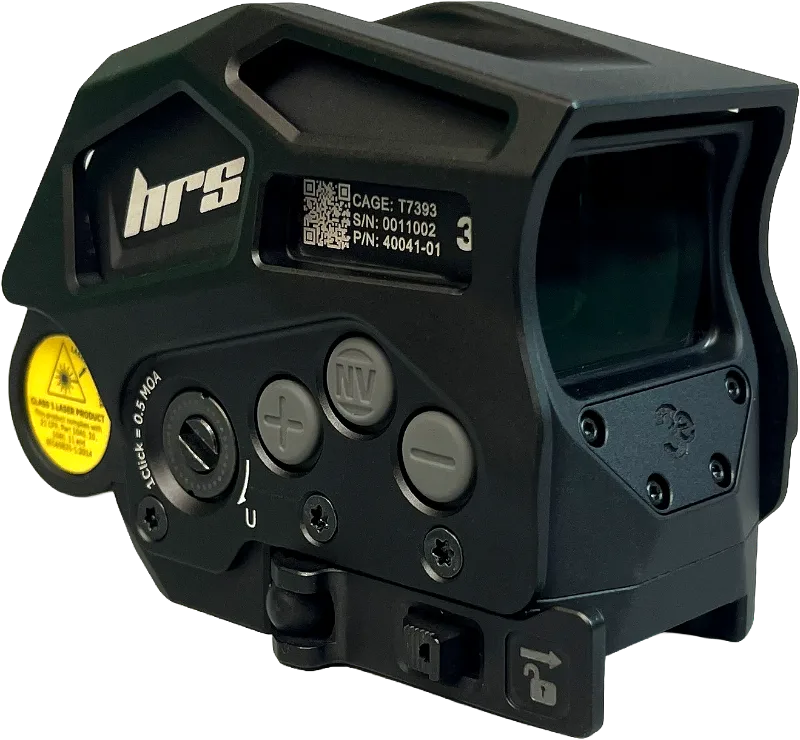
The HRS Gen I is the only holographic sight in the 3E catalog. The reticle is not projected onto a lens; it is formed across the entire window. According to the manufacturer, the practical consequence is damage tolerance: even if the window is partly obscured or cracked, the shooter continues to see the complete reticle. The pattern is a 1 MOA dot inside a 65 MOA ring, with 10 daytime settings and 10 night vision settings reached by a dedicated button. Since holographic technology exists at only a handful of manufacturers worldwide, the HRS is the domestically produced example in this class; the local content ratio has not been officially disclosed.
The enclosed-emitter family: CRS and A1X
In an enclosed design, the LED emitter and reflective surface sit inside a sealed housing with glass at both ends; rain, dust and mud cannot enter the light path. The CRS Gen II adds six interchangeable reticles to this architecture, including patterns with 300-400-500 meter aiming points; more than 30,000 hours of runtime on a single CR123A is reported. The A1X is an enclosed micro sight using the Aimpoint ACRO footprint: 63 grams, three reticle patterns, an IP68 body and more than 50,000 hours of battery life. The standard kit includes both pistol and rifle mounts.
MTN X90: the machine gun’s sight
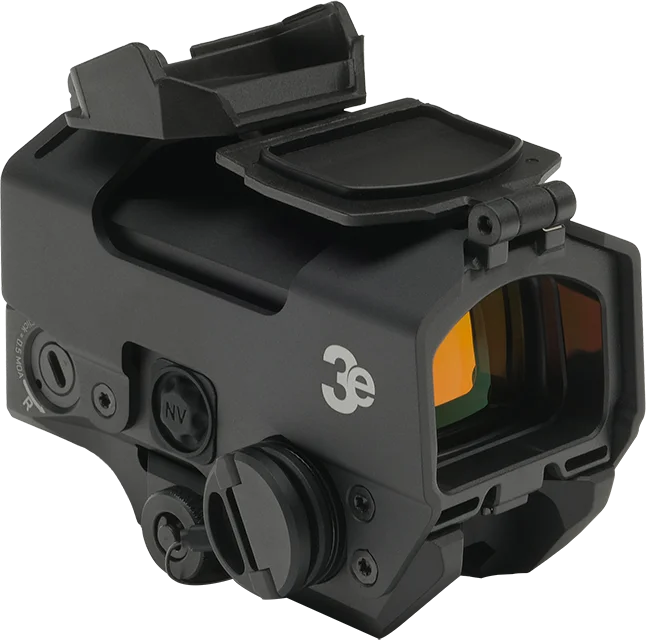
The MTN X90 is the product in the series dedicated to a niche problem: bringing automatic-fire correction into the sight on M2 (12.7 mm) and M240 (7.62 mm) machine guns. The standard kit includes range dials calibrated for the two weapons; the gunner sets the range on the dial and the correction is applied to the reticle. The 90×60 millimeter window is sized for tracking targets with both eyes open; three removable Picatinny rails carry lasers and rangefinders, and the MGM 3x magnifier comes with the kit. The manufacturer reports durability up to the recoil of a 40 mm automatic grenade launcher.
The pistol class and magnifiers
| Model | Footprint | Weight | Reticle | Battery life |
|---|---|---|---|---|
| S1x | RMS | 27 g | 3 patterns (2 MOA dot, 32 MOA ring, combined) | 25,000+ hours |
| S1x+ | RMS | 32 g | 3 / 8 MOA dot; solar assist | 10,000+ hours + solar |
| V1x | RMR | 47 g | 3 patterns | 50,000+ hours |
| VW1x | RMR | Not disclosed | 3 patterns; auto brightness | 50,000+ hours |
| R1x | RMR | 34 g | 3 MOA single dot; auto brightness | 50,000+ hours |
| A1X | ACRO | 63 g | 3 patterns; enclosed emitter | 50,000+ hours |
The RMR and RMS footprints are the world’s most widespread mounting standards for optics-ready pistols; 3E’s adoption of these patterns is consistent with the global market strategy covered in the export file. In the magnifier line, the MGM 3x reports 85 millimeters of eye relief, above the class average; the M3x and M5x are designed to work behind the company’s own sight family.
How the series relates to the whole
The reflex line is the entry layer in 3E’s catalog strategy: on the same rail, the AVCI combat optic covers mid range while the reflex sight covers close range; in night operations, the sights’ NV-compatible brightness settings work together with monoculars such as the M14. The REFLEXLINK interface accepts sights in the RMR, DOCTER, SHIELD and C-MORE patterns on a single mount, a practical solution for units running mixed inventories. The full product breakdown is on the guide page.
Frequently asked questions
What is the difference between a holographic sight and a reflex sight?
A reflex sight reflects an LED dot off a lens; a holographic sight forms the reticle across the window with a laser. The holographic design preserves the reticle when the window is damaged; in return, it is a more complex technology that generally consumes more power.
Why choose an enclosed emitter?
On open-emitter sights, rain or mud getting between the LED and the glass can blot out the dot. In an enclosed design, the light path sits inside a sealed housing; dirt stays on the outer glass and can be wiped off.
Which pistols do 3E sights fit?
The S1x series uses the RMS footprint, the V1x, VW1x and R1x use RMR, and the A1X uses ACRO. These three patterns cover most optics-ready pistol cuts; fit depends on the pistol’s cut type.
How does the range dial on the MTN X90 work?
The dial is marked to the ballistics of the M2 or the M240. The gunner selects the target range on the dial; the sight body tilts the reticle accordingly, applying the drop compensation.
Are the battery life figures realistic?
Values in the 50,000-hour class are manufacturer statements for continuous-on use at low brightness and are a common measurement convention in the industry. At high brightness, real runtime shortens markedly; no independent test data has been published.
Sources and verification note
- https://3eeos.com/catalog/hrs-gen-i — Accessed: August 13, 2026
- https://3eeos.com/catalog/crs-gen-ii — Accessed: August 13, 2026
- https://3eeos.com/catalog/mtn-x90 — Accessed: August 13, 2026
- https://3eeos.com/catalog/a1x — Accessed: August 13, 2026
- https://3eeos.com/catalog/s1x — Accessed: August 13, 2026
- https://3eeos.com/catalog/reflexlink-v1 — Accessed: August 13, 2026
Weight, battery life and durability values are manufacturer statements. ACRO, RMR, RMS, DOCTER, SHIELD and C-MORE are proprietary standards of the respective companies; the compatibility claims are 3E’s.