China’s Sailless Mystery Submarine: What Shanghai’s Latest Launch Tells Us About Beijing’s Naval Ambitions

- Location: JN Shipyard, Shanghai — detected May 31–June 1, 2026
- Dimensions: ~120 m length, 10–11 m beam
- Design: Sailless hull, X-form rudders, streamlined bow
- Propulsion: Nuclear most likely, given hull size
- Classification: Type 095 SSN or entirely new class — unresolved
- China has launched 15–20 submarines and 8+ new classes in five years
A Shape That Doesn’t Match the Catalogue
H.I. Sutton, writing for Naval News, was among the first to flag the vessel’s distinctiveness. The sailless configuration — stripping away the conning tower that has defined conventional submarine profiles for over a century — simultaneously reduces hydrodynamic drag, lowers acoustic signature, and makes passive sonar tracking considerably harder. Conventionally sailed submarines generate a recognizable noise pattern from water flowing over and around the fin structure; remove the sail entirely, and that signature largely disappears.
The boat’s dimensions add another layer of ambiguity. At roughly 120 meters long but only 10–11 meters wide, it is longer yet narrower than China’s known ballistic missile submarines, a ratio more consistent with an attack or cruise-missile role than a strategic deterrence platform. No evidence of ballistic missile launch tubes has been observed, effectively ruling out integration with the JL-3 ICBM that equips China’s Jin-class SSBNs. What is observed — a sleek bow, a smooth upper hull, and those X-form rudders common to modern Western nuclear boats — points toward high-speed deep-water operations.
Separately, analyst imagery suggests a possible simultaneous launch at the Huludao shipyard on China’s Bohai coast — the sprawling complex responsible for the country’s strategic nuclear submarine fleet. If confirmed, two unknown-class vessels entering service within the same week would represent an acceleration even by China’s already-elevated production tempo.
China’s Submarine Surge in Context
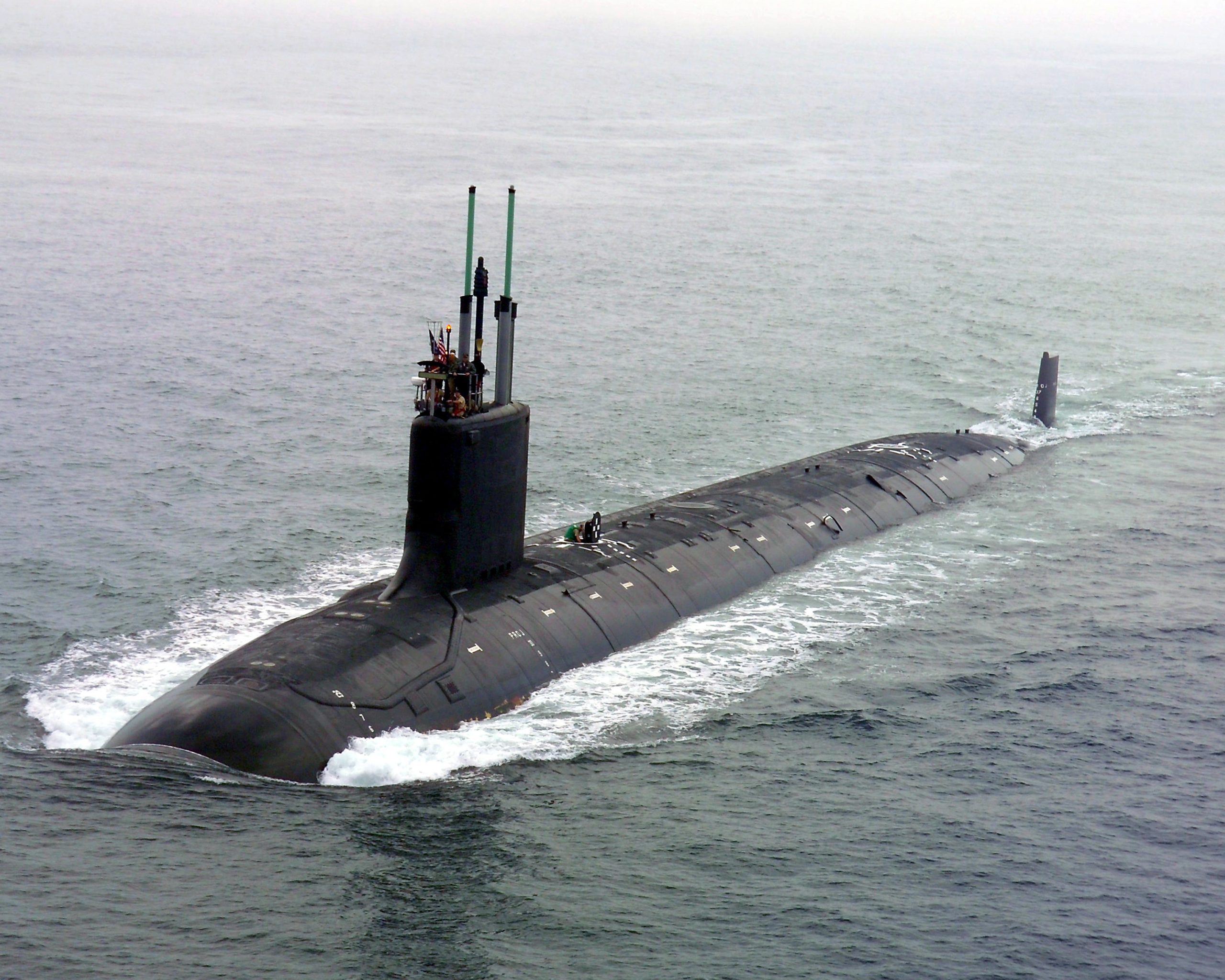
The numbers alone are striking. Over the past five years, China has launched between 15 and 20 submarines — a pace unmatched by any other nation — while developing at least eight distinct new classes across nuclear and conventional propulsion. The U.S. Navy, by comparison, has commissioned roughly five to six Virginia-class submarines in the same window, and is under significant industrial pressure to accelerate production. AUKUS, the trilateral nuclear submarine partnership among the United States, United Kingdom, and Australia, is explicitly designed to close this gap in the Indo-Pacific — though its first submarines won’t enter service until the mid-2030s at the earliest.
The propulsion question remains genuinely open. Most analysts consider nuclear propulsion the only credible option for a hull this large, citing the operational endurance requirements of a Chinese attack submarine operating in the Western Pacific or beyond. A smaller possibility — that China has adapted its “nuclear AIP” concept, using a low-power reactor as an air-independent supplement rather than a primary drive — cannot yet be discarded. Either way, the vessel’s existence underscores that China’s submarine technology is advancing in directions that are genuinely difficult to track, classify, and counter.
The broader picture is one of deliberate strategic opacity. By foregoing an official announcement, Beijing preserves ambiguity — adversaries must plan for capabilities they cannot quantify. Whether this vessel is the Type 095 that Western analysts have anticipated for years, or a parallel development program entirely, the question itself carries strategic weight. Nations monitoring it must hedge against both possibilities simultaneously, diverting intelligence and planning resources in the process. For navies operating in or around the Pacific, the message from Shanghai’s docks is clear enough without a press release.