What is Storm Shadow / SCALP? The Anglo-French Cruise Missile That Strikes Deep Behind Russian Lines

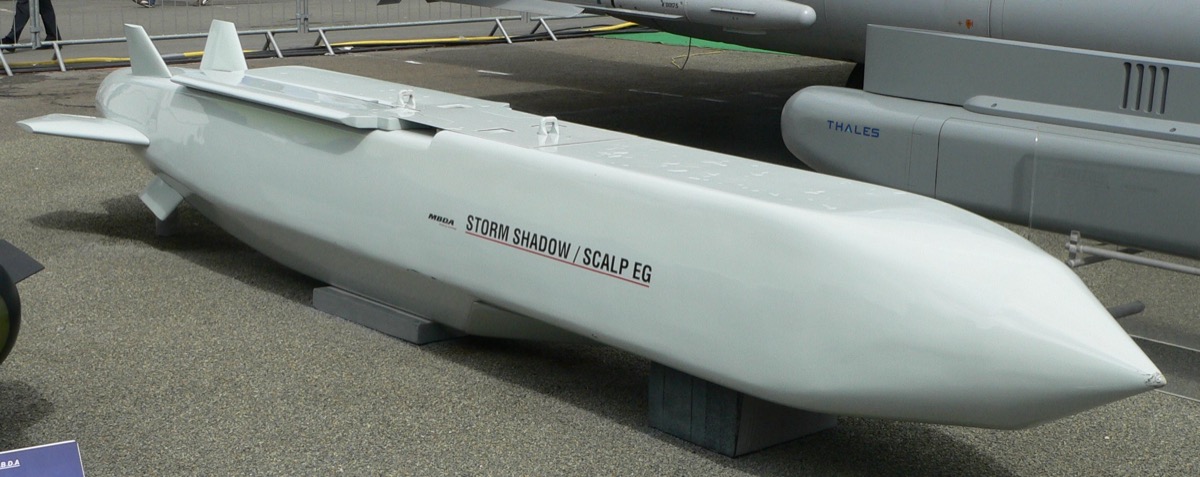
Storm Shadow (British designation) and SCALP-EG (French designation) are the two names for a single weapon: a long-range, air-launched, low-observable conventional cruise missile produced by the European missile consortium MBDA. Designed in the 1990s to strike hardened high-value targets — bunkers, ammunition depots, command posts, hardened aircraft shelters — from beyond engagement range of enemy air defenses, the Storm Shadow / SCALP has become the most prolific Western deep-strike cruise missile of the 21st century. Since first combat use in 2003, the weapon has struck targets in Iraq, Libya, Syria and — most consequentially — across more than two years of war in Ukraine, where Storm Shadow strikes on Russian-held Crimea triggered the destruction of the Russian Black Sea Fleet headquarters and forced the redeployment of Russian naval forces out of Sevastopol.

Key facts at a glance
| Attribute | Value |
|---|---|
| Type | Air-launched stealthy conventional cruise missile |
| Origin | United Kingdom + France (joint development) |
| Manufacturer | MBDA (Matra-BAe Dynamics-Alenia) |
| In service | 2002 (UK); 2003 (France) |
| Length | 5.10 m |
| Diameter | 480 mm |
| Wingspan (deployed) | 3.0 m |
| Launch weight | 1,300 kg |
| Warhead | 450 kg BROACH tandem (precursor + main charge) |
| Maximum range | 250+ km (export); 560 km (national variant) |
| Cruise speed | Mach 0.8 (~1,000 km/h) |
| Cruise altitude | 30–40 m terrain-following |
| Engine | Turbomeca/Microturbo TRI 60-30 turbofan |
| Guidance | INS + GPS + TERPROM terrain-matching + thermal imaging-IR seeker (terminal) |
| Operators | UK, France, Italy, Greece, Saudi Arabia, UAE, Egypt, India (license), Qatar, Ukraine |
| Unit cost | ~ USD 2.5 million per missile (2024) |
Origins: the European deep-strike requirement
The Storm Shadow / SCALP-EG program began in 1994 as the British Conventionally Armed Stand-Off Missile (CASOM) requirement, met by Matra-BAe Dynamics. France joined the program in 1996, harmonizing its own SCALP-EG (Système de Croisière Autonome à Longue Portée — Emploi Général) requirements. The merged design entered Royal Air Force service in 2002 with Tornado GR4 squadrons. Italy adopted the missile shortly after for its Tornado IDS and later Typhoon fleet. France integrated SCALP-EG with the Mirage 2000D and Rafale.
Design philosophy: low and slow, but stealthy
Storm Shadow is a deliberate inversion of the supersonic cruise-missile philosophy embodied by Russian Kalibr or U.S. AGM-86. Three design choices define the weapon:
- Subsonic flight (Mach 0.8). A smaller turbofan and reduced exhaust temperature minimize IR signature.
- Terrain-following ingress. Stormshadow’s TERPROM (Terrain Profile Matching) system uses a stored digital terrain map and barometric reference to fly between 30 and 40 m above the ground, exploiting radar shadows.
- Thermal-imaging terminal seeker. Above the target, the nose cap pops off and an imaging IR seeker compares the actual scene to a stored template — strike accuracy is typically under 3 m CEP.
The BROACH warhead
The Storm Shadow’s distinctive payload is the BROACH (Bomb Royal Ordnance Augmented Charge) tandem warhead designed for hardened-target penetration. A small precursor charge breaches the first layer of reinforced concrete or earth; the missile then continues penetrating; a delayed main charge detonates inside the bunker. Public British MoD estimates put penetration at 6 m of reinforced concrete or 22 m of earth. The combination is optimized against C2 bunkers, hardened aircraft shelters, ammunition magazines, and underground depots — exactly the categories that proliferate in Russian rear-area operations.
Combat record
- 2003 — Iraq. First combat use. RAF Tornados fired 27 Storm Shadows against Iraqi command bunkers during the opening phase of Operation Telic.
- 2011 — Libya. RAF Tornados and French Rafales used Storm Shadow / SCALP-EG against Gaddafi-regime command centers and SAM sites; this was the first major sustained use of the weapon in coalition operations.
- 2015 — Iraq/Syria. RAF and Armée de l’Air strikes against Islamic State command nodes during Operation Inherent Resolve.
- 2018 — Syria. Storm Shadow used in the joint U.S.-UK-French strike on Syrian chemical-weapons facilities at Barzah, Him Shinshar and Homs.
- 2023–present — Ukraine. The UK announced Storm Shadow transfer in May 2023; France followed with SCALP-EG. Ukraine’s air force fitted the missiles to upgraded Su-24M Fencers. Verified strikes include:
- 13 September 2023 — Sevkabel shipyard, Sevastopol: destroyed a Russian Kilo-class submarine (Rostov-on-Don) and a Ropucha-class landing ship (Minsk).
- 22 September 2023 — Black Sea Fleet headquarters, Sevastopol: killed multiple senior Russian Navy officers.
- April–August 2024 — Saky and Belbek airbases in Crimea: multiple Su-30/Su-27 destroyed on the ground.
- October 2024 — Russian S-400 radar facility, Cape Tarkhankut.
Storm Shadow / SCALP, alongside U.S. ATACMS and U.S. JASSM-ER variants, was central to forcing the Russian Black Sea Fleet’s effective withdrawal from Crimea by mid-2024.
Operators
| Country | Platform | Variant |
|---|---|---|
| UK | Typhoon FGR4; ex-Tornado GR4 | Storm Shadow |
| France | Rafale; Mirage 2000D (retiring) | SCALP-EG |
| Italy | Typhoon, F-35A, Tornado IDS (retiring) | Storm Shadow |
| Greece | Mirage 2000-5 | SCALP-EG |
| Saudi Arabia | Tornado IDS (retiring); Typhoon | Storm Shadow (Black Shaheen) |
| UAE | Mirage 2000-9 | Black Shaheen (export SCALP) |
| Qatar | Typhoon, Rafale | Storm Shadow / SCALP-EG |
| Egypt | Rafale | SCALP-EG |
| India | Rafale | SCALP-EG |
| Ukraine | Su-24M (UK/French-supplied) | Storm Shadow + SCALP-EG |
Storm Shadow vs. its peers
| Storm Shadow / SCALP-EG | AGM-158 JASSM-ER | Kh-101 (Russia) | Tomahawk Block V | |
|---|---|---|---|---|
| Launch platform | Aircraft | Aircraft | Aircraft | Surface ship / submarine |
| Range | 250–560 km | 900 km | 2,500 km | 1,600 km |
| Speed | Mach 0.8 | Mach 0.8 | Mach 0.7 | Mach 0.7 |
| Warhead | 450 kg BROACH tandem | 454 kg WDU-42/B | 450 kg unitary or thermonuclear | 450 kg unitary or submunition |
| Stealth shaping | Yes | Yes (extensive) | Partial | No (subsonic but conventional shape) |
| Combat record | Iraq, Libya, Syria, Ukraine | Limited (Ukraine 2024+) | Ukraine (Russian use) | Iraq, Syria, Yemen, Libya |
The export politics of range
The published 250 km export-range figure for Storm Shadow / SCALP-EG is a deliberate political ceiling set by the Missile Technology Control Regime (MTCR). The actual national-variant range is significantly longer; multiple credible sources put the maximum at 560 km. The UK government quietly authorized Ukraine to fire export-restricted rounds at full operational range in 2023, a decision matched by France for SCALP-EG, and one of the more consequential proliferation events of the post-Cold-War era.
Limitations
- Subsonic. Mach 0.8 makes Storm Shadow vulnerable to modern Russian Pantsir-S and Tor-M2 point-defense systems. Ukrainian strikes have suffered attrition when ingress routes were predictable.
- Aircraft-launched only. Unlike Tomahawk, Storm Shadow has no ship- or ground-launched version, restricting it to nations with strike-capable aircraft.
- GPS dependence in mid-course. Russian EW (Murmansk-BN, Krasukha-2) jammed Ukrainian Storm Shadow strikes in late 2024; the missile’s INS and TERPROM can compensate but accuracy degrades.
- Cost. USD 2.5 million per round is roughly 2× the cost of a Tomahawk and 10× the cost of a JDAM.
The future: SCALP-EG mid-life update and FC/ASW
MBDA is currently delivering a mid-life upgrade for both UK and French rounds: improved GPS anti-jam, an upgraded TERPROM with higher-resolution maps, and integration with the European F-35 fleet (currently only Italy and UK F-35Bs in the operator base). Looking further, the FC/ASW (Future Cruise/Anti-Ship Weapon) program — jointly run by MBDA UK and MBDA France — will deliver two replacements by the early 2030s: a supersonic anti-ship missile and a subsonic stealth cruise missile that will succeed Storm Shadow / SCALP. The FC/ASW subsonic variant is the formal successor and is funded for entry into UK and French service in 2032.
Why Storm Shadow / SCALP matters
Storm Shadow has done for European aerospace what JASSM-ER has done for the United States: given a middle-power air force the ability to strike strategic-distance targets while remaining outside the engagement range of modern integrated air defenses. The Ukraine war’s most consequential single weapons effect — the destruction of the Russian Black Sea Fleet’s headquarters in Sevastopol — was a Storm Shadow strike. As Russia continues to operate its own long-range cruise missiles against Ukrainian cities, the symmetry of Storm Shadow’s deep-strike role has reshaped European thinking on what cruise missiles can do in a peer war.