TRG-122 Guided Rocket: Roketsan’s Precision 122 mm Round


The TRG-122 is a 122 mm guided artillery rocket developed by Roketsan of Türkiye. Serving as the precision munition of the T-122 SAKARYA multiple launch rocket system, it reaches 13-30 km with GPS+GLONASS-aided inertial guidance and a circular error probable of 10 m or less. Unveiled in September 2016, it converts the world’s most widespread MLRS calibre into a point-strike weapon; a laser-guided TRLG-122 variant has also been tested.
| TRG-122 — At a Glance | |
|---|---|
| Category | 122 mm guided artillery rocket |
| Developer | Roketsan (Türkiye) |
| Unveiled | September 2016 |
| Range | 13-30 km (28 km max in the official table) |
| Speed | Not officially disclosed |
| Weight | 76 kg (official; 72 kg in early sources) |
| Length / diameter | Length not officially disclosed / 122 mm |
| Warhead | HE + steel balls; 13.5 kg (official; 18.4 kg in early sources) |
| Accuracy | CEP ≤10 m |
| Guidance | GPS+GLONASS-aided INS; four electromechanical tail actuators |
| Propulsion | Composite solid propellant |
| Platform | T-122 SAKARYA MLRS, Roketsan MCL, compatible 122 mm launchers |
| Operator | Turkish Armed Forces; exports not officially disclosed |
What is the TRG-122?
The TRG-122 is Roketsan’s answer to a simple problem: the 122 mm rocket is the most widely fielded multiple-launch artillery calibre in the world, yet in its classic form it is unguided, built for saturating area targets rather than hitting points. The TRG-122 adds a GPS+GLONASS-aided inertial guidance section to this well-established calibre, turning a statistical area weapon into a munition capable of striking individual targets with a single round.
The rocket was unveiled in September 2016 and serves as the guided munition of the Turkish Armed Forces’ T-122 SAKARYA multiple launch rocket system. It is the smallest member of Roketsan’s TRG family, which also includes the 230 mm TRG-230 and the 300 mm TRG-300. The family logic is consistent across calibres: retain the rocket airframe and solid motor, add a guidance kit and control surfaces, and combine the salvo economics of an artillery rocket with missile-class accuracy.
The accuracy gain is the headline figure. An unguided 122 mm rocket can miss by hundreds of metres at longer ranges, while the TRG-122 delivers a circular error probable (CEP) of 10 m or less. Early promotional material quoted under 50 m; as the design matured, the official catalogue figure tightened to ≤10 m. Fewer rockets per target and reduced collateral risk follow directly from that number.
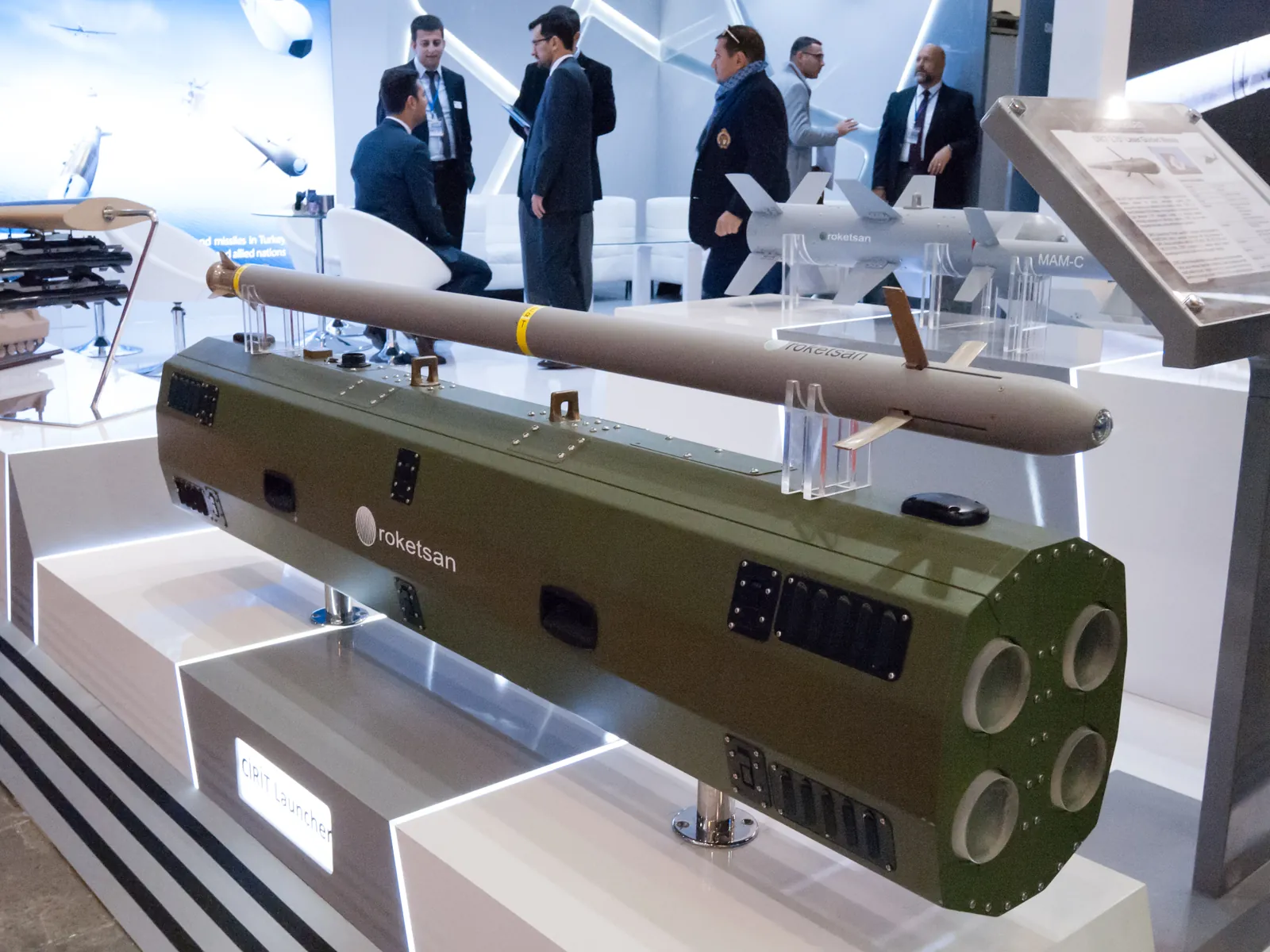
Technical specifications and how it works
The TRG-122’s guidance architecture is built around an inertial navigation system (INS) aided by both GPS and GLONASS. Target coordinates are loaded before launch; in flight, the INS continuously computes position while satellite updates correct accumulated drift. Steering is provided by nose canards and four electromechanically actuated control surfaces at the tail. Using two satellite constellations reduces dependence on any single system and improves resilience in degraded signal conditions.
Official figures put the range at 13 to 30 km, with Roketsan’s specification table listing a maximum of 28 km. The official launch weight is 76 kg, though early sources cited 72 kg. The warhead combines high explosive with steel balls for fragmentation effect: the official weight is 13.5 kg, against 18.4 kg quoted in early sources. Speed and length have not been officially disclosed.
- Guidance: GPS+GLONASS-aided INS; nose canards plus four electromechanical tail actuators.
- Propulsion: composite solid-propellant rocket motor.
- Warhead: HE + steel balls, effective against personnel, soft-skinned and lightly armoured targets.
- Accuracy: CEP ≤10 m — a step change over unguided 122 mm rockets.
A notable sibling is the TRLG-122, which adds a laser seeker to the same airframe. In 2024-25 this variant was test-fired from a pickup-truck platform against a naval target — a demonstration that 122 mm precision fires need not be tied to heavy launcher vehicles, and that the family can engage moving and maritime targets under terminal laser guidance.
The TRG-122 competes in the niche of guided 122 mm rockets — effectively a lighter tier below the American 227 mm GMLRS. Its direct rivals are other programmes that add precision guidance to the ubiquitous 122 mm calibre. The table below is a class-level comparison; manufacturers publish performance data at different levels of detail, so figures should not be read as a like-for-like benchmark.
Platforms, operators and exports
The TRG-122’s primary platform is the T-122 SAKARYA multiple launch rocket system, a 6×6 truck-mounted launcher with forty 122 mm tubes. The guided rocket slots into SAKARYA’s munition family, allowing the same vehicle to deliver unguided saturation salvos against area targets and precision shots against point targets. The rocket is also compatible with Roketsan’s Multi-Calibre Launcher (MCL) concept and other compatible 122 mm launchers.
The confirmed operator is the Turkish Armed Forces. Export status has not been officially disclosed: while the global spread of 122 mm launcher infrastructure gives the rocket a naturally large addressable market, no confirmed export contract has appeared in open sources.
The laser-guided TRLG-122 trials of 2024-25 — fired from a light pickup platform against a naval target — extend the family’s employment envelope in two directions at once: launch from cheap, mobile, low-signature platforms, and terminal laser guidance against moving and maritime targets. Both open doors for coastal-defence and asymmetric-warfare applications.
Place in Turkish defence industry: advantages and limits
The TRG-122 is the entry tier of Türkiye’s guided artillery rocket family, and its strategic rationale is clear: give the vast installed base of 122 mm launchers — at home and worldwide — precision-strike capability without requiring new platform investment. Its warhead is small compared with 300 mm class munitions, but a CEP of ≤10 m compensates by placing that smaller charge exactly where it matters.
Its advantages fall under three headings: cost-effectiveness (compatibility with existing 122 mm infrastructure and a far lower unit cost than a missile), precision (converting an area weapon into a point weapon), and family architecture (a common guidance approach shared with the TRG-230 and TRG-300, plus laser-seeker TRLG options). The limits are equally clear: a 13.5 kg warhead is not sized for hardened targets; satellite-aided guidance can be stressed in heavy electronic-warfare environments; and 30 km does not answer the long-range demands of modern rocket artillery on its own — that is the role of the TRG-230 (20-70 km) and TRG-300 (up to 120 km) further up the family.
In short, the TRG-122 is the 122 mm leg of Roketsan’s guidance-for-every-calibre strategy: a conversion munition that extends the operational life and value of the SAKARYA fleet while carrying meaningful export potential.
The TRG-122’s range (13-30 km; 28 km max in the official table), calibre (122 mm) and accuracy (CEP ≤10 m) are drawn from Roketsan’s official data. Sources diverge on weight figures: the official catalogue lists a 76 kg rocket with a 13.5 kg warhead, while early sources quoted 72 kg and 18.4 kg respectively — both are presented here with attribution. Speed, length and export status have not been officially disclosed. The TRLG-122 pickup-platform test is reported from open sources.
Frequently Asked Questions
What is the range of the TRG-122?
The TRG-122 has a range of 13 to 30 km; Roketsan’s official specification table lists the maximum as 28 km.
Which platforms fire the TRG-122?
Its primary platform is the T-122 SAKARYA multiple launch rocket system. It is also compatible with Roketsan’s Multi-Calibre Launcher (MCL) and other compatible 122 mm launchers.
How is the TRG-122 guided?
It uses an inertial navigation system aided by GPS and GLONASS, steering with nose canards and four electromechanically actuated tail control surfaces. Accuracy is CEP ≤10 m.
What is the difference between the TRG-122 and TRLG-122?
The TRLG-122 adds a laser seeker to the same airframe for terminal precision against moving targets. In 2024-25 it was test-fired from a pickup-truck platform against a naval target.
What are the TRG-122’s closest rivals?
In the guided 122 mm class it is compared with China’s Fire Dragon 40 and Serbia’s G-2000; the US GMLRS (227 mm) sits a tier above. Against unguided Fajr-type 122 mm rockets its precision is the key differentiator.
Who operates the TRG-122, and has it been exported?
The confirmed operator is the Turkish Armed Forces. Export status has not been officially disclosed, and no confirmed export contract has appeared in open sources.
Sources
- Roketsan official product page — roketsan.com.tr
- Roketsan TRLG-122 official page — roketsan.com.tr
- GlobalSecurity.org TRG-122 profile; Army Technology TRG-122 project file; Quwa system profile
- Türkiye Today — report on the TRLG-122 pickup-platform test against a naval target
- Company and open-source records, verified as of 23 July 2026