Navantia and L&T Team Up to Bid for India’s Four-Ship Amphibious Assault Program

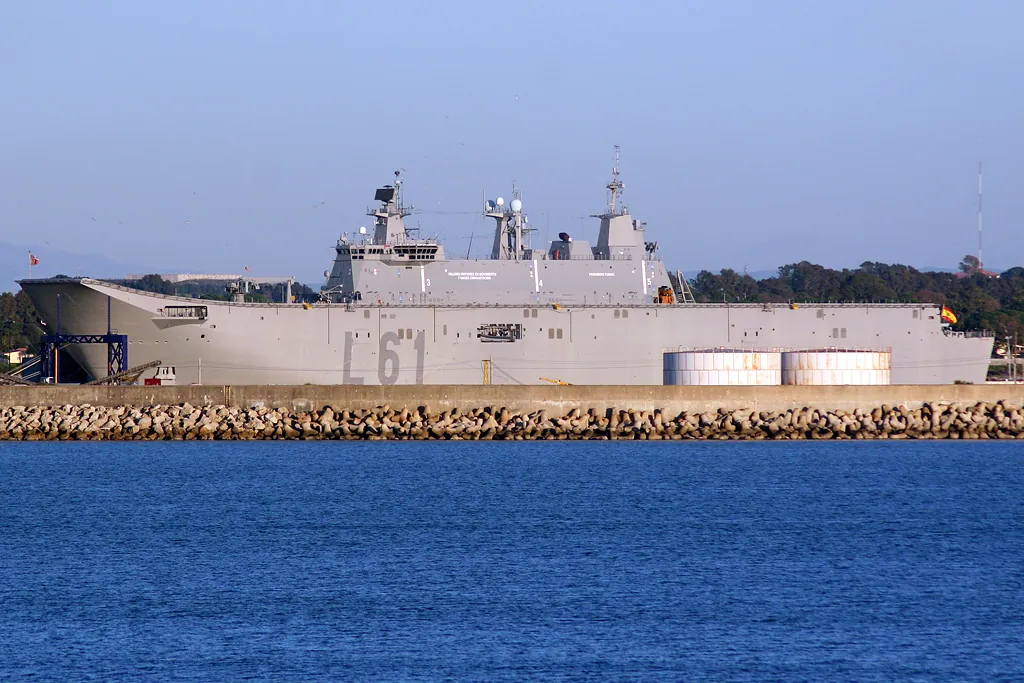
Spanish shipbuilder Navantia and Indian engineering group Larsen & Toubro (L&T) signed a memorandum of understanding (MoU) in Madrid for India’s four-ship amphibious assault ship (LPD) program. The agreement, announced on October 9, 2026, sets up a framework for long-term collaboration between the two companies.
The MoU is not a construction contract. It covers preparing a joint bid for the Indian Navy’s requirement for four amphibious platforms. Arun Ramchandani, Senior Vice President and Head of Precision Engineering & Systems at L&T, said the partnership aims at “advancing the country’s autonomy in constructing such complex and essential platforms.” Gonzalo Mateo-Guerrero, Navantia’s Director of Operations and Business, said the company “remains committed to providing long-term support.”
The offer’s design basis will draw on Navantia’s Juan Carlos I family, which includes Spain’s own Juan Carlos I (L-61) alongside the Royal Australian Navy’s Canberra and Adelaide-class ships — an architecture already proven operationally across NATO and Pacific fleets.
The division of labor is explicit: L&T brings shipbuilding capacity and engineering experience, while Navantia contributes its surface-ship and submarine design background plus lifecycle support capability. Both companies say the partnership is meant to help build domestic capacity for large-ship construction in India — a framing that aligns directly with India’s “Atmanirbhar Bharat” (self-reliant India) defense-industrial policy.
The program’s backdrop is the steady decline of Indian Navy’s amphibious lift. The fleet’s current flagship is INS Jalashwa, an ex-US LPD, backed by four aging Landing Ship Tanks — three Shardul-class vessels and INS Gharial — plus eight Mk IV landing craft. As older LSTs have been retired, the fleet has shrunk; Jalashwa has also supported trials for ISRO’s crewed Gaganyaan space program.
The Navy’s original 2021 Request for Information called for four roughly 200-metre, electrically propelled ships carrying about 900 troops with a through deck for helicopter operations, and specified 16 anti-ship missiles plus 32 VL-SRSAM missiles. Later refined specifications pushed length to around 220 metres (±5%) and displacement to about 29,000 tonnes (±10%), adding multifunction and air-surveillance radars, fully integrated electric propulsion, landing craft and the ability to serve as a mothership for unmanned surface and air systems.
This is not Navantia’s only move in the Indian market. The Spanish yard has previously pursued Indian naval tenders with its S-80 submarine and F-100/F-110 frigate families; this new partnership with L&T reads as an effort to extend Navantia’s Indian footprint into large-tonnage surface ships. Domestic yards including Hindustan Shipyard (HSL), Cochin Shipyard (CSL), Mazagon Dock (MDL) and GRSE are also positioned as likely bidders. A 2025 report estimated the tender’s scale at roughly ₹80,000 crore, or about $9.6 billion.
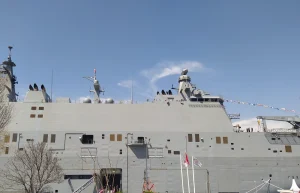
For Turkish readers, the development offers a direct point of comparison with Turkey’s own amphibious-ship export potential. TCG Anadolu, built at Sedef Shipyard, was produced as a licensed derivative of the Juan Carlos I design and gave Turkey the foundation for its own amphibious-ship design base. Navantia’s effort to bring that same family to the Indian market underscores how much global demand exists for designs in the Juan Carlos I lineage — a useful reference point, and a potential competing data point, for Turkey’s own amphibious-ship export ambitions.
The MoU’s commercial terms have not been disclosed; the two companies have not specified how they would split work, or which Indian yard would carry out construction. Early-stage agreements of this kind can change significantly once a formal tender is published, so the final design and cost figures for a Juan Carlos I-based bid will take shape as the tender process advances in the coming months.
Turning the MoU into a construction contract requires the Indian Navy to complete its formal tender process, which has not yet concluded. For now, Navantia and L&T’s goal is to enter that tender with a strong, technically mature offer.
Sources
- Naval News, “Navantia and Larsen and Toubro collaborate to offer LHDs to the Indian Navy” (Oct. 9, 2026) — used for the signing location, parties, design basis and RFI history. navalnews.com
- Baird Maritime, “Spanish-Indian partnership sign MOU for Indian Navy four-ship LPD programme” (October 2026) — used for the scope of the partnership and the division of roles. bairdmaritime.com
- Indian Defense News, “Navantia And L&T Join Forces For Indian Navy’s Four Amphibious Ship Fleet Program” (October 2026) — used for the current state of the Indian Navy’s amphibious fleet. indiandefensenews.in