Two Nations, One Flashpoint: Which Military Really Has the Edge in 2026?
- 29 Aug 2026 07:22
- Updated: 05 Aug 2026

- Personnel: Iran’s Overwhelming Numbers
- Budget: Israel Outspends Iran Nearly 4-to-1
- Air Power: Israel’s Uncontested Superiority
- Land Power: Iran’s Armor Dominance
- Naval Power: Iran’s Submarine Fleet vs Israel’s Blue-Water Ambition
- Defense Industry: Innovation vs Resilience
- The Verdict: How Two Deeply Different Military Models Stack Up in 2026
- Master Comparison Table — Israel vs Iran 2026
- Which country fields the world’s most powerful military in 2026?
- Frequently Asked Questions
GlobalFirepower 2026 · Special Comparison
Two Nations, One Flashpoint:
Which Military Really Has the Edge?
Israel and Iran sit back-to-back at #15 and #16 on the 2026 GlobalFirepower index — separated by a single rank but divided by radically different military philosophies. One bets everything on technology, precision, and intelligence. The other fields the largest standing army in the region and has spent decades hardening itself against siege. Six metrics. Two powers. One definitive verdict.
ISRAEL
#15
PowerIndex 0.2707
IRAN
#16
PowerIndex 0.3199
Note: On GFP, a lower PowerIndex score indicates a stronger military. Israel leads Iran by 0.0492 points.
Metric 01 · Manpower
Personnel: Iran’s Overwhelming Numbers
ISRAEL · Active Personnel
169,500
IRAN · Active Personnel
610,000
Iran’s active headcount is 3.6 times larger than Israel’s — a gap that looks decisive on paper but demands context. The Islamic Republic runs a dual-military system: the conventional Artesh (army) handles territorial defense, while the Islamic Revolutionary Guard Corps (IRGC) operates as a parallel force with its own navy, air force, missile corps, and the Quds Force for extraterritorial operations. This layered structure gives Tehran deep redundancy but also creates friction between competing chains of command.
Israel’s Israel Defense Forces (IDF) runs on a mandatory conscription model — roughly 26 months for men, 24 for women — followed by long reserve obligations. At full mobilization, Israel can field an estimated 465,000 reservists within 72 hours, partially closing the gap. The IDF’s doctrine is built on quality over quantity: small, rapid units backed by elite intelligence and air assets rather than mass infantry formations.
The October 7, 2023 Hamas attack and the subsequent Gaza campaign exposed IDF readiness gaps — intelligence failures, command coordination issues, and the sheer strain of sustained high-tempo ground operations. Tehran, watching closely, has drawn its own lessons about Israeli reserve mobilization timelines. On raw manpower, Iran wins this round. Whether those numbers translate into battlefield effectiveness against a technology-first adversary is a different question entirely.
| Indicator | Israel | Iran | Edge |
|---|---|---|---|
| Active military | 169,500 | 610,000 | Iran |
| Reserve forces | ~465,000 | ~350,000 | Israel |
| Paramilitary | 8,000 | 220,000+ | Iran |
Numbers tell only part of the story. The next metric reveals where Israel more than compensates — and where the real asymmetry begins.
Metric 02 · Defense Spending
Budget: Israel Outspends Iran Nearly 4-to-1
ISRAEL · Defense Budget
$34.6B
~4.5% of GDP
IRAN · Defense Budget
$9.23B
~2.1% of GDP (official)
Israel’s declared defense budget of $34.6 billion dwarfs Iran’s official $9.23 billion — a ratio of nearly 3.75-to-1. But the headline figures require qualification. Israel receives roughly $3.8 billion per year in U.S. Foreign Military Financing, one of the largest bilateral security packages in the world, plus emergency supplementals that spiked post-October 2023. That external subsidy effectively supercharges the IDF’s procurement pipeline without appearing on domestic budget lines.
Iran’s figures are notoriously opaque. Western intelligence assessments typically estimate the IRGC’s real defense and paramilitary spending — including covert programs, proxy funding across Lebanon, Yemen, Iraq, and Syria, and ballistic missile development — at anywhere between $20 billion and $30 billion annually when off-book expenditures are factored in. U.S. sanctions have forced Iran toward domestic production and barter arrangements with Russia and China, compressing costs but also limiting the quality ceiling of imported systems.
Where Israel’s budget is concentrated in precision systems, sensors, and air superiority platforms, Iran’s is spread wide: maintaining a standing army three times the size of the IDF, funding regional proxies, sustaining an extensive ballistic missile arsenal estimated at over 3,000 warheads, and bankrolling its nuclear program. Per-soldier, Israel spends roughly ten times what Iran can allocate — a financial leverage that shapes every other metric in this comparison.
| Indicator | Israel | Iran | Edge |
|---|---|---|---|
| Official defense budget | $34.6B | $9.23B | Israel |
| U.S. military aid (annual) | ~$3.8B | None | Israel |
| Est. real spending (incl. off-book) | $38B+ | $20–30B | Israel |
Budget is the engine — but where does that Israeli money actually go? The air power picture answers that decisively.
Metric 03 · Air Power
Air Power: Israel’s Uncontested Superiority
ISRAEL · Air Assets
IRAN · Air Assets
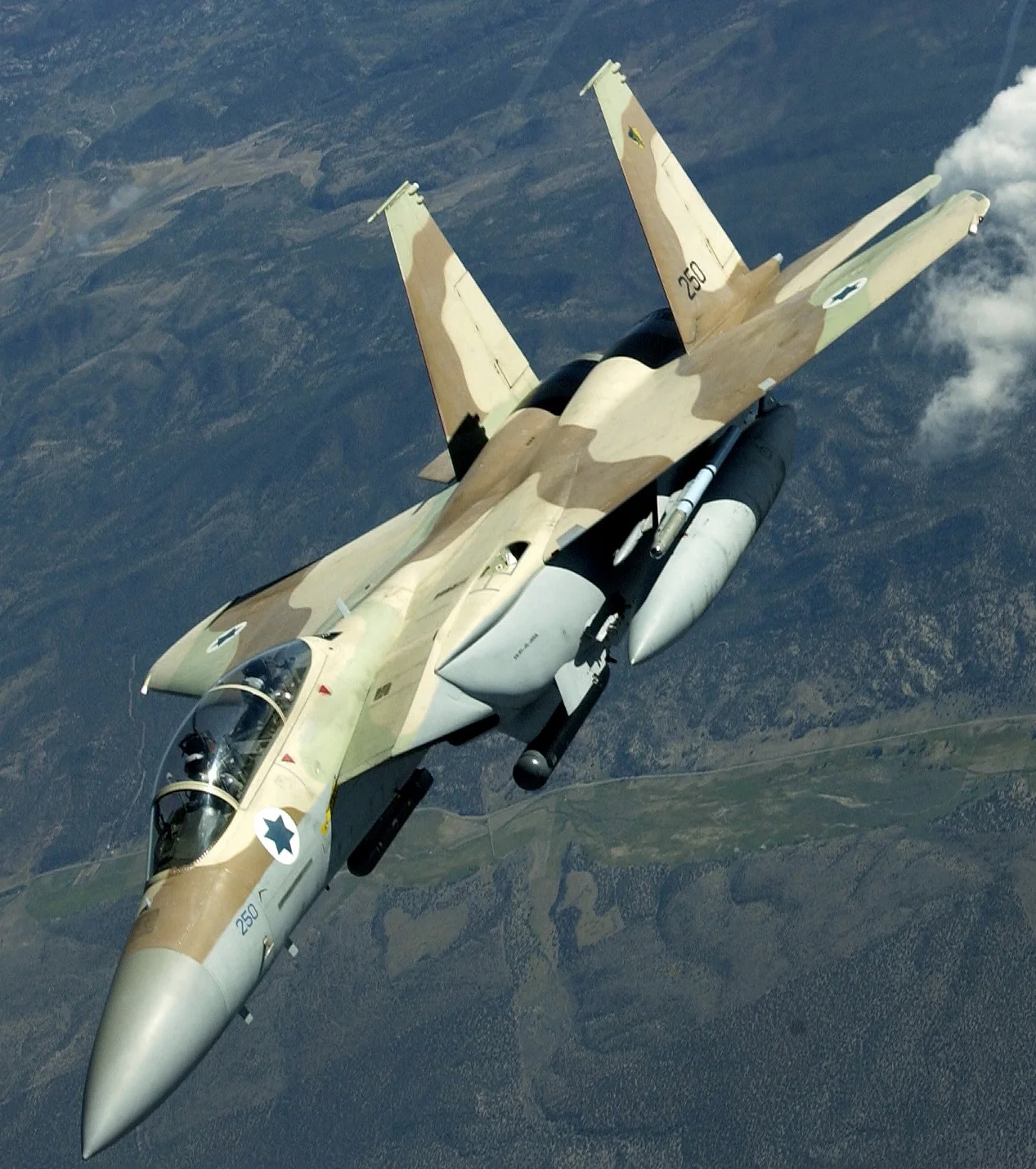
Raw aircraft counts — 597 vs 551 — suggest rough parity. The qualitative gap between the two air forces is anything but. The Israeli Air Force (IAF) operates the F-35I Adir, a customized variant of Lockheed Martin’s fifth-generation stealth fighter fitted with domestically developed avionics, electronic warfare suites, and weapons. Israel is one of only a handful of nations outside the United States operating F-35s in sustained combat — it used them covertly over Syria and reportedly inside Iranian-linked targets during the shadow war that escalated through 2024–2025.
The Islamic Republic of Iran Air Force (IRIAF) is flying a fleet composed largely of American-origin aircraft acquired before the 1979 Revolution — F-14 Tomcats, F-4 Phantoms, F-5 Tigers — supplemented by Russian and Chinese platforms and domestically produced fighters like the HESA Kowsar. Decades of sanctions have choked spare parts pipelines; analysts at the International Institute for Strategic Studies (IISS) estimate that less than 60 percent of Iran’s nominal fighter fleet is combat-ready at any given time. In April 2024, when Iran launched over 300 drones and missiles at Israel in its first-ever direct attack, the IAF — with U.S., British, French, and Jordanian support — intercepted more than 99 percent of the incoming projectiles.
Israel’s air defense architecture layers Iron Dome (short range), David’s Sling (medium), Arrow-2 and Arrow-3 (long-range ballistic), creating an integrated shield that is among the most tested in the world. Iran has no equivalent layered air defense. In any direct air campaign, the IAF would hold decisive escalation dominance — the ability to strike deep, fast, and with near-impunity.
| Category | Israel | Iran | Edge |
|---|---|---|---|
| Total aircraft | 597 | 551 | Israel |
| Fighter/attack aircraft | 239 | 188 | Israel |
| 5th-gen stealth aircraft | ~50+ F-35I | 0 | Israel |
| Layered air defense | Iron Dome / Arrow / David’s Sling | Limited (S-300 variant) | Israel |
The air domain belongs to Israel without serious contest. But on the ground, a very different story unfolds — one where Iran’s numerical advantage becomes impossible to ignore.
Metric 04 · Land Power
Land Power: Iran’s Armor Dominance
ISRAEL · Main Battle Tanks
1,300
IRAN · Main Battle Tanks
2,675
Iran’s 2,675 main battle tanks — more than double Israel’s 1,300 — represent its single most imposing conventional ground asset. The inventory is built around the domestically produced Karrar, Soviet-era T-72S units acquired pre- and post-Revolution, and extensively modified older platforms. Iran has invested heavily in converting numerical mass into layered defense-in-depth, constructing fortified positions across mountainous terrain that would turn any armored assault into a grinding war of attrition.
Israel’s Merkava series — currently the Merkava Mk 4 with the Trophy active protection system — is widely regarded as one of the world’s most crew-survivable main battle tanks. Trophy, which intercepts incoming anti-tank guided missiles and rocket-propelled grenades, has a documented combat interception record dating to 2011. The IDF’s armored corps demonstrated both its lethality and its limitations during the Gaza ground campaign: even Merkava IVs took losses to tunnel-based ambushes and improvised anti-armor devices, illustrating that technological edge does not eliminate attrition in close urban terrain.
In any realistic conflict scenario between the two states, conventional land invasion by either party is geographically implausible — they share no border and are separated by Iraq and Syria. The land power balance therefore matters primarily in the context of proxy ground forces (Hezbollah armor in Lebanon, IRGC-linked units in Syria) and in deterrence signaling rather than direct force-on-force scenarios. Still, Iran’s quantitative edge in armor contributes meaningfully to its overall strategic weight.
| Asset | Israel | Iran | Edge |
|---|---|---|---|
| Main battle tanks | 1,300 | 2,675 | Iran |
| Armored vehicles | ~10,000 | ~6,800 | Israel |
| Self-propelled artillery | ~700 | ~580 | Israel |
Iran leads on tanks, Israel on protected mobility. Below the surface — literally — the naval balance shifts the conversation again.
Metric 05 · Naval Power
Naval Power: Iran’s Submarine Fleet vs Israel’s Blue-Water Ambition
ISRAEL · Submarines
6
Dolphin-class (German-built)
IRAN · Submarines
25
Kilo-class + midget subs
Iran’s 25 submarines represent the region’s largest submarine fleet, though the majority are Ghadir-class midget submarines — 120-ton vessels designed for shallow-water mine-laying, ambush attacks, and special operations insertions in the shallow Persian Gulf and Strait of Hormuz. The Strait of Hormuz, through which roughly 20 percent of globally traded oil transits, is Iran’s foremost strategic leverage point. Tehran has repeatedly demonstrated the credible threat of Hormuz closure — a move that would trigger an immediate global energy shock.
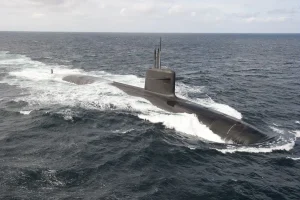
Israel’s six Dolphin-class submarines are German-built, air-independent propulsion vessels capable of operating across the Mediterranean, Red Sea, and Arabian Sea. They are widely believed — though never officially confirmed by Israel — to carry nuclear-tipped cruise missiles as the sea-based leg of Israel’s presumed second-strike nuclear deterrent. That nuclear dimension elevates each Israeli submarine far beyond its conventional warfighting value: sinking any one of them would risk crossing a threshold that transforms a regional conflict into something far more dangerous. Iran has no equivalent deterrent leg.
Iran’s IRGC Navy also deploys swarms of fast-attack craft, armed speedboats, and anti-ship missile batteries along its Persian Gulf coastline — an asymmetric maritime force optimized for harassment, anti-access area denial (A2/AD), and the threat of tanker seizures rather than blue-water engagement. The U.S. Fifth Fleet, permanently based in Bahrain, complicates any Iranian naval calculus considerably.
| Asset | Israel | Iran | Edge |
|---|---|---|---|
| Submarines | 6 | 25 | Iran (quantity) |
| Nuclear deterrent (sea-based) | Presumed | None | Israel (quality) |
| Frigates / corvettes | 6 Sa’ar 6 | ~6 | Parity |
Submarines matter — but so does who builds them at home. The defense industry scorecard may be the most consequential metric of all.
Metric 06 · Domestic Defense Industry
Defense Industry: Innovation vs Resilience
ISRAEL · Key Platforms
- Merkava IV (MBT + Trophy APS)
- Iron Dome / Arrow / David’s Sling
- F-35I Adir (customized)
- Heron / Hermes UAV family
- Spike ATGM (global export)
- Rafael / Elbit / IAI ecosystem
IRAN · Key Platforms
- Shahed-136 loitering munition
- Fatah / Fattah-2 hypersonic missile
- Karrar MBT (domestic)
- HESA Kowsar fighter
- Qaher-313 (limited production)
- 3,000+ ballistic missile stockpile
Israel’s defense industrial base — anchored by Rafael Advanced Defense Systems, Elbit Systems, and Israel Aerospace Industries (IAI) — is among the world’s most export-competitive. Israeli systems are deployed by over 100 countries; the Spike missile family alone has been procured by more than 40 nations. This export revenue funds continuous R&D, creating a virtuous cycle: combat experience in Gaza, Lebanon, and Syria feeds directly into system upgrades within months, not years. Israel effectively uses the entire Middle East as a live-fire test range for its defense industry.
Iran’s defense industry, by contrast, is optimized for one primary mission: surviving under sanctions. The Defense Industries Organization (DIO) has achieved remarkable self-sufficiency in missiles, drones, and ammunition — the Shahed-136 loitering munition became globally notorious after its large-scale deployment in Ukraine via Russian procurement channels in 2022–2023. Iran produces its own solid-fuel ballistic missiles, satellite launch vehicles, and claims a hypersonic glide vehicle program with the Fattah-2. The quality ceiling is lower than Israel’s, but the sheer volume of missile and drone production represents a genuine strategic asset.
Israel holds a decisive edge in electronics, cyber warfare, artificial intelligence-assisted targeting, and precision munitions. Iran holds a meaningful edge in missile and drone mass production and in the tested logistics of supplying proxy forces across a 2,000-kilometer regional arc from Tehran to the Lebanese coast.
Six metrics. Two very different military models. Now — putting it all together — who actually wins?
Final Verdict · Comprehensive Analysis
The Verdict: How Two Deeply Different Military Models Stack Up in 2026
GlobalFirepower’s 2026 ranking places Israel at #15 with a PowerIndex of 0.2707 versus Iran’s #16 at 0.3199 — a margin that understates both the complexity and the stakes of this comparison. These are not two armies waiting to fight each other in a set-piece battle. They are two military systems locked in a multi-decade shadow war that has periodically broken the surface, most dramatically in April and October 2024 when Iran launched direct missile and drone salvos at Israeli territory for the first time in history — and Israel responded with precision strikes inside Iran that destroyed key air defense radar systems.
Where Israel wins decisively: air power quality, defense spending per soldier, intelligence and cyber capabilities, domestic defense industry innovation, missile defense architecture, and alliance network (U.S. Fifth Fleet, NATO partnerships, intelligence sharing with the Five Eyes). The IAF’s F-35I fleet represents a generation-ahead capability edge that Iran cannot credibly answer in the near term. Israel’s layered air defense — tested in real wartime conditions against both state and non-state threats — is the most operationally proven in the world.
Where Iran holds meaningful advantages: raw manpower (3.6x Israel’s active forces), total tank inventory (2x), submarine numbers, missile stockpile volume, strategic geographic position astride the Persian Gulf and Strait of Hormuz, and — critically — its regional proxy network. Hezbollah’s arsenal, the Houthi long-range drone and missile capability, and IRGC-affiliated militias across Iraq and Syria collectively function as a force-multiplier that dilutes Israel’s technological advantages through geographic spread and simultaneity. The multi-front pressure model is Iran’s real strategic weapon.
The nuclear dimension: Israel maintains a policy of deliberate ambiguity regarding its nuclear arsenal, estimated by the Federation of American Scientists at 90 warheads. Iran’s nuclear program — enriching uranium to 60 percent purity as of 2026 — remains the single most consequential unresolved variable in the regional security equation. A nuclear-armed Iran would fundamentally reframe every metric in this comparison. It is the reason Israeli policymakers have consistently characterized Iranian nuclear capability as an existential red line, and why the covert war between the two countries’ intelligence services — assassinations, cyberattacks, facility sabotage — has been so relentless.
Overall assessment: In a direct, conventional, force-on-force conflict, Israel holds decisive advantages in air power, intelligence, precision strike, and the ability to hold Iranian targets at risk. The April 2024 Israeli strike on Isfahan — penetrating Iranian air defenses and destroying radar systems within striking distance of the Natanz nuclear facility — demonstrated both capability and strategic messaging simultaneously. Iran wins on raw numbers in several categories, but raw numbers have diminishing returns against a military that spent the last two decades waging and refining precision warfare. However, the framing of a “winner” obscures a more important reality: neither side has yet found the means to decisively alter the other’s strategic calculus. What GlobalFirepower captures in numbers is, at best, a partial map of a conflict that has as much to do with intelligence services, proxy armies, economic sanctions, and nuclear thresholds as with tank counts and fighter jets.
Master Comparison Table — Israel vs Iran 2026
| Metric | Israel | Iran | Edge |
|---|---|---|---|
| GFP Rank (2026) | #15 | #16 | Israel |
| PowerIndex | 0.2707 | 0.3199 | Israel |
| Active Personnel | 169,500 | 610,000 | Iran |
| Defense Budget | $34.6B | $9.23B | Israel |
| Total Aircraft | 597 | 551 | Israel |
| Fighter Aircraft | 239 | 188 | Israel |
| Main Battle Tanks | 1,300 | 2,675 | Iran |
| Submarines | 6 | 25 | Iran (qty) |
| 5th-Gen Aircraft | 50+ F-35I | 0 | Israel |
| Ballistic Missiles | ~50 Jericho | 3,000+ | Iran |
| Nuclear Capability | Presumed (~90) | Threshold | Israel |
| Overall GFP Score | STRONGER | WEAKER | Israel |
Explore More
Which country fields the world’s most powerful military in 2026?
Explore our full GlobalFirepower rankings — tanks, air forces, naval fleets, and defense budgets compared across every major power.
Frequently Asked Questions
Is Israel’s military stronger than Iran’s according to GlobalFirepower?
Yes. GlobalFirepower 2026 ranks Israel at #15 with a PowerIndex of 0.2707, ahead of Iran at #16 with 0.3199. On GFP, a lower score indicates a stronger overall military. Israel leads Iran across most qualitative categories — air power, defense spending, technology, and alliance support — while Iran holds numerical advantages in manpower and tanks.
Why does Iran have so many more troops and tanks than Israel?
Iran operates a conscript military with a population of 87 million, compared to Israel’s 9.7 million. Tehran also maintains two parallel military structures — the Artesh and the IRGC — which inflates aggregate headcounts. Its tank inventory includes large numbers of older Soviet-era vehicles of limited combat effectiveness. Israel compensates through mobilization reserves of ~465,000 and dramatically higher per-unit spending and capability.
Could Iran and Israel fight a direct conventional war?
A direct conventional ground war is geographically implausible — the two countries share no border and are separated by Iraq and Syria. Realistic conflict scenarios involve air strikes, ballistic missile exchanges, naval operations in the Eastern Mediterranean and Red Sea, and proxy warfare. April 2024’s Iranian drone and missile salvo — and Israel’s retaliatory strikes inside Iran — represent the most direct military confrontation to date.
Does Iran have nuclear weapons?
As of 2026, Iran has not publicly tested or declared nuclear weapons but has enriched uranium to 60 percent purity — below weapons-grade (90 percent) but within technically short reach. Israel is widely assessed by independent experts to possess an undeclared nuclear arsenal of approximately 90 warheads, though it maintains a policy of deliberate ambiguity and has never officially confirmed this.
What is Iran’s biggest strategic military advantage over Israel?
Iran’s most consequential strategic asset is not any single weapon system but its regional proxy network — Hezbollah in Lebanon, the Houthis in Yemen, and IRGC-affiliated militias in Iraq and Syria. This distributed force architecture creates a multi-front pressure model that dilutes Israel’s technological superiority. Combined with a ballistic missile stockpile exceeding 3,000 warheads and the credible threat of Strait of Hormuz closure, Tehran possesses leverage mechanisms that raw troop counts alone do not capture.
Data source: GlobalFirepower.com (2026 edition). All figures current as of publication date. PowerIndex scores: lower is stronger.