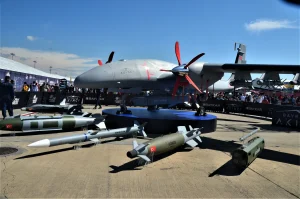
Hermes 900: Elbit Systems’ MALE UAV – Technical Analysis, Global Operators and Comparison with ANKA-S

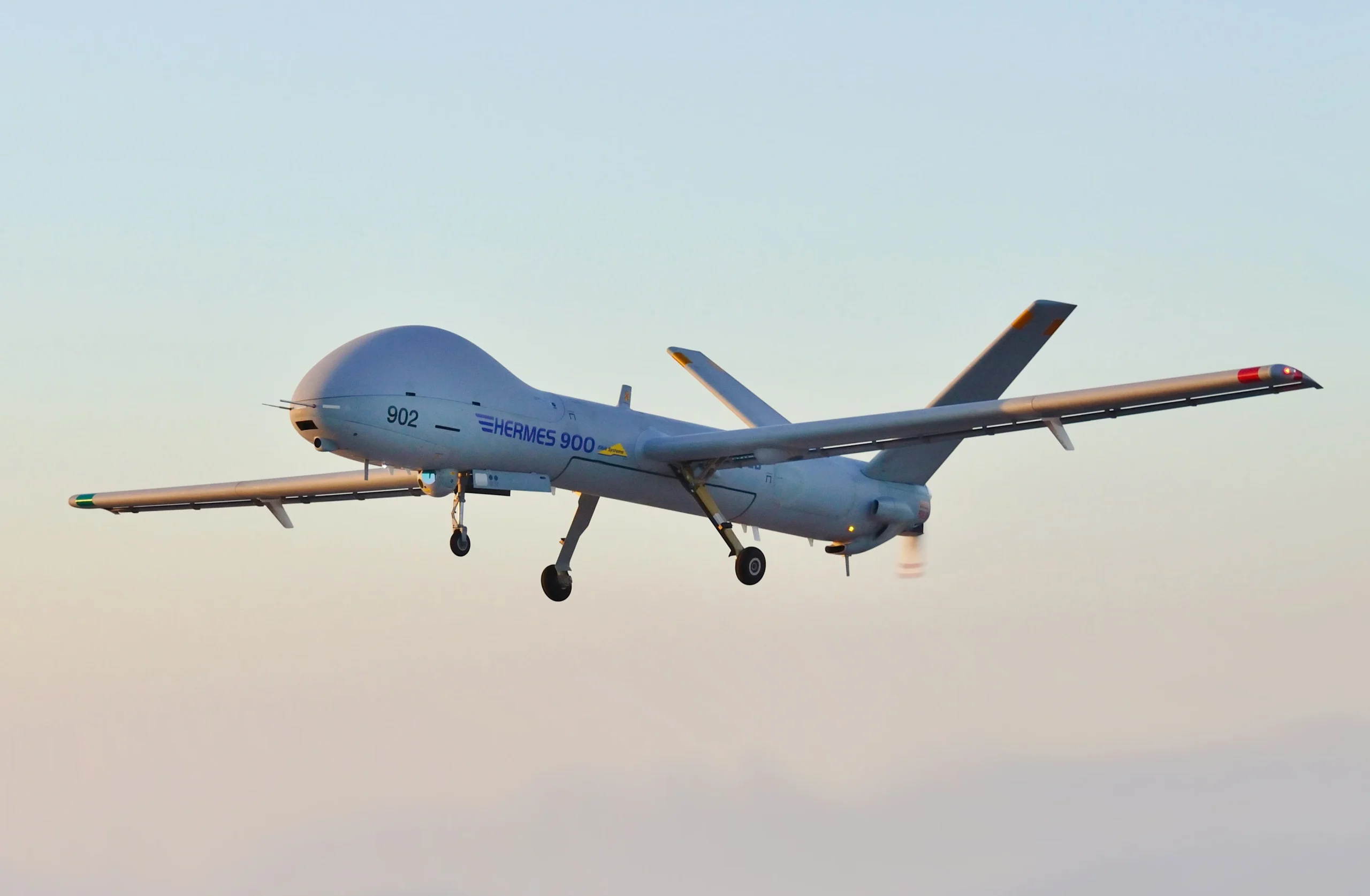
Hermes 900 is Elbit Systems’ flagship Medium Altitude Long Endurance (MALE) unmanned aerial vehicle. Delivered to the Israel Air Force in 2009 under the designation “Kochav” (Star), the system made its combat debut during Operation Protective Edge in Gaza in July 2014. Since then, more than 120 units have been ordered across eight or more countries, making the Hermes 900 one of the most commercially successful MALE UAVs outside the United States.
System Overview
MALE UAVs occupy a critical segment between short-endurance tactical drones and large strategic platforms. The Hermes 900’s combination of a 30,000 ft service ceiling, 30-plus hour endurance and 300 kg payload capacity allows it to sustain multi-role operations that a smaller tactical UAV cannot maintain:
- ISR: Persistent wide-area surveillance, fixed-site monitoring and moving target indication.
- Communications relay: Bridging voice and data networks over extended ranges, mountains or maritime gaps.
- SIGINT: Electronic emission collection with specialised payload modules.
- Targeting coordination: Real-time coordinate handoff to ground forces and artillery.
- Electronic warfare support: EW payload options for electromagnetic domain awareness.
The platform’s modular payload architecture is its key differentiator: the same airframe can be reconfigured between ISR, EW and strike coordination roles within hours, reducing the fleet size a customer must procure to cover multiple mission requirements.
Technical Specifications
| Parameter | Value |
|---|---|
| Wingspan | 15 m |
| Length | 8.3 m |
| Maximum take-off weight | 970 kg |
| External payload capacity | 300 kg |
| Service ceiling | 30,000 ft (9,100 m) |
| Typical operating altitude | 18,000–24,000 ft |
| Endurance | 30+ hours |
| Maximum speed | 220 km/h |
| Cruise speed | ~130 km/h |
| Engine | Rotax 914 turbocharged (115 hp) |
| Data link | Satellite (BLOS) + line-of-sight (LOS) |
| Payload stations | Multiple; EO/IR, SAR radar, SIGINT, EW, munitions |
| Ground crew | 2 (pilot + mission operator) |
Combat Record
Israel – Operation Protective Edge, Gaza (2014)
The Hermes 900 flew its first combat missions in July–August 2014 during Operation Protective Edge, the IDF’s 50-day campaign in Gaza. The system performed persistent urban-area surveillance and communications relay above the dense civilian-military environment, providing the ground forces command with a continuous overhead picture. The Hermes 900’s satellite data link allowed real-time imagery to be streamed to commanders dozens of kilometres from the front.
Azerbaijan – Second Nagorno-Karabakh War (2020)
Azerbaijan deployed both ATMOS 2000 howitzers and Hermes 900 UAVs during the 44-day Second Nagorno-Karabakh War. The Hermes 900 provided sustained ISR over mountainous terrain where ground reconnaissance was dangerous and difficult, feeding targeting data to Azerbaijani artillery and coordinating with Bayraktar TB2 strike drones supplied by Turkey. Armenian forces claimed to have downed a Hermes 900 in July 2020; Azerbaijan denied the loss and independent analysis found the claim unsubstantiated. The overwhelming majority of UAV losses documented in the conflict were attributed to smaller loitering munitions.
Israel – Post-October 2023 Operations
Following the Hamas attacks of 7 October 2023, the IDF conducted its most intensive multi-domain campaign since 2006. The Hermes 900 fleet played a sustained role in continuous urban surveillance over Gaza City and Rafah, tunnel network detection support, and artillery strike coordination. During the wider regional escalation involving Hezbollah and Iran in 2024–2025, the system reportedly contributed to SIGINT collection missions tracking missile launch sites.
Operators
| Country | Status | Notes |
|---|---|---|
| Israel | Operational | Primary user; “Kochav” designation in IAF |
| Azerbaijan | Operational | Active in 2020 Nagorno-Karabakh War |
| Brazil | Operational | Licensed as “Harpia” by Embraer |
| Canada | Operational | Arctic and maritime surveillance |
| Chile | Operational | Border and Pacific coast surveillance |
| Colombia | Operational | Counter-narcotics and internal security |
| Mexico | Operational | Border surveillance |
| Unnamed European country | On order | 120th order announced in 2025 |
Key Export Contracts
Brazil – Embraer Co-production: The most strategically significant Hermes 900 export is Brazil’s co-production arrangement with Embraer, which produces a locally adapted version designated “Harpia.” This model is operated by both the Brazilian Air Force and Navy, covering maritime surveillance over the South Atlantic and border monitoring in the Amazon. The Harpia arrangement is one of the few examples of a mid-tier country successfully localising MALE UAV production under licence.
Colombia (2014): Four Hermes 900s were delivered to Colombia’s Air Force for counter-insurgency and anti-narcotics operations — missions requiring long persistence over remote jungle terrain where manned aircraft sorties are expensive and pilot-fatiguing.
120th order (2025): Elbit announced reaching 120 total Hermes 900 orders in 2025, with an unnamed European customer providing the milestone order. The announcement reflected sustained demand driven by the European defence expansion following Russia’s Ukraine invasion.
Competing Systems
| System | Country | MTOW | Payload | Endurance |
|---|---|---|---|---|
| IAI Heron TP (Eitan) | Israel | 4,650 kg | 1,000 kg | 36+ hrs |
| General Atomics MQ-9 Reaper | USA | 4,763 kg | 1,700 kg | 27+ hrs |
| Bayraktar AKINCI | Turkey | 6,000 kg | 1,350 kg | 24+ hrs |
| TUSAŞ ANKA-S | Turkey | 1,600 kg | 200 kg | 24 hrs |
| IAI Heron 1 | Israel | 1,150 kg | 250 kg | 52 hrs |
| Hermes 900 | Israel | 970 kg | 300 kg | 30+ hrs |
Turkish Counterpart – ANKA-S
Turkey’s primary equivalent in the MALE UAV category is the TUSAŞ ANKA-S, developed by Turkish Aerospace Industries. A direct comparison reveals both the competitive gap and Turkish industry’s trajectory:
| Feature | Hermes 900 | ANKA-S |
|---|---|---|
| Wingspan | 15 m | 17.3 m |
| MTOW | 970 kg | 1,600 kg |
| External payload | 300 kg | 200 kg |
| Endurance | 30+ hrs | 24 hrs |
| Service ceiling | 30,000 ft | 30,000 ft |
| Satellite data link | Yes (BLOS) | Yes (BLOS) |
| Combat record | Gaza, Nagorno-Karabakh | Libya (limited reporting) |
| Export customers | 8+ countries | Limited |
| Local production licence | Brazil (Harpia) | No (yet) |
The ANKA-S is 65% heavier than the Hermes 900 but carries less external payload and offers shorter endurance — a gap that reflects the aerodynamic efficiency advantage Elbit has accumulated over many development cycles. Turkey’s broader UAV ecosystem, however, is one of the world’s most dynamic: the Bayraktar TB2’s export success across 30-plus countries has demonstrated Turkish industry’s ability to scale commercially. As TUSAŞ continues refining ANKA and developing the ANKA-3 next-generation platform, the competitive picture in this segment will continue to evolve.
Advantages
- Combat-proven: Validated in real warfighting environments across multiple theatres.
- Payload efficiency: High payload-to-weight ratio relative to MTOW class.
- Long endurance: 30-plus hour persistence reduces sortie frequency for sustained surveillance.
- Modular payload: Reconfigurable between ISR, SIGINT, EW and strike coordination roles.
- Satellite connectivity: True beyond-line-of-sight operation globally.
- Technology transfer model: Brazil’s Harpia demonstrates willingness to localise production.
Disadvantages
- Limited strike payload: Base configuration does not carry air-to-surface munitions; primarily an ISR/support platform.
- Israeli export policy exposure: Elbit’s involvement in active operations can create political friction in sensitive markets.
- NATO investigation risk: The 2025 suspended contracts create reputational headwinds.
- Outclassed at higher weight tier: Cannot match the payload of MQ-9 Reaper or Heron TP for demanding strike-ISR missions.
Inventory Media Assessment
The Hermes 900 occupies a well-defined and commercially successful niche in the MALE UAV market. Its 120-plus order tally, diverse customer base across four continents and verified multi-theatre combat deployments give it a credibility that few non-US MALE platforms can match. The Brazil co-production model demonstrates a sophisticated export strategy that goes beyond simple equipment sales to include industrial partnership.
For Turkey, the Hermes 900 represents a benchmark rather than an insurmountable obstacle. The ANKA-S’s platform weight penalty is real, but Turkish industry’s pace of development — evidenced by the TB2’s unprecedented commercial success — suggests the gap will narrow. The broader question is whether TUSAŞ can replicate the Bayraktar export model for ANKA, converting strong technical progress into the kind of international reference portfolio that sustains long-term market share in the competitive MALE segment.