Gulf Wheeled Armour: Why Localisation, Not Firepower, Decides the 8×8 Race

Week 12 of the Gulf Defence Procurement Analysis series.
Executive Summary
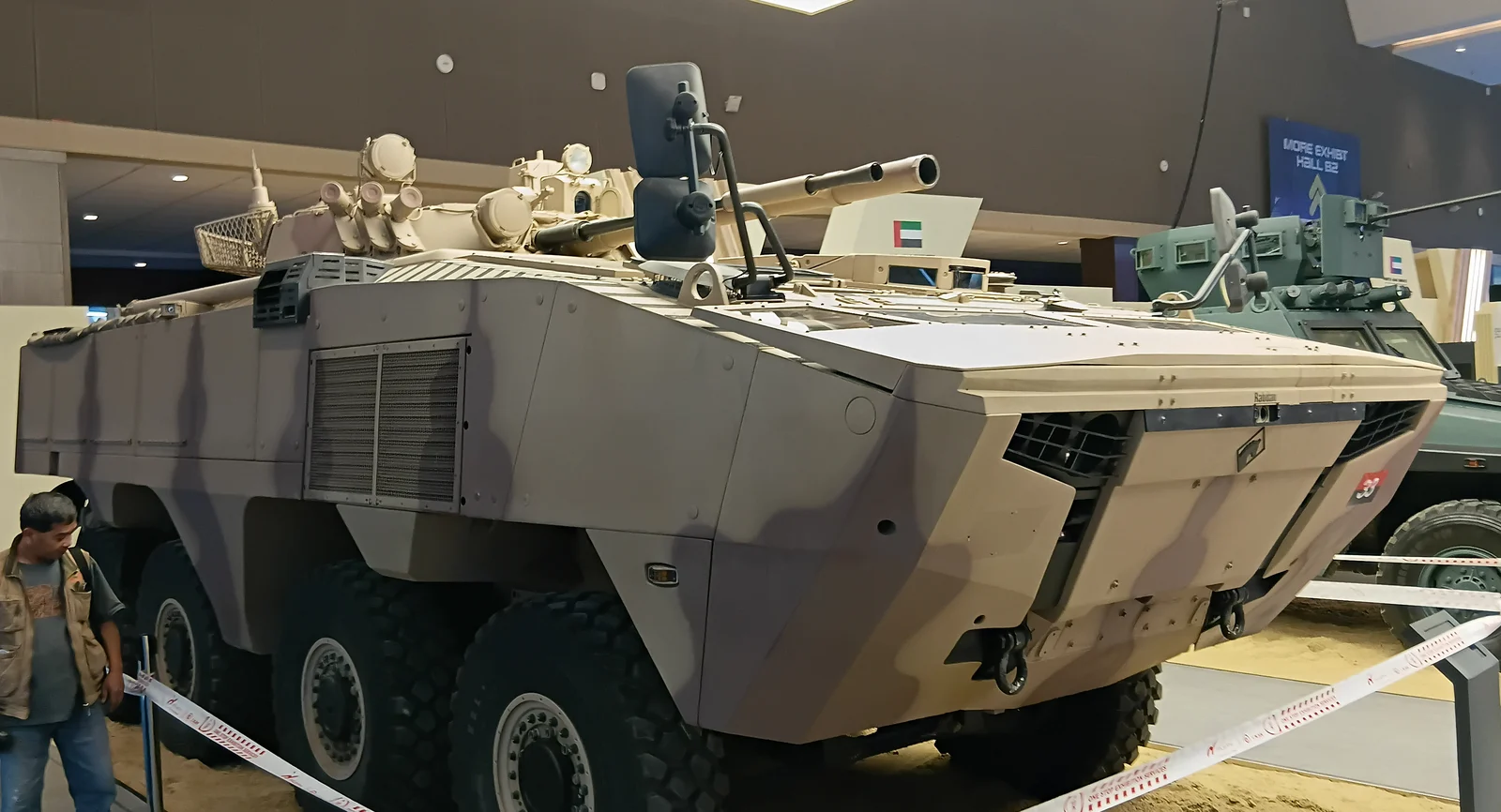
Across the six Gulf Cooperation Council states, the medium-weight 8×8 and 6×6 wheeled armoured personnel carrier has quietly become the volume category of land-force modernisation, displacing the main battle tank as the platform most states are actually buying in bulk. The driver is less a single tactical requirement than industrial policy. The United Arab Emirates has built an entire vertically integrated supply chain around the Tawazun Council and EDGE Group, fielding the Rabdan 8×8 (a $661 million, roughly 400-vehicle programme built on a licensed Otokar Arma design through the Al Jasoor joint venture) alongside the indigenously developed Calidus Wahash and Nimr Hafeet families. Saudi Arabia continues to operate a large fleet of Canadian-built General Dynamics Land Systems LAV 700s while pushing localisation through the General Authority for Military Industries (GAMI) and a new Saudi Arabian Military Industries (SAMI) production line planned at Al Kharj. Oman and Bahrain took the more conventional route of direct government-to-government purchases of Turkish FNSS Pars and Otokar Arma vehicles, while Qatar’s decade-long attempt to replace its Piranha II and AMX-VCI fleet with a large 8×8 buy has repeatedly stalled, leaving a modest ten-vehicle Boxer order as the only recent addition. Kuwait, by contrast, has made no significant new wheeled-APC acquisition in ten years. The pattern that emerges is one in which localisation capacity, not unit cost or protection level, increasingly separates Gulf procurement outcomes.
Operational Context
The Gulf’s appetite for wheeled protected mobility reflects a mission set that differs from the heavy-armour recapitalisation covered elsewhere in this series. Where main battle tanks address a residual state-on-state armoured threat, 8×8 and 6×6 platforms are being bought primarily for border and counter-infiltration duty, protected troop movement in coalition operations such as the Yemen campaign, and, increasingly, as mobile chassis for counter-UAS sensors and effectors. The proliferation of low-cost loitering munitions and cross-border rocket and drone harassment against Saudi and Emirati territory since the mid-2010s pushed several air-defence and electronic-warfare payloads onto wheeled hulls rather than towed or fixed installations, a trend visible in Calidus’s air-defence variant of the Wahash and in UAE efforts to mount short-range interceptors on 8×8 chassis shown at IDEX.
These platforms are also replacing genuinely old inventory. Qatar’s roughly 30 AMX-VCI and 180 VAB carriers date largely from the 1980s, and the region’s stock of early Piranha I/II variants is approaching four decades of service in some cases. Saudi Arabia’s own LAV fleet, ordered from Canada in a programme that was reduced from an original 928 vehicles to roughly 742 by 2018 amid political controversy in Ottawa over the export licence, remains the backbone of National Guard mechanised units even as newer, partly localised platforms are introduced alongside it rather than replacing it outright.
Comparative Analysis
The regional picture divides into three procurement models: fully indigenous design and production (UAE’s Nimr and Calidus lines), licensed or joint-venture local assembly of a foreign design (UAE’s Rabdan, Saudi Arabia’s planned SAMI-badged platforms), and straightforward government-to-government purchase with limited or no local content (Oman’s and Bahrain’s Turkish-sourced fleets, Qatar’s Boxer order, Saudi Arabia’s LAV 700). No two Gulf states have converged on the same combination of platform and industrial arrangement, which is itself a finding: unlike the relative convergence seen in main battle tank or standoff-missile procurement covered earlier in this series, wheeled APC choices remain fragmented along national industrial-policy lines rather than tactical or budgetary ones.
| State | Platform | Origin / Industrial Arrangement | Contract / Units | Status (2026) |
|---|---|---|---|---|
| UAE | Rabdan 8×8 | Otokar Arma design, Al Jasoor JV (Tawazun–Otokar), Nimr assembly | ~$661m, ~400 vehicles | Over 250 delivered; full domestic production not yet mature |
| UAE | Calidus Wahash / LIFV 8×8 | Indigenous (EDGE/Calidus) | ~$642.5m (IDEX 2025) | In production; SPH and air-defence variants unveiled |
| UAE | Nimr Hafeet 6×6 / Ajban 4×4 | Indigenous (Nimr/EDGE) | Multiple batches | In service; exported (e.g. Maldives, 2025) |
| Saudi Arabia | LAV 700 | General Dynamics Land Systems (Canada) | Reduced from 928 to ~742 vehicles | Core National Guard fleet |
| Saudi Arabia | SAMI-badged 8×8 (Jais Mk2-derived) | SAMI/EDGE cooperation | Localisation line planned, Al Kharj | Early-stage; production target 2026 |
| Oman | FNSS Pars III 8×8 / 6×6 | FNSS (Turkey), direct purchase | 145 (8×8) + 27 (6×6), 2015 contract | Deliveries completed 2020 |
| Bahrain | Otokar Arma 6×6 | Otokar (Turkey), direct purchase | Procurement from 2015 | In service, Defence Force and National Guard |
| Qatar | Piranha II / AMX-VCI / VAB (legacy) | Switzerland/France, legacy | ~30 AMX-VCI, ~180 VAB, 36 Piranha II | Ageing; replacement repeatedly deferred |
| Qatar | Boxer | ARTEC (Germany/UK), direct purchase | 10 vehicles | Delivered 2025–26, counter-UAS role |
| Kuwait | Legacy fleet | No major new acquisition | – | Unchanged in past decade |
Two data points illustrate the divergence in ambition. Abu Dhabi has been able to sustain parallel indigenous (Calidus), joint-venture (Rabdan) and legacy-import tracks simultaneously, a luxury that reflects both budget depth and a decade of Tawazun offset accumulation. Riyadh, despite far larger absolute defence spending, is still assembling the industrial base to do the same: GAMI reported that localised military spending reached 24.89% of the total by the end of 2024, against a Vision 2030 target of more than 50%, and the Kingdom’s newer procurement rounds reportedly carry individual localisation requirements above 50% precisely because the aggregate figure remains well short of target.
Procurement Considerations
The offset and local-content dimension now shapes Gulf wheeled-APC competitions as much as protection level or payload flexibility. Foreign contractors bidding into Saudi Arabia’s next rounds face requirements that typically bundle manufacturing presence, subcontracting to Saudi firms, technology transfer and R&D investment, all assessed against GAMI’s published localisation target. The UAE’s experience with Rabdan is a useful caution for other buyers pursuing the same model: a decade after the original agreement, domestic production of the platform has reportedly not fully matured beyond assembly, illustrating that a joint-venture structure and a localisation clause do not by themselves guarantee that technology transfer converts into independent manufacturing capacity on the promised timeline. This is a governance and absorption-capacity issue common to offset programmes generally, not a reflection on the underlying vehicle design, and it argues for buyers to weight an OEM’s demonstrated offset delivery record as heavily as the platform’s specifications.
A second consideration is fleet fragmentation. With Swiss-origin Piranha variants, Canadian LAV 700s, French AMX-VCI and VAB, German-British Boxer, Turkish Arma and Pars, and multiple Emirati indigenous designs all in service somewhere in the Gulf, sustainment and spares logistics are more fragmented at a regional level than the equivalent picture for, say, Gulf main battle tanks. States considering a first large 8×8 order, chiefly Qatar and Kuwait, will need to weigh whether joining an existing regional supply chain (Turkish Arma/Pars, already present in Bahrain and Oman) offers better through-life economics than a fresh, standalone contract with a Western or Emirati supplier, even where the latter might offer superior short-term political or industrial-offset terms.
Outlook
Two trends are likely to define the next several years. First, indigenous and joint-venture Emirati platforms will keep gaining share of new orders as EDGE and Calidus mature their production lines, with UAE-designed vehicles increasingly appearing in export markets, a pattern already visible in the small Maldives sale. Second, GAMI’s localisation trajectory will be the more reliable predictor of which foreign OEMs win Saudi follow-on business than raw platform capability, since any contractor unwilling or unable to meet rising localisation thresholds risks being outcompeted regardless of technical merit. For Qatar and Kuwait, the near-term calculus is different: both states need replacement capacity faster than a new domestic production line could deliver, which favours established suppliers, whether Western or Turkish, able to offer near-term delivery with a partial, credible local-content package rather than a full manufacturing transplant. The wider lesson for the Gulf’s wheeled-armour market is that platform selection has become inseparable from industrial-policy execution, and analysts assessing the next round of contracts will need to track offset delivery records as closely as vehicle specifications.