GKN Aerospace F-35 Components: Wing and Fuselage Production

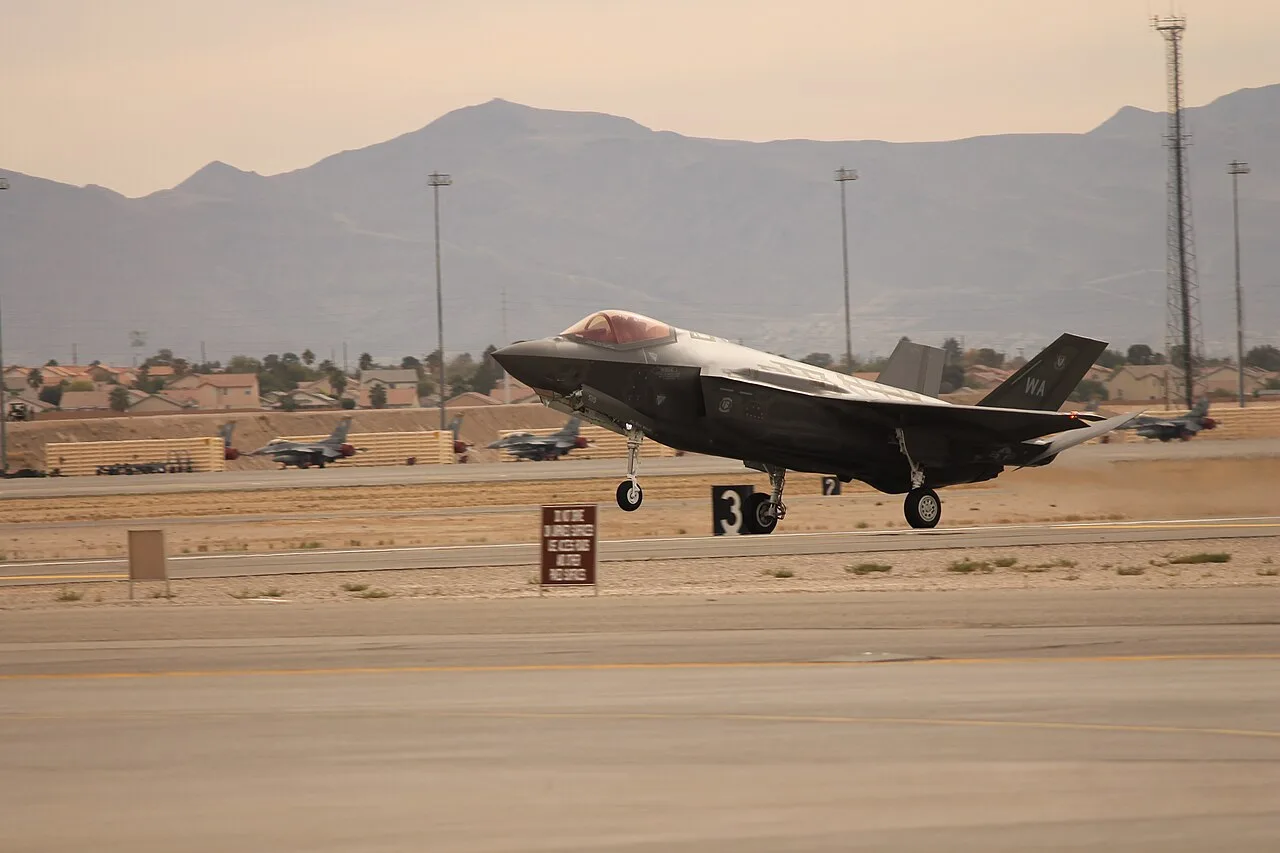
GKN Aerospace does not build the F-35’s wing or fuselage as complete assemblies, but it makes a long list of parts that go into them: composite fuselage skins and structures, large titanium bulkheads, the cockpit canopy and the aircraft’s wiring harnesses. The British company, owned by Melrose Industries since 2018, supplies the programme through Lockheed Martin, BAE Systems and Pratt & Whitney.
Who builds the F-35, and where GKN fits
The F-35 Lightning II is put together in a layered supply chain. Lockheed Martin is the prime contractor and runs final assembly in Fort Worth, Texas, with further final assembly and check-out lines in Italy and Japan. Major sections arrive from partners: Northrop Grumman builds the centre fuselage and BAE Systems the aft fuselage and tail surfaces, while Lockheed Martin produces the forward fuselage and wings. Pratt & Whitney supplies the F135 engine.
GKN Aerospace sits one tier below those companies. It machines, moulds and assembles parts that are delivered to the section builders or straight to Lockheed Martin. That is why its name rarely appears in headlines about the jet even though, by industry accounts, its parts are on every F-35 that leaves the line.
| F-35 work package | Main builder | GKN Aerospace contribution |
|---|---|---|
| Forward fuselage and wings | Lockheed Martin | Wiring harnesses |
| Airframe bulkheads (F-35A, F-35C) | Supplied to Lockheed Martin | Machined titanium bulkheads |
| Centre fuselage | Northrop Grumman | Wiring harnesses and detail parts |
| Aft fuselage and tails | BAE Systems | Composite fuselage parts (Isle of Wight) Machined titanium structures |
| Cockpit | Lockheed Martin | Canopy transparency (Garden Grove, California) |
| F135 engine | Pratt & Whitney | Advanced composite engine parts (Hoogeveen, Netherlands) |
Composite and titanium structures for BAE Systems
GKN’s largest early F-35 airframe award came in 2010, when BAE Systems selected it as a strategic supplier of composite and metallic structures for its share of the aircraft. Trade press put the value at more than $200 million. Under that deal GKN produced composite fuselage parts at its plant on the Isle of Wight in southern England, while titanium parts were machined at its sites in Filton, near Bristol, and St Louis in the United States. At the time the contract was described as raising the value of GKN content on each F-35 to around $2.5 million.
Composites, which combine carbon fibre with resin, matter on the F-35 for two reasons: they save weight and they can be shaped to hold the tight tolerances that the aircraft’s low-observable (stealth) design needs. Skins that sit slightly out of line can increase radar returns, so the precision of the supplier’s tooling has a direct effect on the finished aircraft.
Titanium bulkheads: long-lead parts
Bulkheads are the ribs of the fuselage, the frames that carry loads from the wings and landing gear into the airframe. In July 2018, at the Farnborough Airshow, GKN and Lockheed Martin signed an agreement for GKN to increase bulkhead production through 2023 for the conventional take-off and landing F-35A and the carrier-based F-35C. According to GKN, these bulkheads are machined from some of the largest titanium forgings used on any aircraft and have among the longest lead times of any part on the F-35. A delay at this stage would ripple through the whole build schedule.
No newer bulkhead contract terms were found in public sources reviewed for this article, so the current scope after 2023 has not been confirmed.
The canopy
The F-35’s one-piece canopy is one of the harder parts to make. It has to stay optically clear for the pilot, survive bird strikes and pressure loads, and carry a coating that helps keep the aircraft’s radar signature low. GKN Aerospace makes F-35 canopies at its facility in Garden Grove, California.
In June 2024 the company said it would double canopy production capacity at Garden Grove, a move expected to create more than 100 jobs. Aviation Week reported that the expansion is due to be completed in 2027 and that it is meant to ease a canopy shortage that had held back F-35 output. Lockheed Martin has been trying to keep deliveries steady across a growing international customer base, and transparencies were one of the parts with the fewest alternative sources.
Wiring harnesses from Fokker Elmo
GKN bought Dutch group Fokker Technologies in 2015 for £499 million. Fokker had been on the F-35 programme since 2002, and its Fokker Elmo unit signed a memorandum of agreement with Lockheed Martin in 2010 naming it the designated strategic supplier of wiring harnesses for the aircraft. GKN now says it has designed, produced and delivered the wiring harness packages for all F-35s flying and in production.
A modern fighter carries kilometres of wiring linking sensors, flight controls, weapons and the cockpit displays. On the F-35, much of that wiring is routed through the forward, centre and aft sections, so harness work touches all three major fuselage builders.
Engine parts for the F135
GKN’s F-35 role also extends to the engine. In 2019 GKN Fokker and Pratt & Whitney agreed that GKN would manufacture advanced composite components for the F135, the engine that powers all three F-35 variants. Production was assigned to GKN Fokker’s plant in Hoogeveen in the Netherlands. Industry reporting has also linked the company to much of the F135’s outer engine casing, although detailed part lists have not been published.
Locations at a glance
| Site | Country | Reported F-35 work |
|---|---|---|
| Isle of Wight | United Kingdom | Composite fuselage parts for BAE Systems |
| Filton | United Kingdom | Titanium machining |
| St Louis | United States | Titanium machining |
| Garden Grove | United States | Canopy transparencies |
| Hoogeveen | Netherlands | F135 composite engine parts |
The table lists sites named in company statements and trade press. GKN has not published a full breakdown of which plant makes which F-35 part today.
Ownership and outlook
Melrose Industries took over GKN in 2018 in an £8.1 billion deal and later separated the automotive and powder metallurgy businesses, leaving GKN Aerospace as its core holding. For Melrose, the F-35 is a long-running defence revenue stream that sits alongside GKN’s civil work on Airbus and Boeing airliners. Lockheed Martin plans to keep building F-35s well into the 2030s, which gives suppliers such as GKN visibility over a long production run, provided the parts keep arriving on time.
FAQ
Q: Does GKN Aerospace build the F-35’s wings?
A: No. Lockheed Martin builds the wings. GKN supplies parts such as titanium bulkheads and wiring that go into the airframe.
Q: What F-35 fuselage work does GKN do?
A: It produced composite fuselage parts on the Isle of Wight for BAE Systems’ aft fuselage and machines titanium structures, according to company and trade press reports.
Q: Where is the F-35 canopy made?
A: GKN Aerospace makes F-35 canopies at Garden Grove, California, and plans to double capacity there by 2027.
Q: Who owns GKN Aerospace?
A: Melrose Industries, a London-listed company that acquired GKN in 2018.
Q: Does GKN supply parts for the F-35 engine?
A: Yes. Under a 2019 agreement with Pratt & Whitney it makes composite parts for the F135 in the Netherlands.
Sources: GKN Aerospace, Lockheed Martin, Aviation Week, AIN, Composites World, ADS Group, Aviation Pros, Wikipedia (GKN).