YÖRÜK 4×4: Nurol Makina’s Light Armored Vehicle — Specs, Turkish Service and Exports Explained


The YÖRÜK 4×4 is Nurol Makina’s light tactical armored vehicle, a compact derivative of the combat-proven EJDER YALÇIN that has quietly become one of Türkiye’s more successful protected-mobility exports. Marketed abroad as the NMS 4×4, it has been bought by Estonia for its 2nd Infantry Brigade and by Qatar, while at home Türkiye’s Defence Industry Agency (SSB) lists the national police as its user.
| Builder | Nurol Makina, Ankara |
| Turkish user | General Directorate of Security (national police), per SSB |
| Program status | Company-funded design; listed in SSB’s security-vehicles portfolio; in series production |
| Key contracts | Estonia ~100 units (Oct 2023); Qatar ~100 units (2017) |
| Local content | No official figure published; Turkish design and IP |
| Debut | IDEF 2017, Istanbul |
What Is the YÖRÜK 4×4?
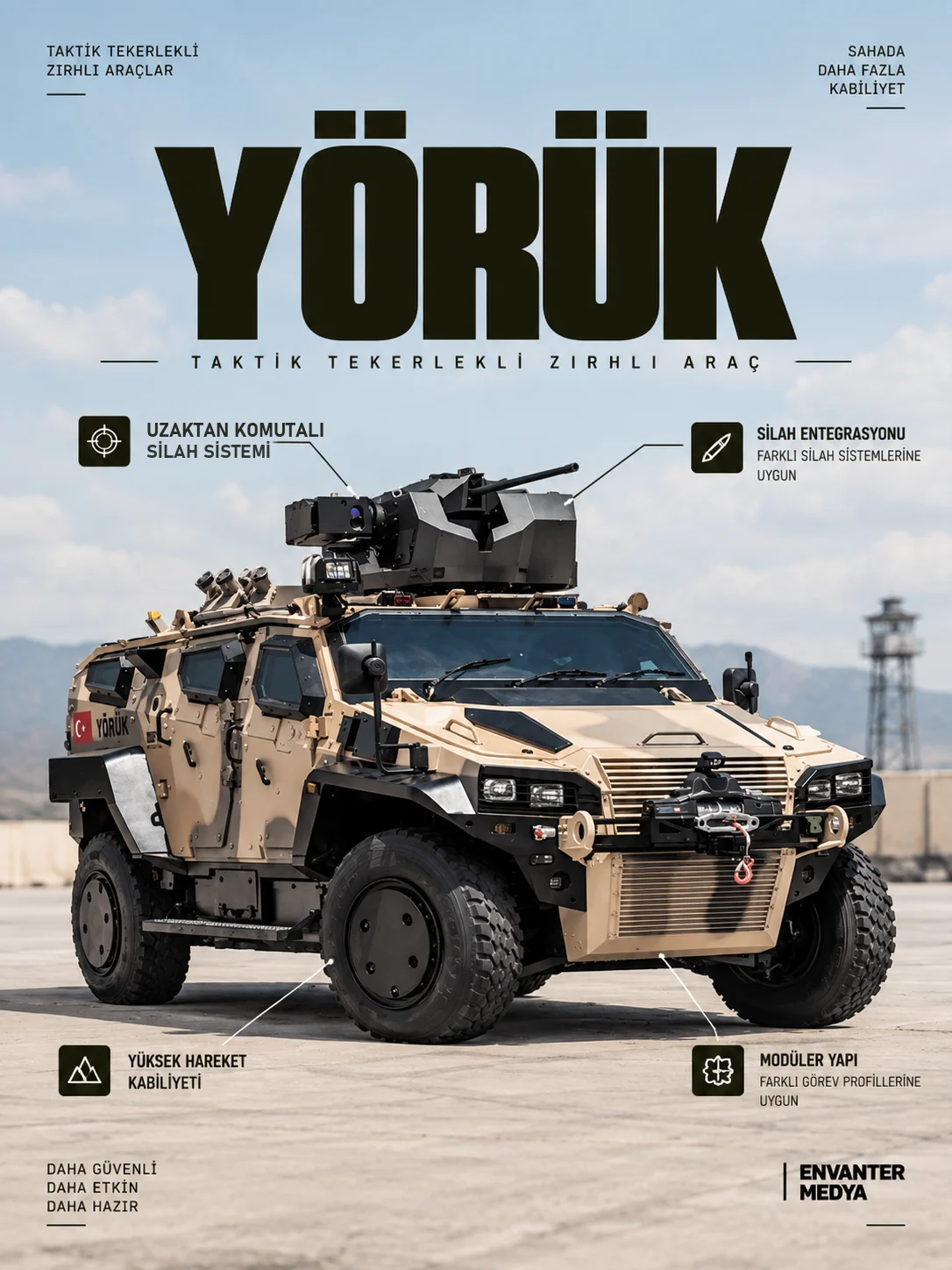
Nurol Makina set out to package MRAP-style blast protection into a lighter, faster vehicle. The result is a V-hulled monocoque design weighing about 8 tonnes empty, with roughly 4 tonnes of payload margin for turrets, sensors or missile launchers. That margin is what lets the same hull serve as a police special-operations vehicle, a reconnaissance platform or an anti-tank carrier.
Nurol offers the vehicle in armored personnel carrier, missile carrier, air-defense, anti-tank, reconnaissance, SWAT, single- and double-cab pickup and radar configurations. An extended-wheelbase version shown at IDEF 2023 raised seating from seven to eleven.
Technical Specifications
| Parameter | Value |
|---|---|
| Type | 4×4 light tactical armored vehicle, V-shaped monocoque hull |
| Dimensions | 4.9 m long, 2.4 m wide, 2.1 m high |
| Weight | About 8 t curb; roughly 10 t gross |
| Capacity | 9 in the baseline; up to 11 in the extended-wheelbase (EWB) version |
| Powerpack | 300 hp diesel, 813 Nm, automatic transmission, permanent 4×4 |
| Speed / range | Up to 140 km/h (manufacturer figure) / about 700 km |
| Mobility | 70% gradient, 40% side slope, 0.5 m step, 0.9 m trench, 90 cm fording |
| Protection | Mine, IED and side-blast protection; scalable composite armor |
| Armament | RWS with 7.62 mm or 12.7 mm MG or 40 mm grenade launcher; ATGM and air-defense options |
Figures are drawn from manufacturer and trade-press data and vary with customer fit. Independent suspension front and rear, a locking-differential full-time 4×4 driveline and ABS give the vehicle road speeds that are unusual for its protection class, while run-flat tires and dual-side firing ports reflect its internal-security heritage.
Who Builds It and Program History
The vehicle is designed and built by Nurol Makina ve Sanayi A.Ş. in Ankara. It debuted at IDEF 2017 and, according to Turkish sources, entered series production in 2018. SSB’s September 2026 briefing note from its Land Vehicles Department places YÖRÜK in the security and logistics vehicles portfolio with the General Directorate of Security (EGM) as user, but gives no contract date or milestones, which indicates a company-funded product procured off the shelf rather than an SSB development program.
Nurol supports the fleet internationally through subsidiaries in Hungary and the United Kingdom and a maintenance facility in Qatar.
Turkish Service and Deliveries
Turkish reporting from June 2023 identified the presidential protection service as the first domestic operator, with vehicles fitted with ASELSAN’s SARP ZAFER remote weapon station and used in and around the presidential complex. Neither SSB nor Nurol has disclosed how many vehicles Turkish security forces have received, and no Turkish Land Forces or Gendarmerie order appears in the SSB note.
Exports
Exports are where YÖRÜK has made its name. Army Technology reports that the Qatari Army ordered around 100 vehicles in 2017, showcased them in the December 2017 national day parade, and placed a follow-on order for its special forces in March 2018. Open-source imagery has documented the type with Chad’s forces since 2018, and trade press reports it in service with Indonesian police special units.
The landmark deal came on October 18, 2023, when the Estonian Centre for Defence Investment signed for about 100 NMS 4x4s, valued at roughly 70 million euros, alongside a separate Otokar ARMA 6×6 buy. Tallinn chose heavily modified variants with enhanced anti-armor capability for a brigade that had no wheeled armor before. Nurol says it has signed YÖRÜK contracts with five countries, including European customers.
Trade Show Appearances
After its IDEF 2017 launch, the vehicle went to Eurosatory 2018 in Paris alongside the EJDER YALÇIN. A pickup variant followed at IDEF 2021 and the extended-wheelbase model at IDEF 2023. In 2025 Nurol showed new weapon integrations at IDEF and introduced the lighter NMS-L derivative at FEINDEF in Madrid.
Local Content and Key Subsystems
No official local-content percentage has been published for YÖRÜK. Hull design, armor solution and systems integration are Nurol’s own, and the intellectual property sits in Türkiye. Remote weapon stations from ASELSAN add further Turkish content; the engine and transmission suppliers are not specified in public sources.
Global Counterparts
YÖRÜK competes with the Oshkosh JLTV, Iveco’s LMV, the Arquus Sherpa Light and Plasan’s SandCat. The JLTV is heavier and costlier; the LMV sits in a similar weight bracket but carries fewer troops. YÖRÜK’s pitch is nine to eleven seats, a V-hull and high road speed in a roughly 10-tonne package, a combination that proved competitive enough to win a NATO army’s tender.
Frequently Asked Questions
Who makes the YÖRÜK 4×4?
Nurol Makina of Ankara. It is sold internationally as the NMS 4×4.
Is it in Turkish service?
Yes. SSB lists the General Directorate of Security as user, and the presidential protection service fields vehicles with ASELSAN SARP ZAFER stations. Quantities are not public.
Which countries have bought it?
Public sources confirm Qatar, Chad and Estonia, with Estonia signing for about 100 vehicles in October 2023. Indonesian police special units are also reported as users.
Does it have autonomous driving?
No such capability is described by the manufacturer. The vehicle carries a remote weapon station but is crewed and driven conventionally.
- MİĞFER: ASELSAN’s Vehicle-Mounted Anti-Drone Shotgun System — Specs, Status and Exports Explained
- ÖMTTZA: FNSS’s PARS SCOUT 6×6 and 8×8 Mission Vehicles — Specs, Turkish Service and Exports Explained
- BMC 2.5-Ton Cargo and Personnel Vehicle — Specs, Turkish Service and Exports Explained
- BOZKURT: Elektroland’s 6×6 Wheeled UGV — Specs, Turkish Service and Exports Explained
Featured photo: Presidency of Defence Industries (SSB)
Sources
- SSB Land Vehicles Department program briefing note, September 2026
- Nurol Makina – YÖRÜK 4×4 ürün sayfası
- Nurol Makina – NMS 4×4 product page
- Army Recognition – Nurol Makina NMS-Yörük light armored vehicle (2018)
- Army Technology – Nurol Makina NMS 4×4 Armoured Vehicle
- Military Africa – Chad operating Yörük 4×4 armored vehicle
- Defence Turkey – Estonia Purchased NMS 4×4 Armored Vehicles from Nurol Makina
- Janes – Estonia orders Nurol Makina NMS 4×4 vehicles and Otokar Arma 6×6 APCs
- MilitaryLeak – Eurosatory 2018: Nurol Makina presents Ejder Yalçın and NMS 4×4
- European Security & Defence – Nurol Makina Developing New NMS Variants
- Army Recognition – Nurol Makina NMS-L 4×4 at FEINDEF 2025
- Gazete Birlik – YÖRÜK 4X4 Türkiye’deki ilk görevine Cumhurbaşkanlığında başladı
- Son Dakika – YÖRÜK 4X4, ihracatta başarıyı artırmak için gelişimini sürdürüyor