What Is Agile Combat Employment (ACE)? Dispersed Airpower Explained

Agile Combat Employment, or ACE, is a U.S. Air Force way of operating in which aircraft and teams spread out to many smaller, often austere airfields instead of depending on a few large bases. The aim is to survive an opening strike and keep generating sorties.
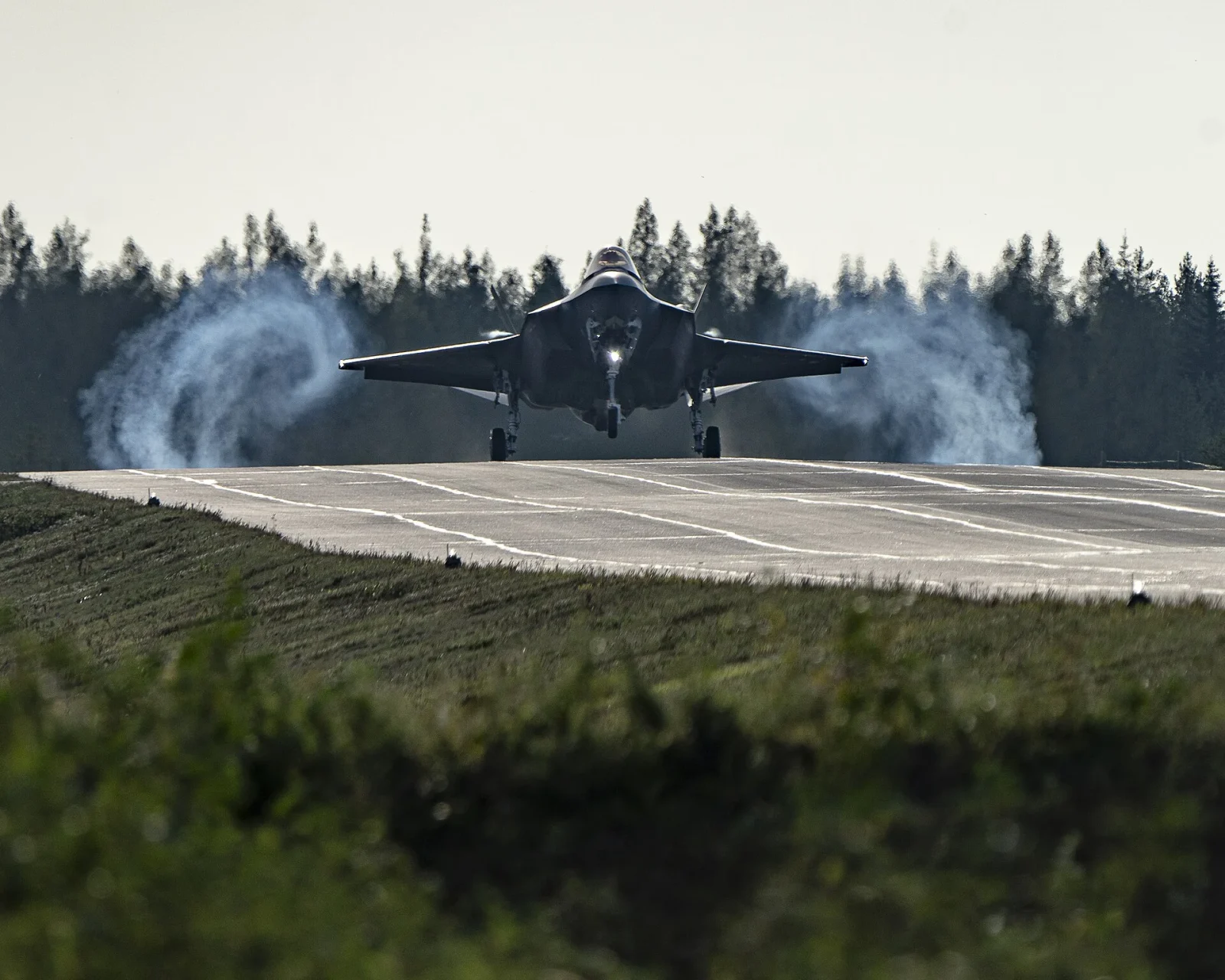
The idea is not only American. In September 2024, during exercise BAANA in Finland, F-35 Lightning II jets of the U.S. Air Force’s 48th Fighter Wing landed on the Hosio highway strip at Ranua. Official captions said the airmen were practising ACE skills by learning austere landing and take-off techniques from their Finnish counterparts.
What is Agile Combat Employment?
ACE is the U.S. Air Force’s operational concept for dispersing combat airpower, command and support across a network of bases, highway strips and expeditionary sites. Instead of massing jets, fuel and munitions at one well-known air base, units move in small teams, often for a short period, then shift again.
The logic is straightforward. A handful of large air bases are easier to target with long-range missiles. A larger number of shorter, rougher strips is harder to hit all at once and lets aircraft keep flying after the first wave.
What does ACE look like in practice?
Typical ACE tasks, as described in official U.S. Air Force exercise reporting, include:
- landing and taking off from highways or short, austere strips
- refuelling and re-arming with a small ground team, sometimes with host-nation support
- moving between sites so that the next operating location is not predictable
- working with allies who already train for road-base operations, such as Finland
The F-35s that took part in BAANA 2024 came from RAF Lakenheath in the United Kingdom. The highway work was presented by the U.S. Air Force as a historic first for the F-35 on a Finnish road strip, and as a way to strengthen collective defence with NATO allies. For the aircraft itself, see our guide to the F-35 Lightning II.
Why air forces are practising ACE
Potential adversaries have invested in long-range strike and reconnaissance. Fixed, crowded bases are easier to find and to attack. ACE does not make a base invulnerable, but it is meant to raise the number of targets an attacker must hit and to shorten the time a jet sits in one place.
Allies in northern Europe have long practised highway operations with national aircraft. ACE borrows that experience and applies it to U.S. and NATO fifth-generation jets as well as older types.
Frequently asked questions
What does ACE stand for in the Air Force?
ACE stands for Agile Combat Employment, a U.S. Air Force concept for dispersing aircraft and support teams to many austere locations.
Has the F-35 landed on a highway?
Yes. In September 2024, U.S. Air Force F-35s landed on the Hosio highway strip in Ranua, Finland, during exercise BAANA 2024, according to official U.S. military photographs and captions.
Is ACE only an American idea?
The name is American, but the practice of using road bases is older, especially in Nordic air forces. ACE formalises that approach for U.S. and allied operations.
Sources: Official U.S. Air Force and U.S. Army photographs and captions from exercise BAANA 2024, Hosio Highway Strip, Ranua, Finland, 4 September 2024; U.S. Air Force public descriptions of Agile Combat Employment.