UK Puts Four Missiles on Always-On Production: CAMM, LMM, ASRAAM and NLAW


LONDON, 17 September 2026 — Britain has decided to place four missile systems on continuous production under its new defence investment plan. The CAMM air defence missile, the Lightweight Multirole Missile (LMM), the ASRAAM short-range air-to-air missile and the NLAW anti-tank weapon will now be built without waiting for fresh orders. The move reframes industrial capacity as part of military readiness rather than as a procurement line item.
What the plan changes
Western missile plants have traditionally run at the pace of signed contracts. No order meant a slower line, dispersed skilled labour and a shrinking supplier base. When a new order finally arrived, rebuilding that capacity took months — sometimes years.
The “always-on” model announced in London is meant to break that cycle. For four priority weapons, the production line will stay warm regardless of order flow. The intended effect is twofold: shorter stockpile replenishment times, and the removal of the long lead-in normally required to surge output in a crisis.
The plan also carries a £1.6 billion commitment to supply air defence missiles to Ukraine, with a significant share of those rounds produced in Northern Ireland. Over the past three years the Belfast line has become one of Europe’s critical nodes for short-range air defence and anti-armour munitions.
Six new factories, first ground broken in 2026
On the industrial side, the plan calls for at least six new munitions and energetics plants spread across England, Scotland and Wales. Energetics — propellants, explosive fills and the chemistry that drives them — remain the tightest bottleneck in munitions manufacturing. A missile airframe can be produced in weeks; fill capacity can stay flat for years.
Construction on the first plant is due to begin before the end of 2026, and the programme is expected to create at least 1,000 jobs. Roughly £1.5 billion is earmarked for the factory build-out, within a wider £11.1 billion planned for weapons and munitions over the next four financial years.
The document also signals that Britain is examining a restart of Sting Ray lightweight torpedo production and the repatriation of sonobuoy manufacturing. Both are consumables in anti-submarine warfare — items whose burn rate climbs sharply once a campaign begins.
Four weapons, four industrial stories
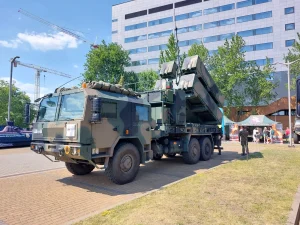
CAMM (Common Anti-air Modular Missile): Built by MBDA UK. It arms the Royal Navy as Sea Ceptor, fired from soft-launch vertical cells, and the British Army as Sky Sabre. Active radar guidance; the extended-range CAMM-ER pushes the engagement envelope into the 45-kilometre class.
LMM / Martlet: Produced by Thales UK in Belfast. Launched from helicopters, ships and ground mounts, it is positioned as a low-cost answer to small drones and fast attack craft.
ASRAAM (AIM-132): Another MBDA product — an infrared-guided within-visual-range air-to-air missile carried by Typhoon and F-35. In Ukraine it was adapted to a ground launcher and pressed into the air defence role.
NLAW: Developed by Sweden’s Saab and manufactured in the UK, this single-shot anti-tank weapon uses an overfly top-attack mode to strike armour where it is thinnest.
Why now
The reasoning traces directly to consumption rates observed in Ukraine. Under sustained combat, a NATO member’s entire peacetime annual output can be expended in days. Air defence interceptors and anti-armour rounds proved the fastest-melting items on that list.
The wider European pattern is similar. Germany, France and Poland have each announced separate capacity programmes over the past two years, while Rheinmetall, MBDA and Nammo have opened new lines. What distinguishes the British approach is the decision to underwrite capacity directly with a state commitment: the line runs, and the product is stockpiled.
Read from Ankara
Türkiye has long solved the continuity problem through a different mechanism. Roketsan and MKE lines are fed by regular Turkish Armed Forces procurement cycles and a growing export book, so the shut-down/restart cycle is far less pronounced than in Western Europe. For systems such as the HİSAR family, SUNGUR, TOLUN and KARAOK, serial production decisions are typically taken at programme launch rather than after an order lands.
Britain’s decision cuts two ways for the Turkish industry. First, competition in the European short-range air defence and anti-armour segment gets harder: placing CAMM and LMM on continuous production puts price pressure on anyone chasing the same export slots. Second, as long as Europe’s energetics bottleneck persists, countries with existing fill and propellant capacity — Türkiye among them — become more visible in the supply chain.
The plan’s clearest gap is its lack of granularity. No per-weapon budget, annual output target, contract length or transition timetable has been published. Until those numbers appear, it will be difficult to judge how much real capacity the “always-on” model actually delivers.
Sources
- Official announcements under the UK Defence Investment Plan 2026, 17 September 2026
- Defence Industry Europe, “Britain to fund continuous production of CAMM, LMM, ASRAAM and NLAW”, 17 September 2026
- Janes, UK Defence Investment Plan 2026 analysis