UAE and South Korea Agree on Air Defence: L-SAM, M-SAM II and Chunmoo

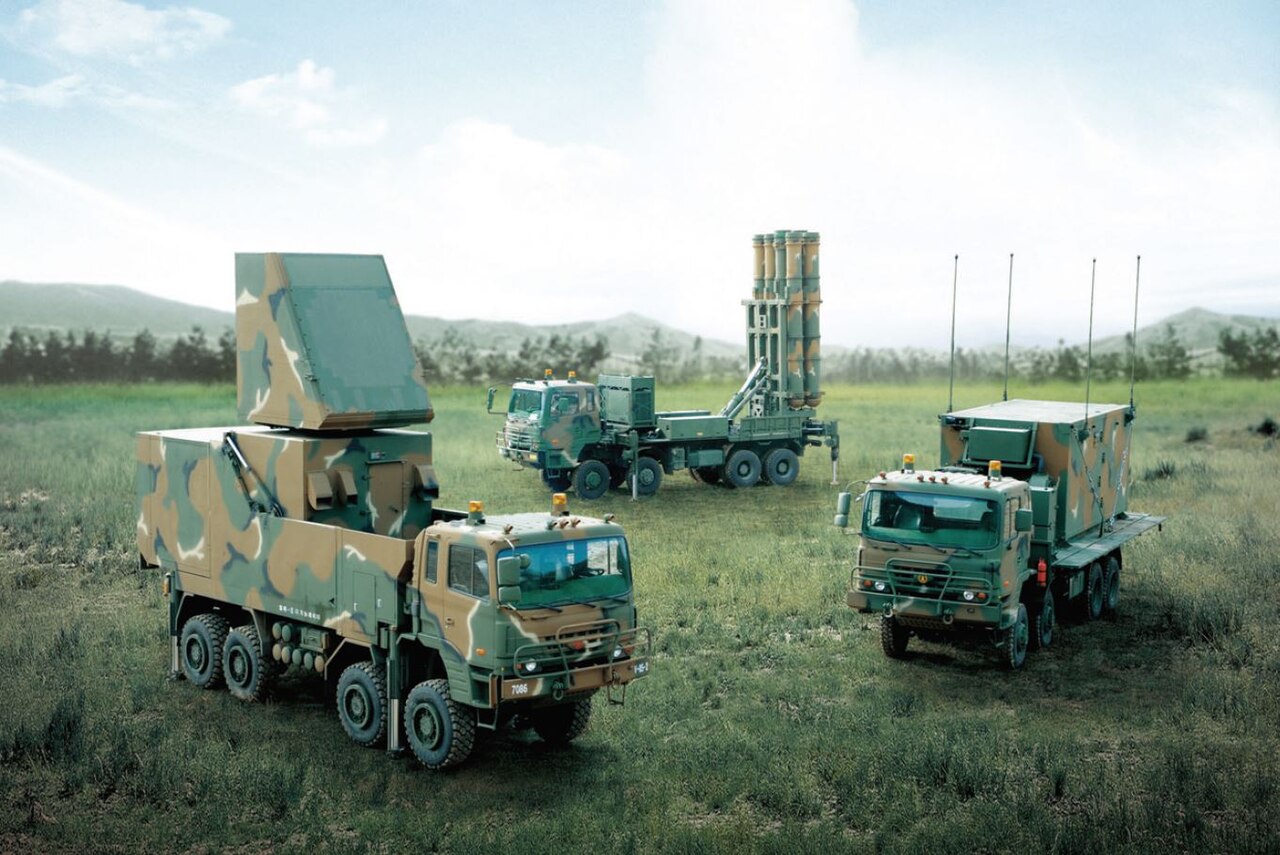
ABU DHABI, 17 September 2026 — EDGE Group and South Korea’s Hanwha have signed a strategic term sheet aimed at broadening the United Arab Emirates’ layered air defence architecture. The agreement, announced in Abu Dhabi, covers the introduction of the long-range L-SAM system into UAE service, additional M-SAM II (Cheongung-II) batteries on top of those already fielded, and the K239 Chunmoo multiple rocket launcher for long-range precision fires.
What the agreement covers
The document is a term sheet rather than a signed contract — a framework in which the parties set out scope, division of work and the shape of industrial cooperation. Even so, the line items point to something more than a numerical top-up: the UAE is trying to close a structural gap at the upper tier of its architecture.
- L-SAM: South Korea’s indigenously developed long-range air and missile defence system. It is a capability the UAE does not currently field, covering upper-layer ballistic missile intercept.
- M-SAM II / Cheongung-II: The medium-range system acquired under a roughly $3.5 billion contract signed in early 2022. The new agreement envisages additional batteries layered onto the existing inventory.
- K239 Chunmoo: A multiple rocket launcher able to fire several calibres of rocket and guided munition. As a complement to air defence, it provides depth fires against launchers and logistics nodes.
The term sheet also includes provisions for a local joint venture, technology transfer and a phased move to domestic production. That triad recurs in almost every large UAE procurement of the past five years — part of a deliberate strategy of tying purchases to industrial capacity building.
Background: the stockpile problem
The timing traces to the intense air attack wave that hit the Gulf in the first months of 2026. According to figures compiled by Army Recognition, 2,819 aerial attacks were recorded against the UAE between January and April 2026 — 537 classified as ballistic missiles, 2,256 as drones and 26 as cruise missiles. Those numbers have not been fully corroborated by independent sources, but the intensity of the attack profile has clearly shaped the procurement conversation in the region.
The problem such a profile exposes is not only intercept success. It is the rate at which interceptor stocks burn down. A system defending against hundreds of ballistic missiles and thousands of drones can exhaust its magazine within days. That pushed two items to the top of the Emirati agenda: closing the upper tier of the architecture, and being able to replenish munitions from inside the country.
How the Seoul–Abu Dhabi line was built
The defence relationship jumped a level with the 2022 M-SAM II contract. Within that roughly $3.5 billion package, the Hanwha Systems multifunction radar component alone carried a value above $1 billion. The wider defence and energy cooperation framework between the two states has since been described in the region of $35 billion.
South Korea’s advantage in the Gulf market rests on delivery speed and pricing flexibility. Western order books are saturated by Ukraine-driven replenishment and NATO stockpile rebuilding; the Korean industrial base, by contrast, has multiplied its capacity over the past five years on the back of Polish, Egyptian and Gulf orders. Seoul is also noticeably more flexible than its Western competitors on technology transfer and local production demands.
Read from Ankara
The UAE has become a fast-growing market for the Turkish defence industry over the past three years, framed by Baykar’s UAV agreements, joint investment vehicles and government-level industrial cooperation memoranda. In the air defence segment, however, the picture is different: the Emirati medium and upper tiers have been shaped by Korean and American systems.
That puts Turkish products in the same segment — HİSAR-O+, HİSAR-U and SİPER Block I/II — into direct competition. SİPER Block II sits in the same category as L-SAM in terms of range and mission profile. Every long-range reference Korea wins in the Gulf makes entry harder for Turkish systems in the same market.
There is, however, an opening in the Emirati insistence on technology transfer and local manufacture. Turkish industry has direct experience of joint-production and localisation models with Gulf partners, and the “export through co-production” approach adopted by Türkiye’s Presidency of Defence Industries over recent years answers precisely that demand.
No timetable for converting the term sheet into a contract has been released, nor battery counts or total value. Until those figures appear, firm conclusions about the final shape of the UAE’s long-range air defence architecture are premature.
Sources
- Joint EDGE Group and Hanwha announcement, Abu Dhabi, 16 September 2026
- Army Recognition, “UAE to expand integrated air defense cooperation with South Korea”, 17 September 2026
- Official statements relating to the 2022 M-SAM II procurement contract