Swarm Aero Unveils Gamera, a Cheaper Bid to Replace the Reaper

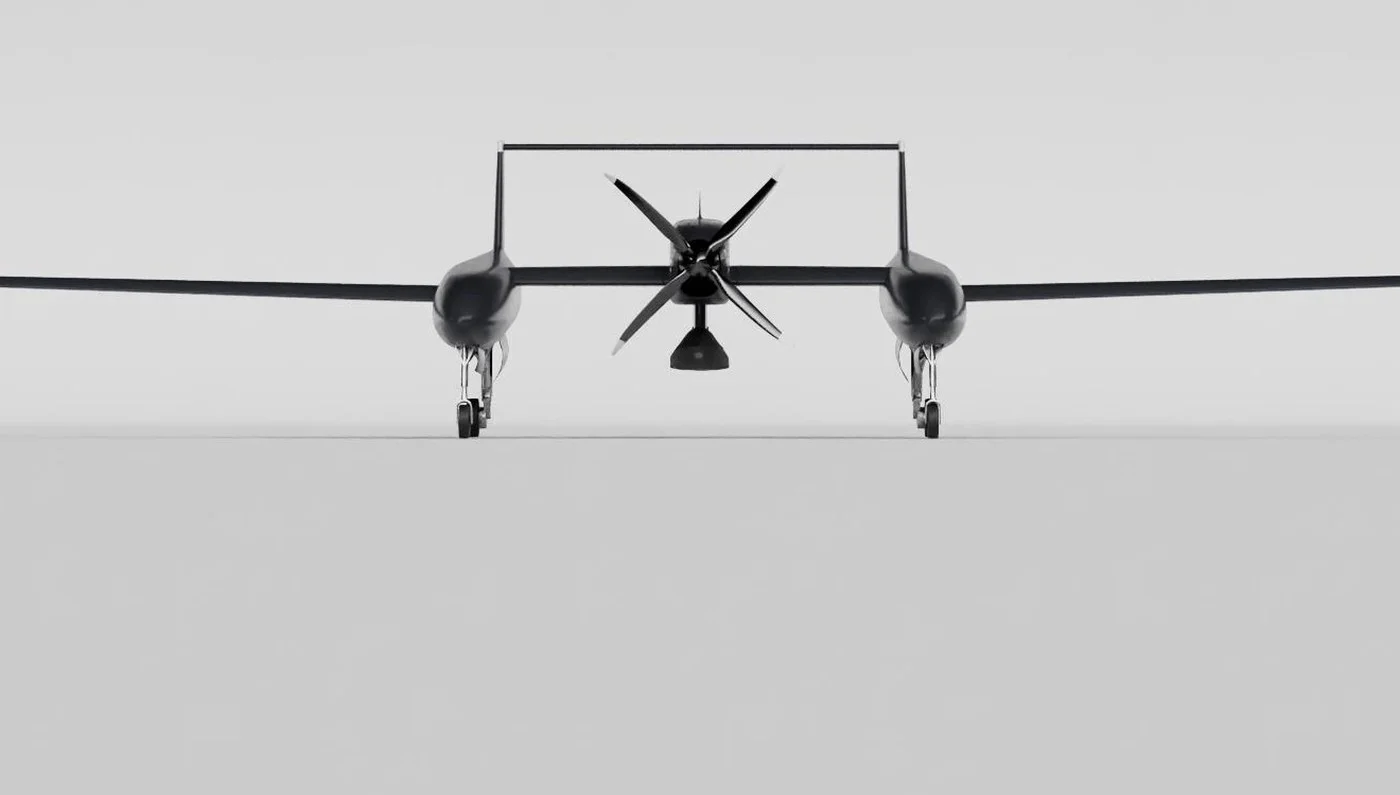
Swarm Aero rolled out a full-scale model of Gamera at the Air and Space Forces Association conference in National Harbor, Maryland on 14 September, pitching it as a successor to the MQ-9 Reaper. The company claims 9,000 nautical miles of unrefuelled range and more than 2,800 pounds of payload, with first flight planned before the end of 2026.
A deliberately unfashionable aircraft
Gamera’s most striking feature is its dual-hull layout — two parallel offset fuselages with a single Honeywell TPE331 turboprop mounted between them, spanning 72 feet. It carries seven hardpoints and makes no attempt at low observability.
Co-founder and Chief Revenue Officer Oliver Palmer was direct about the reasoning: “What we’ve done cuts against conventional wisdom — create a very simple, non-stealthy aircraft optimized for extreme range.” CEO Peter Kalogiannis added that there is “no silver bullet” for cost reduction, attributing the savings to modularity.
Abandoning stealth is a considered trade. Low observability demands specialised materials, complex geometry and expensive manufacturing. Swarm Aero has taken that cost out entirely and spent it on range and producibility instead.
What 9,000 nautical miles buys
Unrefuelled range of that order is unusual for an unmanned aircraft. The MQ-9’s mission radius and endurance require it to launch from a base near the operating area. Gamera’s target range implies an aircraft that crosses oceans on its own.
The rationale is Pacific geography. Chinese medium- and long-range ballistic missile capability puts forward American bases in the region at risk. A platform that can launch from distant bases, loiter over the target area, and be lost without financial catastrophe is one way to disperse that risk.
The price target
The company says it can beat the Air Force’s $10 million per-unit goal. For comparison, an MQ-9A can reach $50 million depending on configuration — a gap wide enough to change force structure arithmetic.
Gamera is aimed at the Massed Modular Aircraft programme, run jointly by the Defense Innovation Unit and the Air Force as the Reaper replacement effort. General Atomics has entered its own candidate, Wildfire, meaning the incumbent is competing to succeed itself.
Producibility as a requirement
American defence discourse has converged on the idea of the “attritable” platform — an aircraft whose loss is operationally acceptable. In that framework, what matters is not a single airframe’s performance but how many can be built, how quickly. Simple structure, a commercial-derived engine and no stealth all serve that end.
The TPE331 choice fits the same logic. The turboprop has been in civil and military service for decades: the supply chain exists, maintenance expertise is widespread and unit cost is predictable.
Part of a thousand-aircraft plan
The unveiling landed in the same week the US Air Force clarified its uncrewed combat aircraft plans. The service outlined a fleet of roughly 1,000 aircraft — at least 500 Collaborative Combat Aircraft by 2032, plus around 500 in the MMA class — and formalised the designations FQ-42 Vengeance and FQ-44 Fury for the CCA effort.
The two classes address different missions. CCAs will fly alongside crewed fighters in air superiority roles; MMA-class aircraft are oriented toward persistent surveillance and strike against ground targets. Gamera is competing for the second category.
Company profile
Founded in 2022, Swarm Aero is backed by Andreessen Horowitz, Founders Fund, Khosla Ventures, Two Sigma and Coatue. It develops its own autonomy stack, called Legion, and is one of three vendors selected for the Pentagon’s Replicator drone swarm command-and-control prototyping effort. Civil applications in logistics and firefighting are on its longer-term roadmap.
A familiar formula
The combination Gamera describes — cheap, non-stealthy, long-ranged, armable — is the formula Turkish industry has pursued for roughly a decade. Bayraktar TB2’s international position was built on exactly that cost-effectiveness balance. Washington now institutionalising the same logic inside its own procurement system suggests Turkish manufacturers will meet sharper competition in export markets. Platforms such as Akıncı and ANKA-3, which push Turkish offerings into higher segments, will have to differentiate on technical maturity and delivery speed.
Sources
- Swarm Aero official unveiling, Air and Space Forces Association conference, 14 September 2026
- Company executive statements at the event
- US Air Force CCA and MMA programme information