RAF Lands the A400M on Grass in Poland as NATO Tests Dispersed Airlift

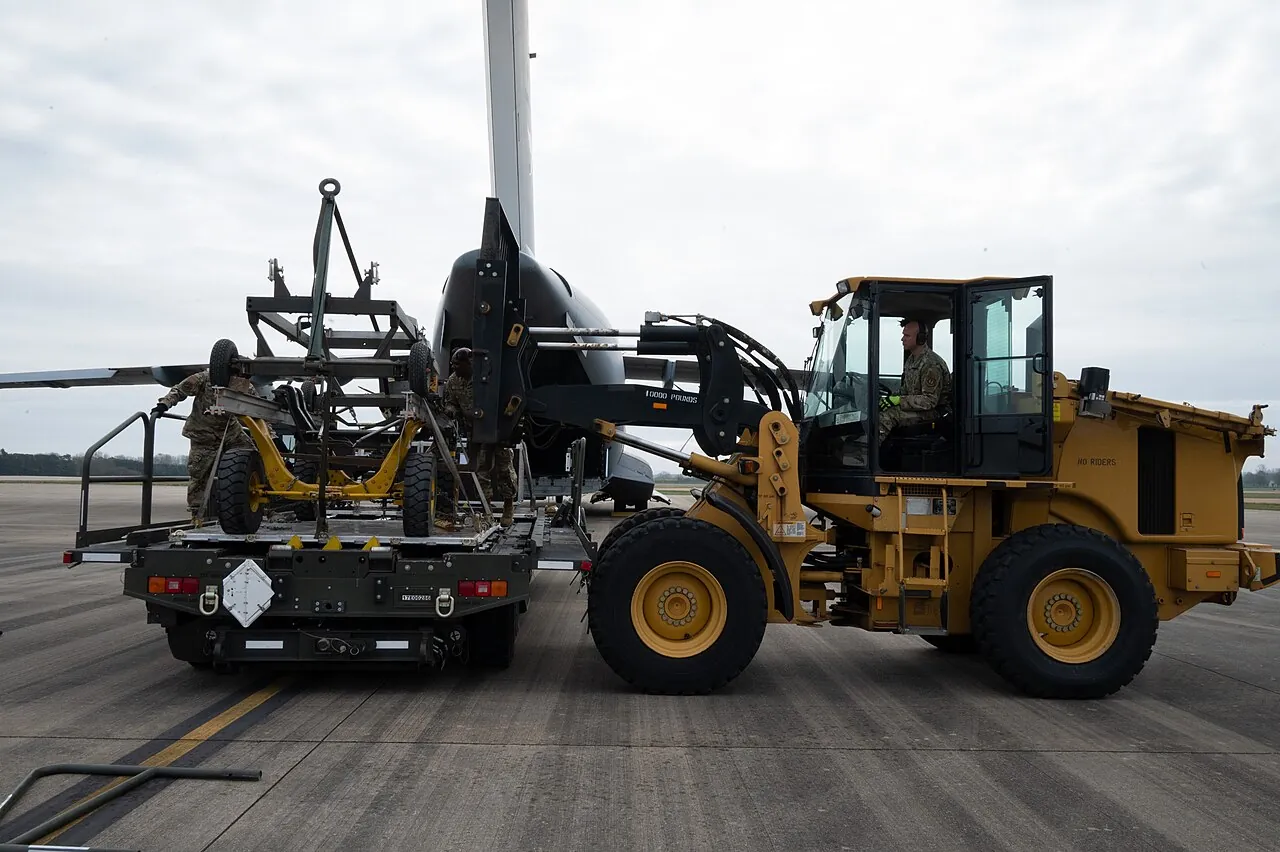
The Royal Air Force has been landing an A400M Atlas on grass in Poland. Crews from 70 Squadron trained at Powidz alongside Polish Air Force pilots, testing whether the alliance’s heavy tactical airlift can work away from the fixed airbases that Russian drone incursions have made look increasingly like fixed targets.
What was flown at Powidz
The RAF deployed a single Atlas C1 to Powidz. The programme covered four areas: tactical low-level flying, operations from grass runways, airdrops, and the movement of NATO partner vehicles.
The trials were run with Polish Air Force pilots. Wing Commander Doug Grove, Officer Commanding 70 Squadron, framed the purpose as giving crews practice on unprepared runways and reinforcing interoperability with NATO partners. Grove said the A400M “continues to prove its worth” by providing the agility to airlift large vehicles, supplies and troops to challenging locations, and remains a cornerstone of the Air Mobility Force.
Why grass matters
Military airlift has traditionally concentrated on a small number of large bases. The model is efficient because long paved runways, fuel farms and maintenance infrastructure are expensive to duplicate. It is also, for the same reason, predictable.
Events on NATO’s eastern flank have turned that predictability into a vulnerability. Repeated Russian drone incursions into Polish, German and Romanian airspace have hardened the assumption that fixed bases sit at the top of any target list. The response being developed is dispersal: spreading aircraft across many small and temporary locations before a conflict starts.
Dispersal only works if the transport aircraft can follow. Fuel, munitions and ground crews travel by truck up to a point, and by air beyond it. Operating from grass, dirt and semi-prepared surfaces is the link that makes the rest of the concept viable.
What the A400M brings
The A400M was designed from the outset for unprepared surfaces. Its high wing, six-bladed TP400-D6 turboprops and multi-wheel landing gear layout let it spread weight across soft ground.
Its real claim in this category is combining the runway flexibility of a C-130-class tactical transport with something closer to strategic lift capacity. Putting armoured-vehicle-class loads onto an unprepared strip fills a gap the C-130 cannot carry and the C-17 cannot always reach.
That is why including vehicle movement in the Powidz programme matters. The scenario rehearsed repeatedly in NATO exercises is moving allied armoured vehicles between countries on short notice, by air.
The alliance dimension
The A400M is flown by a broad group of NATO members, including Germany, France, Spain, Belgium, Luxembourg, the United Kingdom and Türkiye. Operating the same aircraft to the same procedures across national fleets is one of the more concrete forms interoperability takes.
Powidz pushes that a step further. British crews working from Polish strips with Polish pilots turns an abstract question, whose aircraft flies from whose airfield in a crisis, into a rehearsed procedure.
The Turkish angle
The Turkish Air Force operates the same capability set. Türkiye uses its A400M fleet not only for military lift but for earthquake and disaster response and humanitarian operations, much of which already takes place on damaged or marginal airstrips.
Standardising unprepared-surface procedures across NATO therefore has direct value for Türkiye, both in alliance taskings and in its own regional relief operations. Türkiye is also an industrial partner in the programme, with TUSAŞ producing sections of the aircraft’s airframe.
Where dispersal fits in NATO doctrine
The concept behind the Powidz trials is discussed in NATO literature as agile combat employment. The idea is straightforward: instead of concentrating air power at a few large bases, spread it across many small sites and move frequently between them.
Its origin is the Pacific. The US Air Force developed the model after accepting that large bases such as Guam are vulnerable to Chinese long-range missile capability. The war in Ukraine demonstrated that the same logic applies to Europe.
Dispersal carries a cost. Every additional operating location needs fuel, munitions, ground equipment and communications. Logistical complexity rises in direct proportion to the number of sites. The concept therefore succeeds or fails less on how quickly fighters relocate than on how quickly transport aircraft can reach the new site.
That is precisely the link being tested at Powidz. An A400M able to operate from grass is the only category of aircraft that can build the logistical spine of a dispersed posture.
Sources
- Royal Air Force official statement on 70 Squadron’s deployment to Powidz
- Wing Commander Doug Grove, Officer Commanding 70 Squadron
- Defence Industry Europe, RAF A400M grass-runway trials, 13 September 2026