North Korea Commissions Second Choe Hyon-Class Destroyer Kang Kon

North Korea formally commissioned its second Choe Hyon-class guided-missile destroyer, Kang Kon, at a ceremony in the eastern port of Wonsan on September 6, 2026. The roughly 5,000-ton warship marks one of Pyongyang’s most significant naval expansion steps in years.
At a Glance
- Ship name Kang Kon, pennant number 52; class name Choe Hyon
- Commissioned September 6, 2026, in Wonsan; Kim Jong Un attended the ceremony
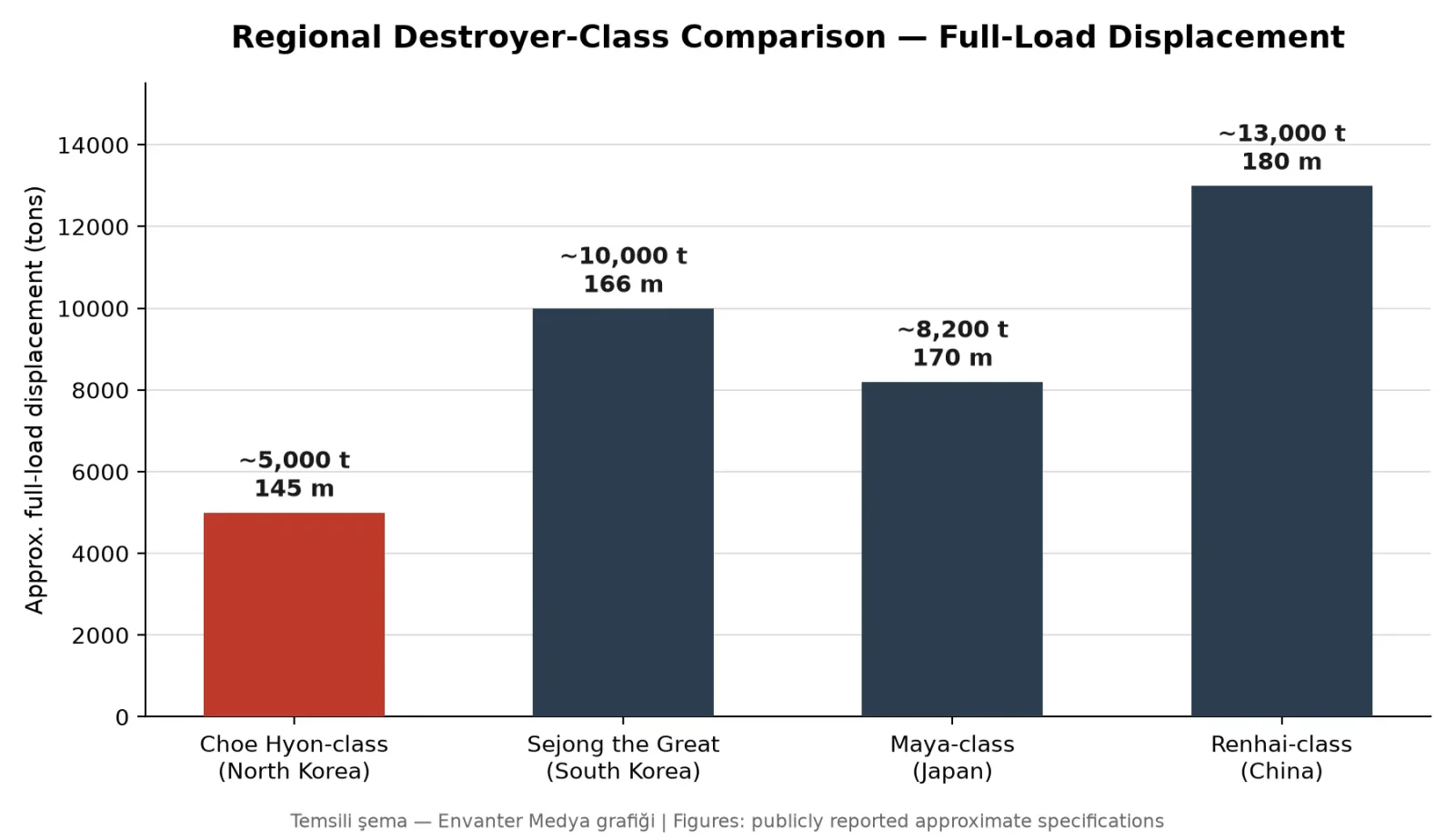
- Roughly 5,000 tons full-load displacement, 145 meters in length
- 88-cell vertical launch system across five configurations, 8 inclined missile launchers, a 127mm bow gun
- Two 6-barrel 30mm close-in weapon systems (resembling China’s Type 730) and a Pantsir-M-type air-defense system
- Two 533mm torpedo tubes, four fixed-face phased-array radar panels
- Lead ship Choe Hyon was commissioned June 23, 2026 in Nampho; two more hulls are under construction
Background
North Korea’s navy has historically consisted of small corvettes, fast attack craft, and submarines. The Choe Hyon class represents a sharp break from that pattern: a 5,000-ton hull, dense vertical-launch capacity, and an integrated air-defense suite signal an attempt to approach the mid-tier destroyer classes fielded by neighboring navies. Kang Kon’s path to service was not smooth — the vessel capsized during a botched launch at Chongjin Shipyard in May 2025, before being refloated and repaired. Roughly sixteen months later, its commissioning carries both technical and propaganda weight for Pyongyang. Kim Jong Un described the ship as part of the country’s “nuclear counteraction system,” though there is no independent confirmation that the VLS cells are configured to carry nuclear-armed missiles. North Korea is reportedly racing to complete a third Choe Hyon-class hull in time for October 10, the anniversary of the ruling Workers’ Party’s founding.
Regional Impact
There is no direct link to Turkey in this development, but the leap in North Korean naval capability carries implications for the wider Northeast Asian balance. Compared with South Korea’s roughly 10,000-ton Sejong the Great-class Aegis destroyers and Japan’s 8,200-ton Maya class, the Choe Hyon class remains smaller and technologically behind — yet it is still expected to factor into Seoul’s and Tokyo’s missile-defense planning. NATO members are closely watching the pace of North Korea’s warship development and any technology transfers, particularly in the context of its deepening ties with Russia, a topic that increasingly features in broader defense-industrial and intelligence-sharing discussions.
FAQ
Can Kang Kon actually carry nuclear weapons?
North Korean state media described the ship as part of a “nuclear counteraction system,” but there is no independent verification that its VLS cells are configured for nuclear-armed missiles — the claim currently rests on Pyongyang’s own statements.
Had the ship been involved in an accident before?
Yes. Kang Kon capsized during launch at Chongjin Shipyard in May 2025, was refloated and repaired, and entered service roughly sixteen months later.
How many ships of the class are planned in total?
Two ships (Choe Hyon and Kang Kon) are now in service, with two more under construction. North Korea has also signaled plans for larger guided-missile cruisers.