MBDA and Safran Form Joint Venture to Build France’s THUNDART Rocket Artillery

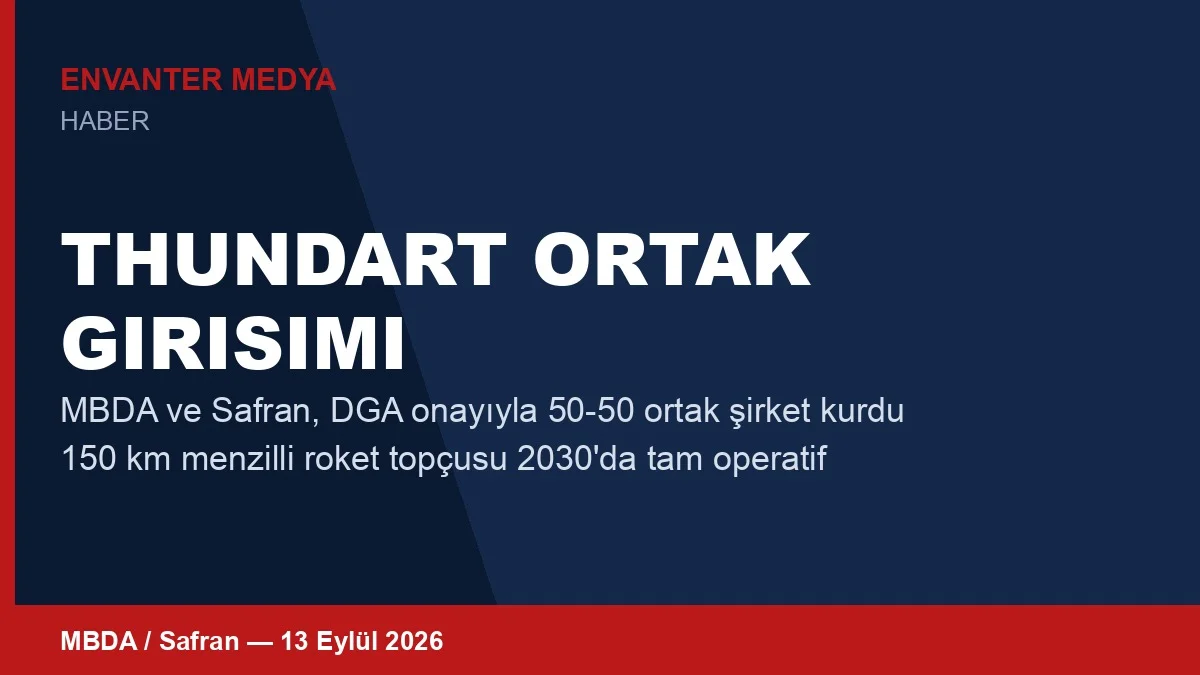
France has turned a procurement decision into a corporate structure. MBDA and Safran Electronics & Defense have formed a 50-50 joint venture to develop and build THUNDART, the guided rocket artillery system chosen to replace the French Army’s ageing LRU launchers. The announcement followed programme approval by the French procurement agency DGA and was made public on 13 September 2026.
What the joint venture looks like
The new company is an equal partnership between two of France’s largest defence groups and will operate from the Paris region. It starts with several dozen engineers, a team tasked with carrying THUNDART from demonstration into series production and managing later block upgrades.
The split of work follows each partner’s existing strengths. MBDA brings the missile airframe, warhead and launch chain. Safran Electronics & Defense brings navigation, inertial measurement and guidance electronics. The venture will also own future modifications of the system, including those intended for export customers.
Production stays in France. The stated objective is full operational autonomy for the French armed forces in long-range land strike by 2030.
The system itself
THUNDART is France’s answer to its Frappe Longue Portée-Terrestre requirement. The system fires guided missiles against ground targets out to roughly 150 kilometres. The launcher carries eight missiles in two containers, keeping the container logic familiar from the MLRS family while shifting the emphasis from volume of fire to precision per round.
A demonstration launch in April 2026 validated the flight profile and guidance chain, clearing the path to the DGA decision that has now been taken.
What THUNDART replaces is the LRU, or Lance-Roquettes Unitaire, the French configuration of the American M270 MLRS. The fleet was always small, part of it was transferred to Ukraine, and what remains is nearing the end of its service life.
Why not HIMARS
France announced in June 2026 that it would take the domestic route rather than buy HIMARS. Cost was not the deciding argument.
In long-range guided munitions, the supply chain, the software update path and control of targeting data determine how freely a weapon can actually be used. The war in Ukraine made that concrete: stockpiles tied to export licences and to a producing country’s political calculations can become constrained quickly. The debate across European capitals over munitions without usage restrictions is the backdrop to the THUNDART decision.
Creating a dedicated joint venture hardwires that political choice into industrial structure. Tying the programme to a jointly owned company rather than to a single prime is meant to keep the engineering workforce and the intellectual property under one roof for the life of the system.
A crowded European field
THUNDART is one of several parallel European efforts. Euro-PULS and related offerings in Germany and the United Kingdom, the Homar-A and Homar-K lines in Poland, and the arrival of South Korea’s Chunmoo in Europe all target the same gap. Demand generated across the continent after 2022 exceeds what American production lines can absorb.
THUNDART’s distinguishing feature is that the missile is matched from the outset to a French guidance and navigation chain. The system is being designed to work with reduced dependence on satellite navigation, and Safran’s inertial product family is the technical spine of the partnership.
The view from Türkiye
The path France is taking closely resembles one Türkiye has followed for roughly two decades. ROKETSAN’s TRG-300 KAPLAN and TRLG-230 families were built on precisely the same logic of pairing a rocket with a domestically developed guidance kit, and Türkiye moved that capability into the export market during the 2020s.
Europe’s turn toward domestic solutions cuts two ways for Turkish manufacturers. It sharpens competition in a market where localisation is now a political preference in its own right. At the same time, the number of suppliers with proven guided rocket artillery, mature series production and short delivery timelines remains small. In a period when stockpile depth has become the binding constraint across NATO inventories, that second point may matter more.
Sources
- Militarnyi, “MBDA and Safran to Establish Joint Venture for THUNDART MLRS Production”, 13 September 2026
- French Directorate General of Armament (DGA) programme approval
- MBDA and Safran Electronics & Defense corporate statements