M829A4 vs DM73: The Most Advanced 120mm APFSDS Tank Rounds Compared

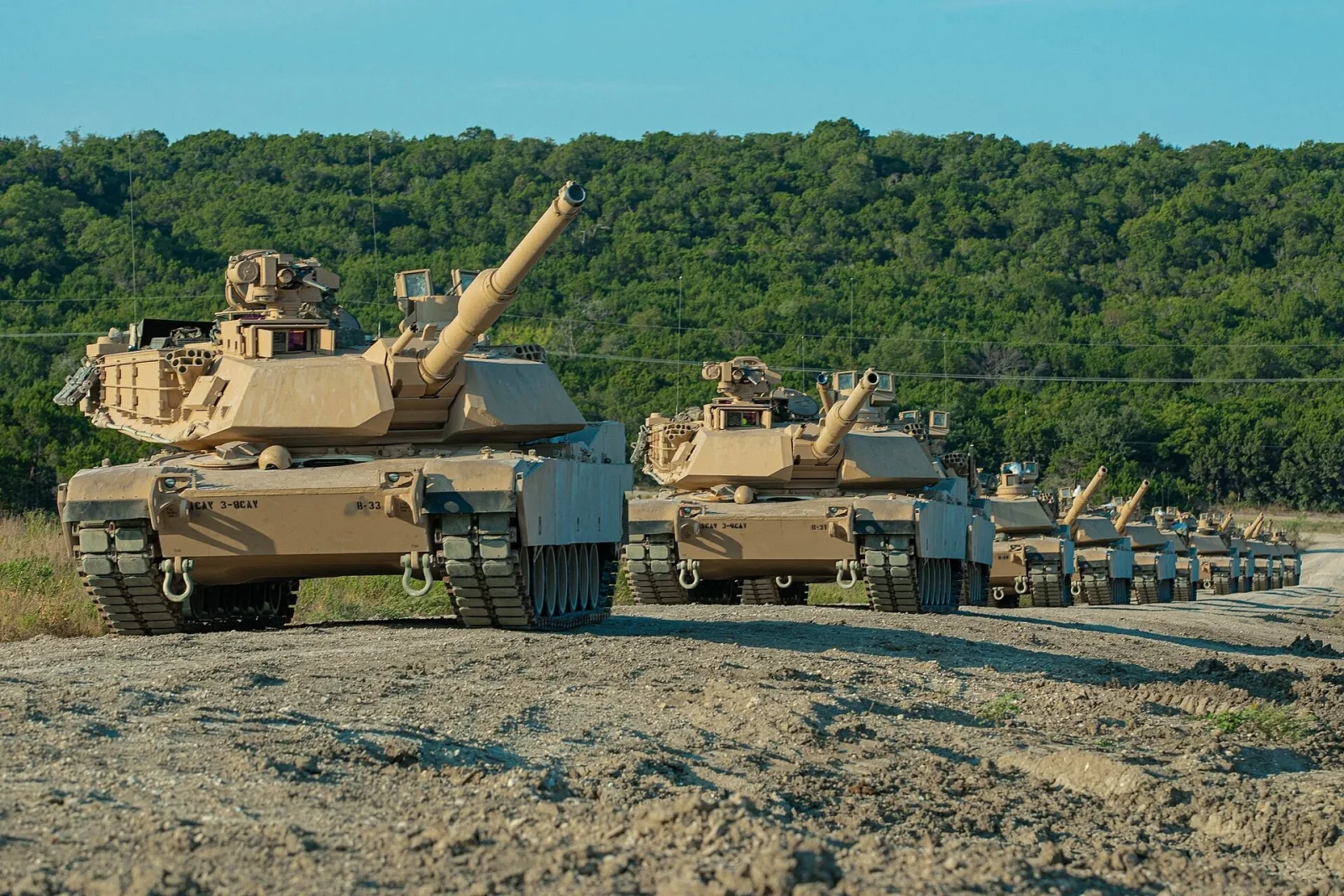
The US M829A4 and the German DM73 are the two most advanced 120 mm APFSDS (armour-piercing fin-stabilised discarding sabot) tank rounds in Western service. Both are long-rod kinetic penetrators fired at very high speed, and both were developed to defeat modern armour fitted with explosive reactive armour. They differ in penetrator material, sabot design, fire-control integration and the guns they are built for. The M829A4 uses depleted uranium and needs the Abrams SEPv3’s data link. The DM73 uses tungsten and is built for Rheinmetall’s longer L55A1 gun. This comparison uses only official programme and manufacturer data. If you are new to the topic, start with What is APFSDS ammunition?.
Key differences in brief
- M829A4 (USA): depleted-uranium long rod; three-petal composite sabot; Ammunition Data Link (ADL) rings; built for the M1A2 SEPv3 Abrams; made by ATK (now Northrop Grumman).
- DM73 (Germany): tungsten heavy-alloy penetrator; muzzle velocity of about 1,780 m/s; effective range up to 5,000 m; about 21 kg per round; for the Rheinmetall 120 mm L55A1 gun.
- Both are 120 x 570 mm NATO-standard smoothbore rounds designed against the newest reactive-armour-protected tanks.
What APFSDS is, in brief
An APFSDS round does not carry explosives. Its effect comes from kinetic energy: a long, thin dart-shaped penetrator made of a very dense metal travels at more than 1,500 m/s. A sabot (a “shoe” around the penetrator) seals the gun bore during firing and then falls away in petals after the muzzle. Fins at the rear stabilise the dart in flight. The longer and denser the rod, and the faster it travels, the deeper it penetrates.
M829A4: the Abrams’ newest “silver bullet”
The M829 family has been the US Army’s main 120 mm kinetic round since the 1980s; the M829A1 earned the nickname “Silver Bullet” in the 1991 Gulf War. According to the Pentagon’s Director, Operational Test and Evaluation (DOT&E), the M829A4:
- uses a depleted uranium (DU) long-rod penetrator;
- has a three-petal composite sabot and new propellant;
- has Ammunition Data Link (ADL) rings, so the tank’s fire-control system can send data to the round before firing;
- was designed to defeat advanced threat armour, including explosive reactive armour;
- is designed for the M1A2 SEPv3 Abrams, whose ADL-capable fire control is needed to use the round;
- was type-classified in October 2015, with a full-rate production decision in December 2015. The manufacturer was ATK.
The data link matters because the gun itself does not change. The Abrams keeps its 120 mm L/44 M256 gun, and performance gains come from the round and its integration with the tank’s systems. More on the tank in our M1 Abrams explainer.
DM73: Rheinmetall’s tungsten answer
Germany does not use depleted uranium, so Rheinmetall’s kinetic rounds rely on tungsten heavy alloy. The company says the DM73:
- reaches a muzzle velocity of about 1,780 m/s;
- has an effective range of up to 5,000 m;
- weighs about 21 kg per complete round;
- is designed for the 120 mm L55A1 smoothbore gun Rheinmetall’s high-pressure gun used on the UK’s Challenger 3 and the latest Leopard 2 versions. Rheinmetall says the DM73 cannot be fired from the older L44 or L55 guns.
- uses an enhanced propulsion unit based on Rheinmetall’s SCDB propellant technology, which gives it more range than earlier rounds.
DM73 continues a line that includes the DM53 and DM63. Rheinmetall says its 120 mm ammunition is used by more than 15 nations.
Side-by-side
| M829A4 | DM73 | |
|---|---|---|
| Country / maker | USA / ATK (Northrop Grumman) | Germany / Rheinmetall |
| Penetrator material | Depleted uranium | Tungsten heavy alloy |
| Sabot | Three-petal composite | Not specified in public data |
| Fire-control link | ADL rings (SEPv3 required) | None disclosed |
| Main gun | M256 120 mm L/44 (Abrams SEPv3) | Rheinmetall 120 mm L55A1 |
| Muzzle velocity | Not officially published | About 1,780 m/s |
| Effective range | Not officially published | Up to 5,000 m |
| Key milestone | Type classified October 2015; FRP December 2015 | Rheinmetall’s newest-generation APFSDS for the L55A1 |
Neither the US Army nor Rheinmetall publishes official armour-penetration figures, and estimates circulating online are not verifiable. That is why this table leaves those cells empty instead of guessing.
Depleted uranium vs tungsten
- Depleted uranium “self-sharpens” by shearing at the tip as it penetrates. A 2001 UK Parliament note, cited by Army Technology, put DU penetration 10–20% above tungsten, but DU raises health, environmental and political concerns.
- Tungsten alloy avoids those concerns and suits countries that do not want DU. To compete, it relies more on velocity and rod length, which is where the L55A1 gun helps.
Frequently asked questions
What does APFSDS stand for?
Armour-Piercing Fin-Stabilised Discarding Sabot: a kinetic-energy tank round with a dart penetrator and a sabot that falls away after firing.
Is the M829A4 made of depleted uranium?
Yes. DOT&E describes it as a depleted uranium long-rod penetrator.
Which gun fires the DM73?
Rheinmetall designed it for the 120 mm L55A1 smoothbore gun.
Can the M829A4 be fired by older Abrams?
The round is built for the SEPv3. Its full capability depends on the SEPv3’s ADL-capable fire-control system.