






L3Harris Wins $60M Contract for Ramjet Drone Interceptor


L3Harris Technologies announced on October 23 that it had received a three-year contract worth up to $60 million from the U.S. Army Combat Capabilities Development Command Aviation & Missile Center. The award funds development of a long-range interceptor under the Army’s Xtended Range Counter-sUAS Missile (XRC) program, aimed at engaging small and medium-size drones at distances beyond current short-range systems.
Scott Alexander, L3Harris’s president of Propulsion Systems within its Missile Solutions business, said the design combines “innovative propulsion with advanced seeker technologies” in what the company describes as a modular, cost-effective package. The interceptor relies on a solid-fueled, air-breathing ramjet engine that burns atmospheric oxygen rather than carrying its own oxidizer — a propulsion approach that can improve fuel efficiency and extend range compared with conventional rocket motors.
The program has advanced into its second phase, which involves flight-performance testing of a fully integrated interceptor. L3Harris’s release did not disclose a verified engagement range, a successful interception test, or an operational fielding date. The company says it is working toward compatibility with existing U.S. military launch platforms, though a final launcher configuration — and whether integration with a Stryker-mounted air-defense system is planned — remains unconfirmed.
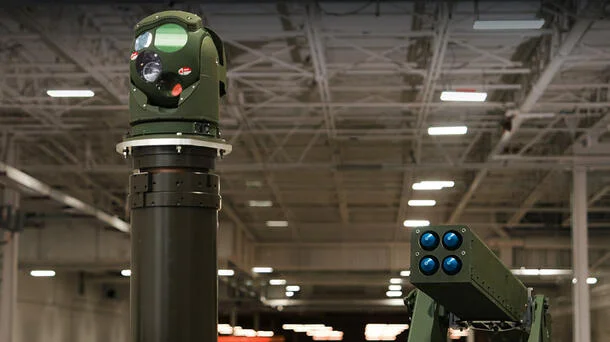
XRC is designed to close a range gap left by existing short-range counter-drone weapons. The infrared-guided Stinger missile remains an established close-range option, but no published data shows XRC will outrange or replace it. RTX’s Coyote family, which uses a rocket booster paired with a turbine engine in its Block 2 variant, competes in a similar niche; rocket-motor upgrades for Coyote are reportedly still in development. No independently verified comparison of range, reaction time, kill probability, or unit cost yet exists among the three systems.
Counter-drone defense has grown more urgent as reconnaissance drones increasingly locate troop positions and attack drones threaten both fixed installations and massed formations. But a longer-range interceptor is only as useful as the sensor and fire-control chain that detects and tracks low-flying, small, terrain-masked targets in the first place. L3Harris’s announcement does not address that integration challenge, which suggests the program’s real test will arrive with the radar and command systems meant to feed it, not with the missile’s propulsion alone.
The contract’s financial scope also sets a clear boundary: a $60 million ceiling funds development, not production, and offers no indication of how many missiles the Army might eventually buy. That positions XRC, for now, as a technology-maturation effort whose path to serial production depends on flight-test results and future budget decisions.
The announcement did not stand alone. The same month, L3Harris said it had delivered its first VAMPIRE counter-drone units to the Army and opened a new solid-rocket-motor facility to expand production capacity. Read together, the three announcements show a company scaling its counter-drone portfolio at both ends of the range spectrum — VAMPIRE already fielded, XRC still in prototype and flight testing, with a meaningful maturity gap between the two.
Seen against Turkey’s own pursuit of layered counter-UAS capability through systems such as KORKUT and Sungur, the XRC case illustrates that even a defense establishment with the U.S. Army’s resources is still working to close the mid-range counter-drone gap. A ramjet-powered interceptor not yet proven in U.S. service underscores how early-stage this particular competition remains.
Sources:
- L3Harris Technologies, “L3Harris Receives Contract to Develop Long-Range Drone Interceptor,” October 23, 2026 — https://www.l3harris.com/newsroom/press-release/2026/10/l3harris-receives-contract-develop-long-range-drone-interceptor — used for contract value, program name and technical description.
- Army Recognition, “L3Harris Develops New Long-Range Ramjet Missile for U.S. Army to Intercept Drones,” October 24, 2026 — https://www.armyrecognition.com/news/army-news/2026/l3harris-develops-new-long-range-ramjet-missile-for-u-s-army-to-intercept-drones — used for comparison with Stinger and Coyote and for the program’s disclosed limits.
