Houthis Claim Strikes on Riyadh and Yanbu: Rare Alert Reaches the Saudi Capital

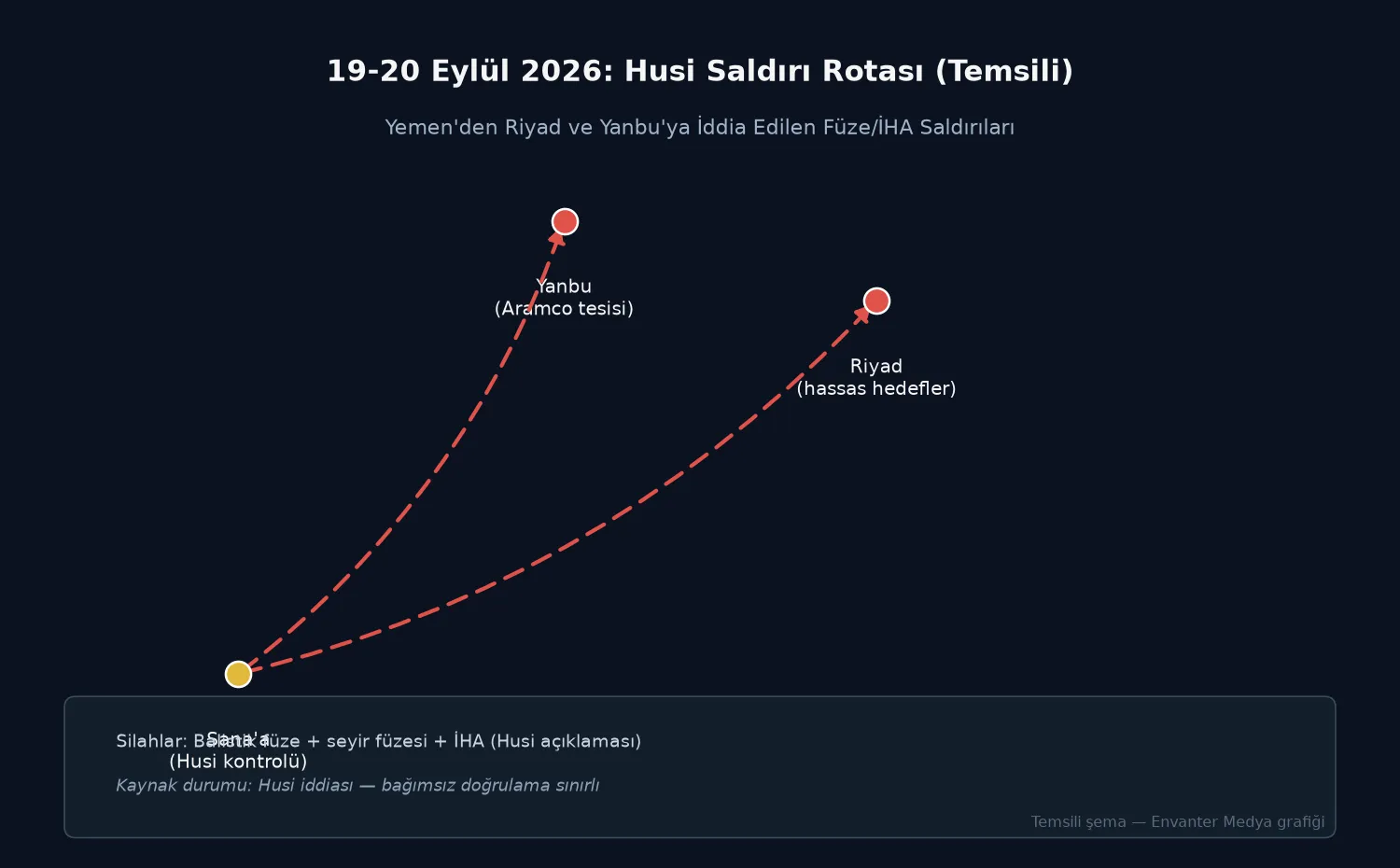
Yemen’s Houthi movement said on the night of September 19-20 that it struck “sensitive sites” in Riyadh and an Aramco facility in the Red Sea port city of Yanbu with a mix of ballistic missiles, cruise missiles and drones. Saudi Arabia’s capital experienced one of its rare direct air-raid alerts; a fire at an Aramco-branded fuel depot near King Khalid International Airport was extinguished by firefighters.
At a Glance
- Houthi military spokesman Yahya Saree announced two separate “special military operations” — one against sensitive sites in Riyadh, one against the Aramco facility in Yanbu.
- The group says it used a combination of ballistic missiles, cruise missiles and drones.
- Air-raid sirens sounded in Riyadh and Al-Kharj; Saudi authorities issued a “hostile aerial threat” warning overnight.
- A fire broke out at an Aramco-logo fuel depot near King Khalid International Airport and was extinguished; FlightRadar24 recorded temporary disruptions to air traffic.
- Status tag: Houthi claim, partially corroborated by Saudi alerts — an independent damage assessment and confirmed hit count have not yet been published.
Background
After hitting an Aramco refinery at Jizan in August, the Houthis have now escalated both geographically and symbolically: Yanbu is one of Saudi Arabia’s largest Red Sea export terminals and the western terminus of the East-West crude pipeline. The claimed strike on Riyadh marks the first time in this renewed campaign that the group has targeted the capital directly — a rare “capital alert” moment even by the standards of this multi-year conflict. Saree said the group would continue enforcing a “siege for siege, escalation for escalation” equation, tying the strikes to the ongoing naval blockade and wider war dynamics around Yemen. The attack lands on the tenth day of the US-Iran ceasefire, underscoring that regional tension continues along a separate axis — the Houthi-Saudi front — even as the Gulf’s other flashpoint cools. Saudi air-defense assets, including Patriot batteries, are understood to have engaged the incoming threats, though Riyadh has not yet issued an official interception tally.
Regional Impact
The strikes test the 14-nation, Saudi-led Bab el-Mandeb maritime security coalition — of which Türkiye is a founding member — precisely on the energy infrastructure it was built to protect. A wider or more frequent Houthi campaign against Red Sea and Gulf energy terminals would likely accelerate Gulf demand for layered air and missile defense, an area where Turkish firms (Baykar, Roketsan, Aselsan) have recently signed export agreements with Saudi Arabia. It also keeps Red Sea shipping-lane risk elevated, a variable that feeds into global energy prices and insurance costs well beyond the immediate parties.
FAQ
Did the strike actually reach Riyadh?
The Houthis claim it did, and Saudi authorities confirmed an air-threat warning and a fire near King Khalid International Airport; whether this was a direct hit or debris from an intercepted projectile remains unclear.
Was the Yanbu facility damaged?
No official damage assessment has been released as of this report.
Does this affect the US-Iran ceasefire?
The Houthi-Saudi front is a separate conflict track, though it signals continued regional escalation.
Sources
The Media Line, Kurdistan24, Xinhua (statements by Houthi military spokesman Yahya Saree), Middle East Monitor, FlightRadar24 — reporting dated September 19-20, 2026.