HD Hyundai and SIMA Peru Launch Landing Support Ship BAP Chimbote

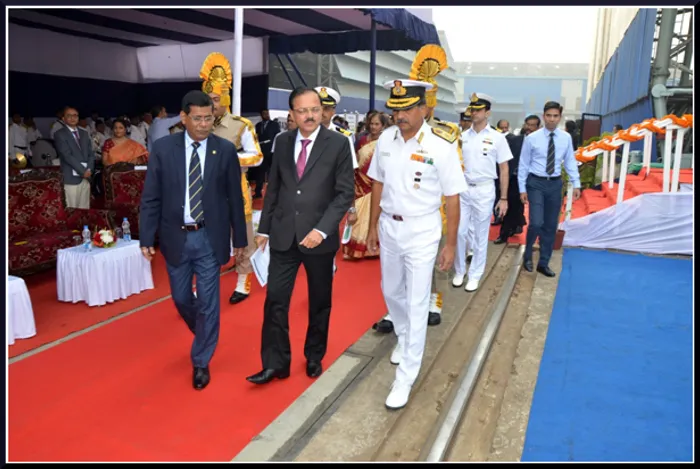
South Korea’s HD Hyundai Heavy Industries held the launch ceremony for the landing support ship Chimbote, built at Peru’s SIMA shipyard for the Peruvian Navy.
South Korean shipbuilding giant HD Hyundai Heavy Industries (HHI) held the launch ceremony for a new-generation landing support ship named “Chimbote,” built at Peru’s state shipyard SIMA, in August 2026. The event marked a tangible milestone in Peru’s naval modernization program.
The ceremony drew a high-level turnout: Peru’s president, Peruvian Navy Commander Federico Javier Bravo de Rueda, South Korea’s ambassador to Peru, and HD Hyundai Heavy Industries President Joo Won-ho all attended. The prominent guest list underscored the symbolic weight the project carries in the defense-industrial relationship between the two countries.
Chimbote is based on HHI’s HDL-1400 Landing Craft Utility design. Fully loaded, the vessel displaces roughly 1,646 tons, with a length of 58.9 meters and a beam of 13.2 meters, placing it in the mid-size class of amphibious and logistics support platforms. Ships in the series are traditionally named after major Peruvian port cities, and Chimbote continues that naming convention.
The ship is designed for personnel and cargo transport, logistics support, and disaster response missions. Given Peru’s extensive coastline and periodic exposure to natural disasters, multipurpose platforms of this kind are seen as carrying meaningful operational value.
The project traces back to April 2024, when HHI won a contract from the Peruvian Navy for four vessels in total: one frigate, one offshore patrol vessel, and two landing support ships. Under the agreement, HHI supplies the design, equipment and material package along with technical support, while the physical construction is carried out by SIMA with HHI’s assistance. All four ships are scheduled for delivery by 2029.
The collaboration model is being viewed as a turning point in South Korea’s naval export strategy. Where the traditional export model centered on delivering finished vessels abroad, this project shifts toward a local co-production and technical-partnership framework. Because this approach carries the potential for technology transfer and strengthened local shipyard capacity, it is being watched as a template HHI could apply to future overseas naval programs.
The launch of BAP Chimbote stands as a notable milestone in the Peruvian Navy’s fleet renewal process; the vessel will move on to fitting-out and delivery stages before beginning operational duties.
The division of labor between HHI and SIMA is itself notable: the South Korean firm supplies the design package, critical equipment and engineering know-how, while the physical assembly of the hull takes place on Peruvian soil, carried out by Peruvian labor. That structure allows the buyer nation to build up its own shipyard capabilities and gain hands-on construction experience, turning the project into more than a simple purchase and into a longer-term industrial partnership.
The fact that the four vessels span different classes and mission profiles broadens the program’s scope: the frigate is intended to anchor combat capability, the offshore patrol vessel supports continuous maritime surveillance, and the two landing support ships strengthen logistics and humanitarian-response capacity. This multi-role structure is designed to give the Peruvian Navy greater flexibility across both military and civilian maritime operations.
Sources
- Naval News, August 2026
- Korea Herald, August 2026
- Marine Insight, August 2026
- Asia Business Daily, August 2026
- Seoul Economic Daily, August 2026