GÜRDESAN Deck Cranes: Cargo, Service and Offshore Types

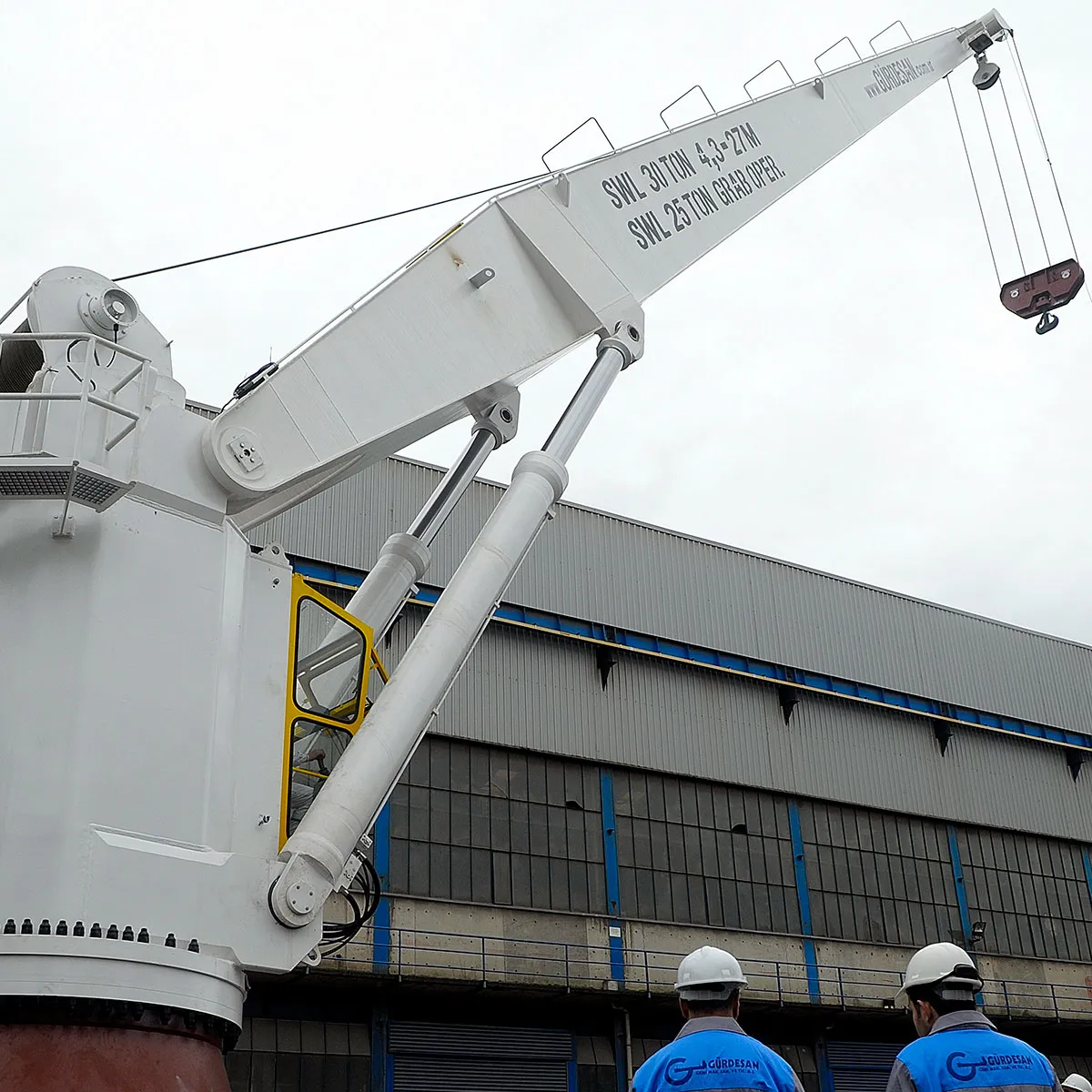
Quick answer: GÜRDESAN’s deck cranes are grouped under five sub-headings in the company’s official product catalogue: cargo cranes, service and provision cranes, hose cranes, heavy-lift and offshore platform cranes, and the travelling gantry hatch cover crane. The cranes are built with classification society approval for platforms ranging from dry cargo ships and tankers to offshore platforms and naval vessels.
Why does the crane product group matter?
A deck crane is the equipment that lets a ship handle its own cargo without depending on port infrastructure. GÜRDESAN states that it develops its cranes in-house from design through application, taking long service in heavy weather conditions as the design basis. Production follows ISO, DIN, BS and JIS standards and is certified with the approval of classification societies such as ABS, DNV, BV, RINA and Türk Loydu. The company’s general profile is covered in the What is GÜRDESAN? file.
Crane types
| Crane type | Task | Typical platform |
|---|---|---|
| Cargo crane | Hold cargo handling | Dry cargo and general cargo ships |
| Service and provision crane | Taking on stores, spare parts, crew supplies | All ship types |
| Hose crane | Lifting loading and discharge hoses | Tanker and terminal operations |
| Heavy-lift / offshore crane | Heavy components and platform supply | Offshore platforms, heavy-lift ships |
| Travelling gantry hatch cover crane | Moving pontoon-type hatch covers | Bulk carriers |
The company’s listing in the SSB industry catalogue also includes items such as an electro-hydraulic telescopic crane, a service crane, a stage crane suitable for carrying personnel, and an overhead vehicle crane. The technical capacity figures of these items (lifting tonnage, outreach) have not been officially published.
Offshore and heavy-lift side
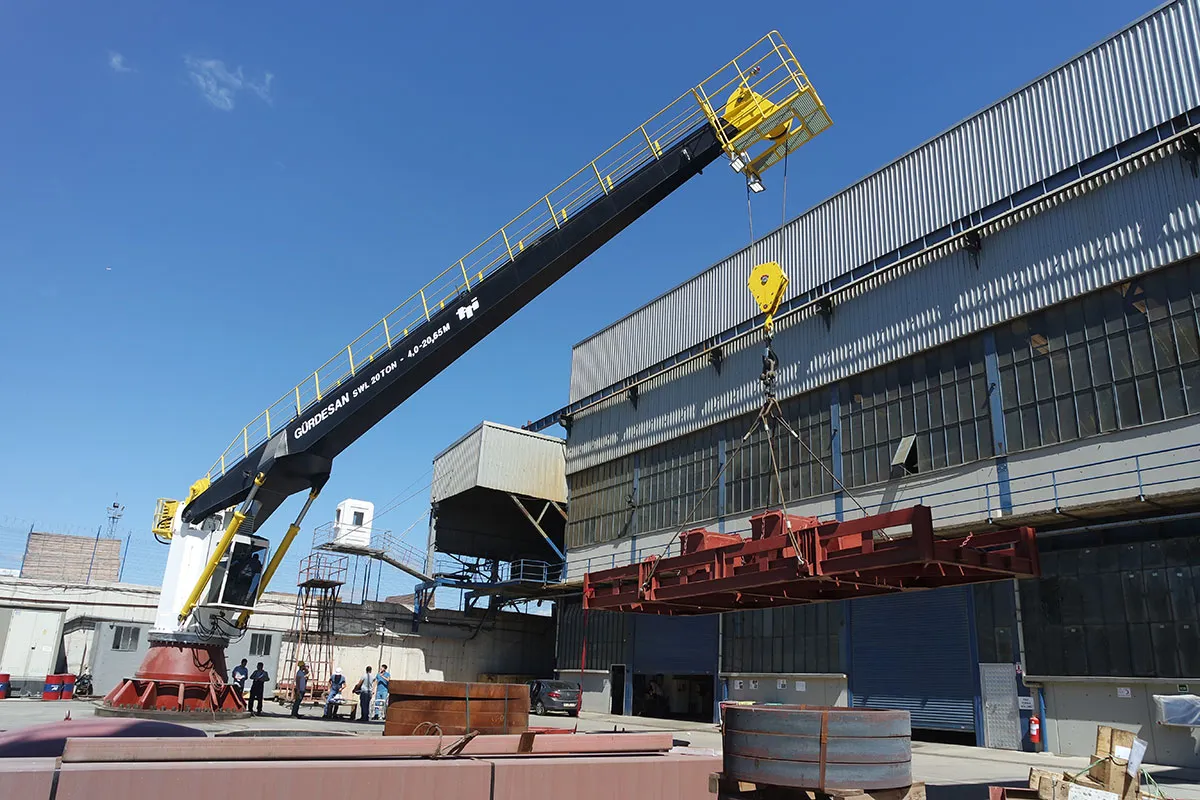
Offshore platform cranes form a separate heading in GÜRDESAN’s crane portfolio. Offshore applications demand resistance to the salt-water environment, load control despite platform motion and stricter safety standards. In this group the company also lists special fabrication work such as the jack-up barge alongside heavy-lift cranes. On the military side, the catalogue includes items such as the RHIB boat winch, spanwire winch and replenishment-at-sea winch, which overlap with boat launch and recovery systems.
Production and testing process
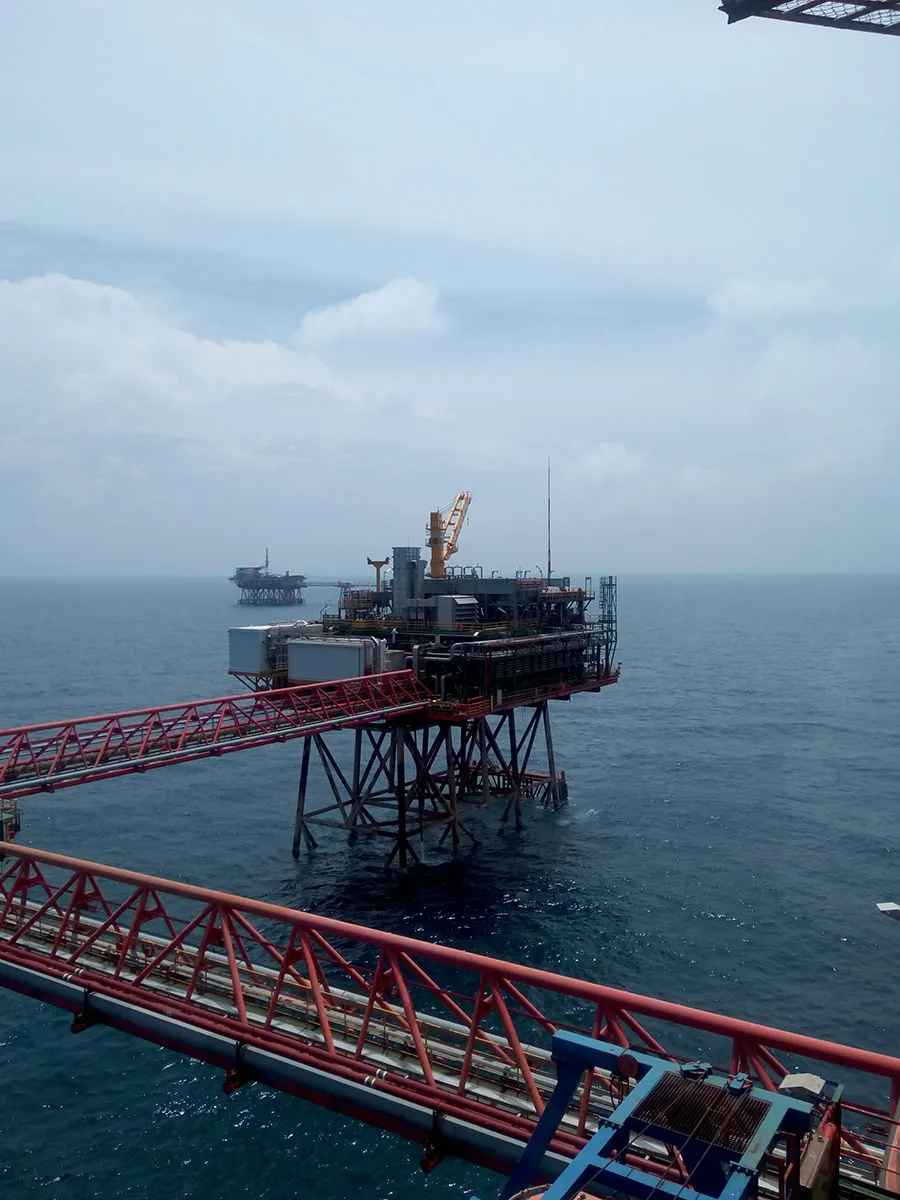
The official site states that quality control starts with raw material procurement and that welding and machining operations are carried out under classification society supervision. The company’s Gebze facilities include an accredited laboratory for mechanical and chemical material testing. Factory acceptance tests for the cranes cover the load test, brake test and safety cut-out checks. A comparison of GÜRDESAN cranes with foreign manufacturers is examined in a separate file.
What drives ship crane design?
Ship crane design differs from land cranes on two fundamental points. The first is platform motion: the crane must operate under the ship’s rolling and pitching, with load swing taken into account; on offshore cranes this requirement is even stricter, and additional equipment such as heave compensation comes into play. The second is the environment: salt water, frost and solar radiation determine the paint system, hydraulic oil selection and electrical protection classes. The “very long service in heavy weather conditions” emphasis on GÜRDESAN’s official site corresponds to these requirements. On the production side, a crane combines a welded steel boom and pedestal, machined shafts and gearing, and a hydraulic or electric drive package. In the factory acceptance test the crane is proof-loaded above its rated load, and brake holding and emergency lowering functions are verified; the framework for these tests is set by class rules. Because the rated loads and outreach of GÜRDESAN’s cranes are project-specific, this file does not give a per-type capacity table.
Frequently asked questions
Which crane types does GÜRDESAN produce?
Cargo, service-provision, hose and heavy-lift/offshore cranes plus the travelling gantry hatch cover crane are listed in the official catalogue; the SSB catalogue also lists telescopic and stage cranes.
To which standards are the cranes built?
According to the official site, production follows ISO, DIN, BS and JIS standards, with classification societies (ABS, DNV, BV, RINA, TL, LR) included in the approval process.
What are the cranes’ lifting capacities?
Per-product capacity tables have not been officially published; capacities are set project by project according to the customer specification.
Are cranes produced for naval vessels?
The company’s SSB industry catalogue listing includes items with military applications such as the RHIB boat winch, spanwire winch and vehicle cranes.
How do offshore cranes differ from ship cranes?
Offshore cranes are designed for platform motion, the salt-water environment and stricter safety requirements; ship cranes are sized mainly for cargo handling in port and seagoing conditions.
Sources and verification note
Product groups and process information were taken from the company’s official website; as capacity figures are not disclosed, no numerical claims were used. Accessed: August 13, 2026.
- https://www.gurdesan.com.tr/Kategori/Guverte-Kreynleri
- https://www.gurdesan.com.tr/Urun/Kargo-Kreynleri
- https://www.gurdesan.com.tr/Urun/Agir-Yuk-Kreyni-ve-Acik-Deniz-Platformu-Kreynleri
- https://www.gurdesan.com.tr/Urun/Hortum-Kreynleri
- https://www.gurdesan.com.tr/Sayfa/Hakkimizda
- https://www.sahaistanbul.org.tr/firma/gurdesan-gemi-mak-san-tic-a-s