Ghana’s Military Strength: How Many Tanks, Aircraft and Ships Are in the Inventory? (2026)

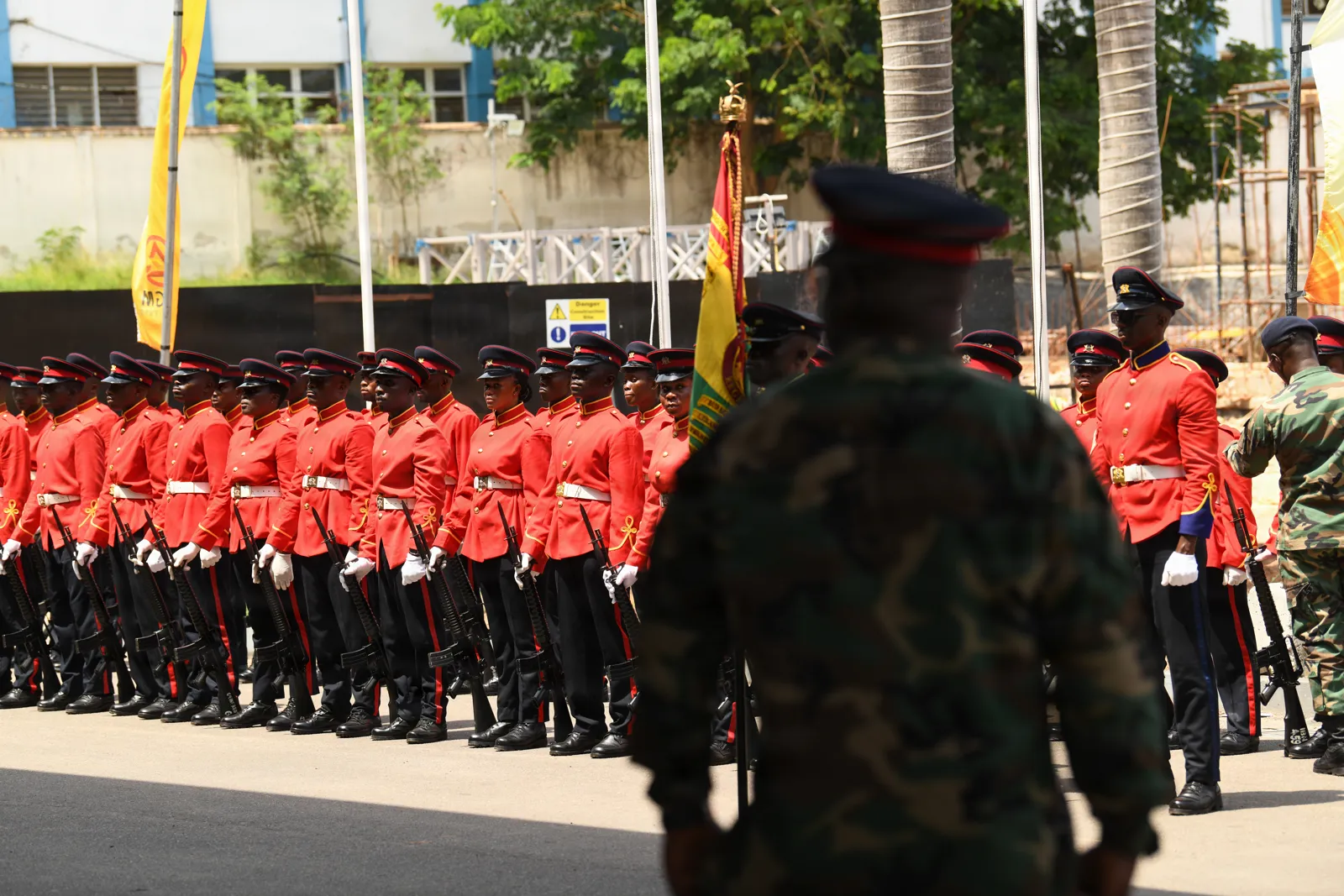
Ghana’s military inventory is, against the usual African pattern, that of a force built on lightness and sustainability rather than numbers and tonnage. The country has never operated a main battle tank since independence, its air force has never had a combat jet squadron and its navy has never held even a corvette. In exchange Ghana is one of the most durable contributors to United Nations peacekeeping, and in recent years the terrorist threat spilling out of the Sahel and the maritime security problem in the Gulf of Guinea have begun to shift the inventory’s direction quickly. One column of that shift already carries the Turkish defence industry: the second most numerous armoured class in service, 73 Otokar Cobra and Cobra II vehicles.
At a Glance
- Active personnel: ≈ 15,500 (Global Firepower 2026); a 12,000-strong recruitment programme is under way over four years
- Main battle tanks: None — there is not a single tank in the inventory
- Military aircraft (total): ≈ 18, of which 10 are airworthy; the fighter count is zero
- Armoured vehicles: ≈ 3,648 (broad definition); the two largest classes are 82 WZ-523 and 73 Otokar Cobra
- Navy: ≈ 20 platforms, all patrol-class; the largest ship is the 65.4-metre GNS Achimota
- GFP ranking: 112th among 145 militaries (PwrIndx 2.4566)
Note: The inventory figures below are approximate values drawn from open sources such as Global Firepower, the IISS Military Balance and SIPRI.
About the Ghana Armed Forces
The Ghana Armed Forces (GAF) comprise the Army, the Air Force and the Navy, headquartered at Burma Camp in Accra. In Global Firepower’s 2026 assessment the country ranks 112th among 145 militaries; total active personnel stand at roughly 15,500 — smaller than most of its West African neighbours, but a comparatively well-trained force. There is no conscription; the force is entirely professional.
The Army is divided into three regional commands: Northern, Central and Southern. At the core of the structure sit six infantry battalions of the Ghana Regiment, the 153 Armoured Regiment, the 66 Artillery Regiment, a Special Operations Brigade, airborne companies and two engineer regiments. The 64th Infantry Regiment, dedicated to counter-terrorism, is regarded as the country’s best-equipped unit.
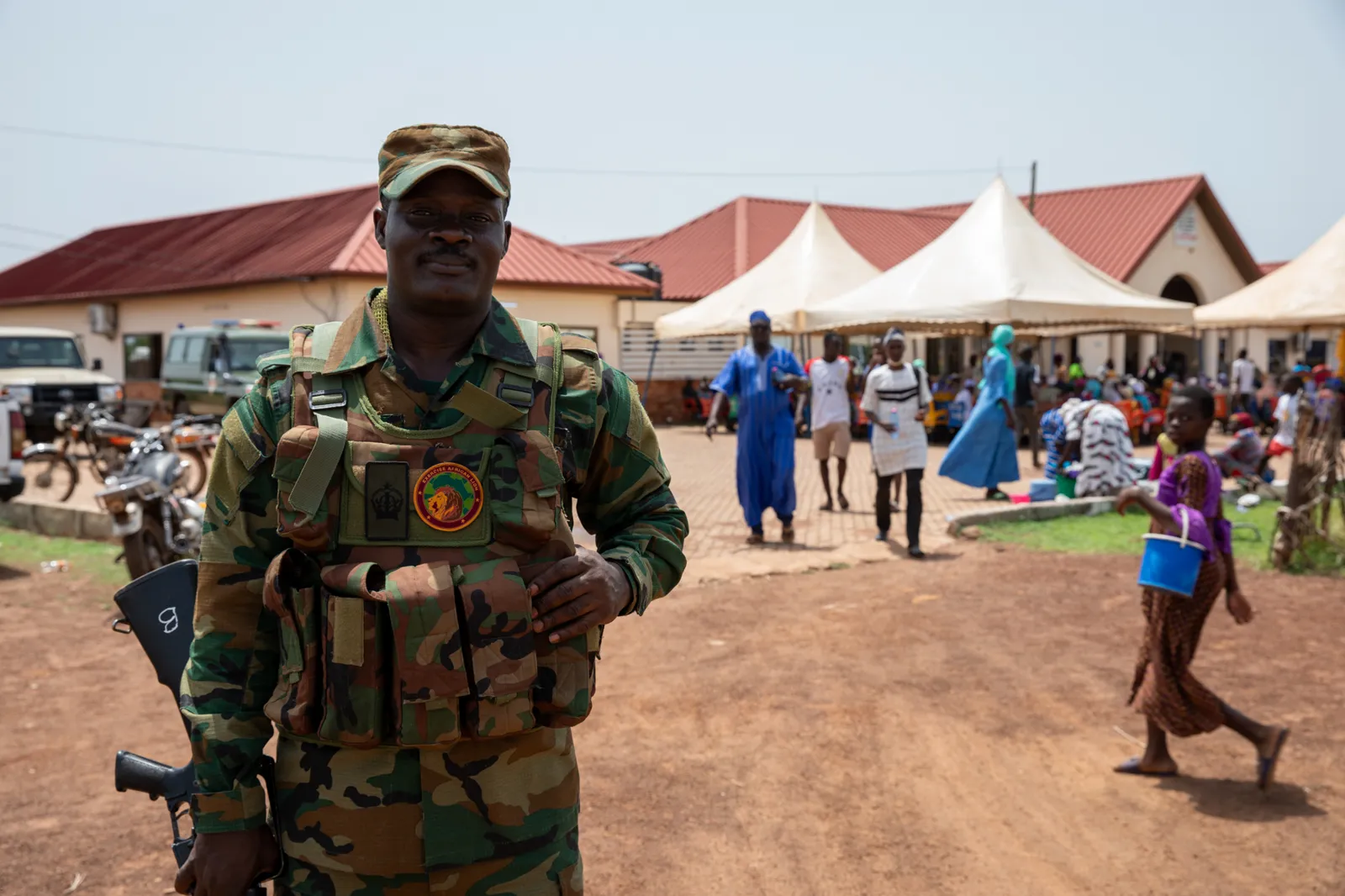
The most striking feature of the inventory is the absence of heavy platforms. Ghana holds not a single main battle tank, and the self-propelled howitzer column is empty as well. The ceiling of land firepower is set by 24 South African-built Ratel-90s, six D-30 howitzers and six rocket launchers. The wheeled armoured fleet, by contrast, is broad by West African standards: 82 WZ-523, 73 Otokar Cobra and Cobra II, 70 MXT-MV Husky, 63 Mowag Piranha I, 50 STREIT Typhoon, 20 Alvis Tactica, 20 Maverick, 19 Terrex AV-81 and 11 Guarani are on the books. This vehicle-heavy shape is no accident; for decades the Ghanaian military has been structured mainly for peacekeeping, internal security and border patrol.
The supply sources reflect that diversity. Platforms of Chinese, Turkish, Swiss, South African, Brazilian, British, Singaporean, Emirati, Russian and Finnish origin sit side by side in the same inventory. At a ceremony in Accra on 1 February 2023, then-President Nana Akufo-Addo handed 175 vehicles to the armed forces: 70 Kamaz trucks, 20 BTR-70 armoured personnel carriers, 20 Husky tactical support vehicles and 65 Toyota utility vehicles. Some went to Operation Gongong on the northern border, while others were painted in United Nations colours and sent to the UNISFA mission in Sudan.
The Air Force is the weakest link in the inventory. The service, based at Accra, Takoradi and Tamale, has 18 aircraft on the books; Global Firepower counts only 10 of them as airworthy. The fighter and attack columns are empty altogether. The only jet platform that can be armed is a set of four Chinese-built K-8 Karakorum trainers. The rest comprises two CASA C-295 transports, Diamond DA42/DA40 reconnaissance and training aircraft, five Mi-17/171s, one Bell 412 and Harbin Z-9 helicopters. The Ghana Air Force has been interested in the Embraer A-29 Super Tucano light attack aircraft since 2015; a flying and static demonstration was held at Air Force Base Accra on 19 February 2024, but no contract has followed. A Czech L-39NG acquisition stalled in 2024.
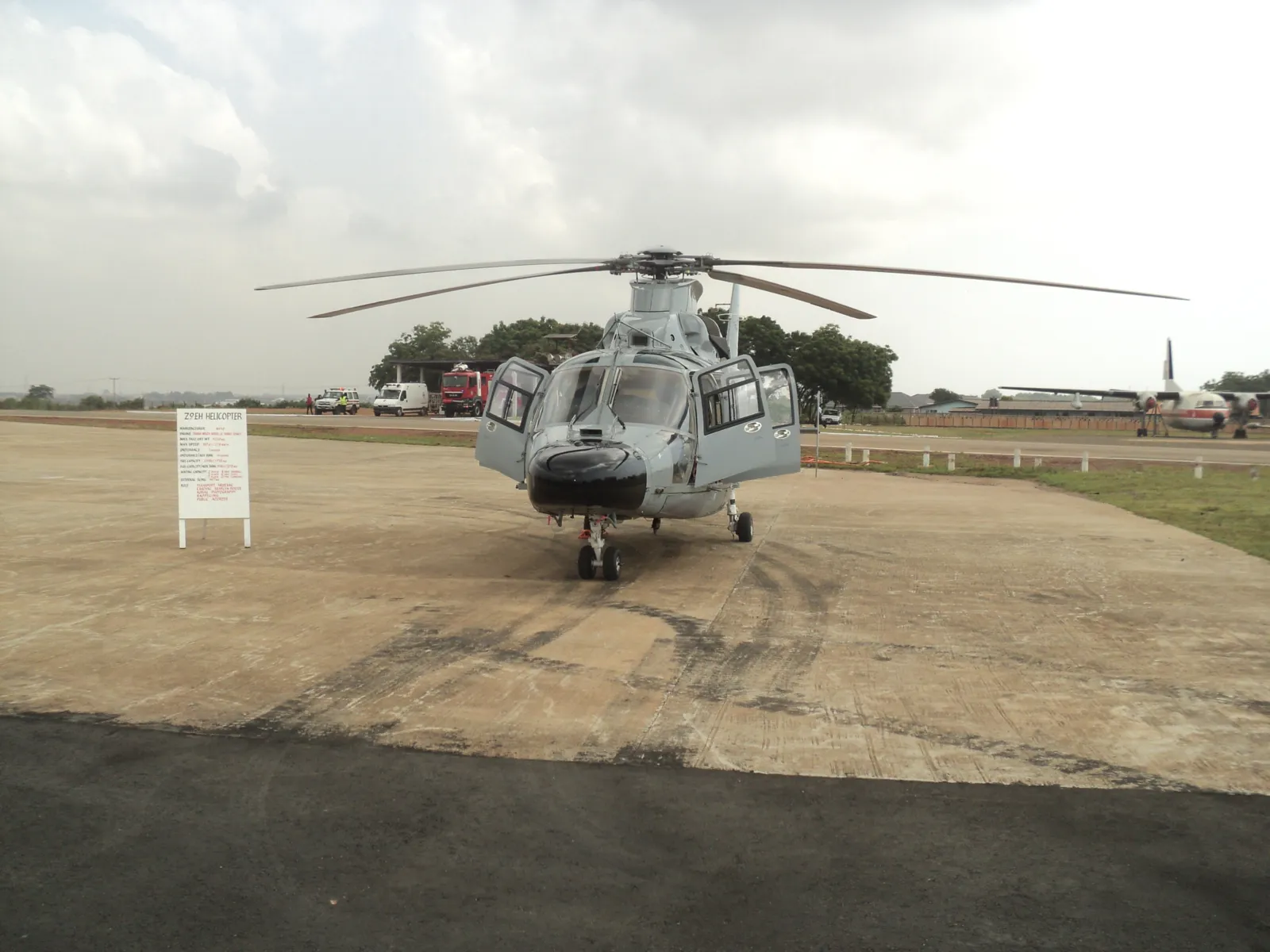
6 August 2025 was the heaviest day in the history of the Ghana Air Force. A Harbin Z-9EH flying from Accra to Obuasi for an anti-illegal-mining event crashed at Akrofuom in the Ashanti Region; Defence Minister Edward Omane Boamah, Environment Minister Ibrahim Murtala Muhammed and six others were killed. The crash pushed fleet age and sustainment to the top of the national agenda, and on 15 January 2026 the Ministry of Defence announced a contract with Airbus Helicopters for four aircraft — two military H175Ms, one ACH175 and one ACH160.
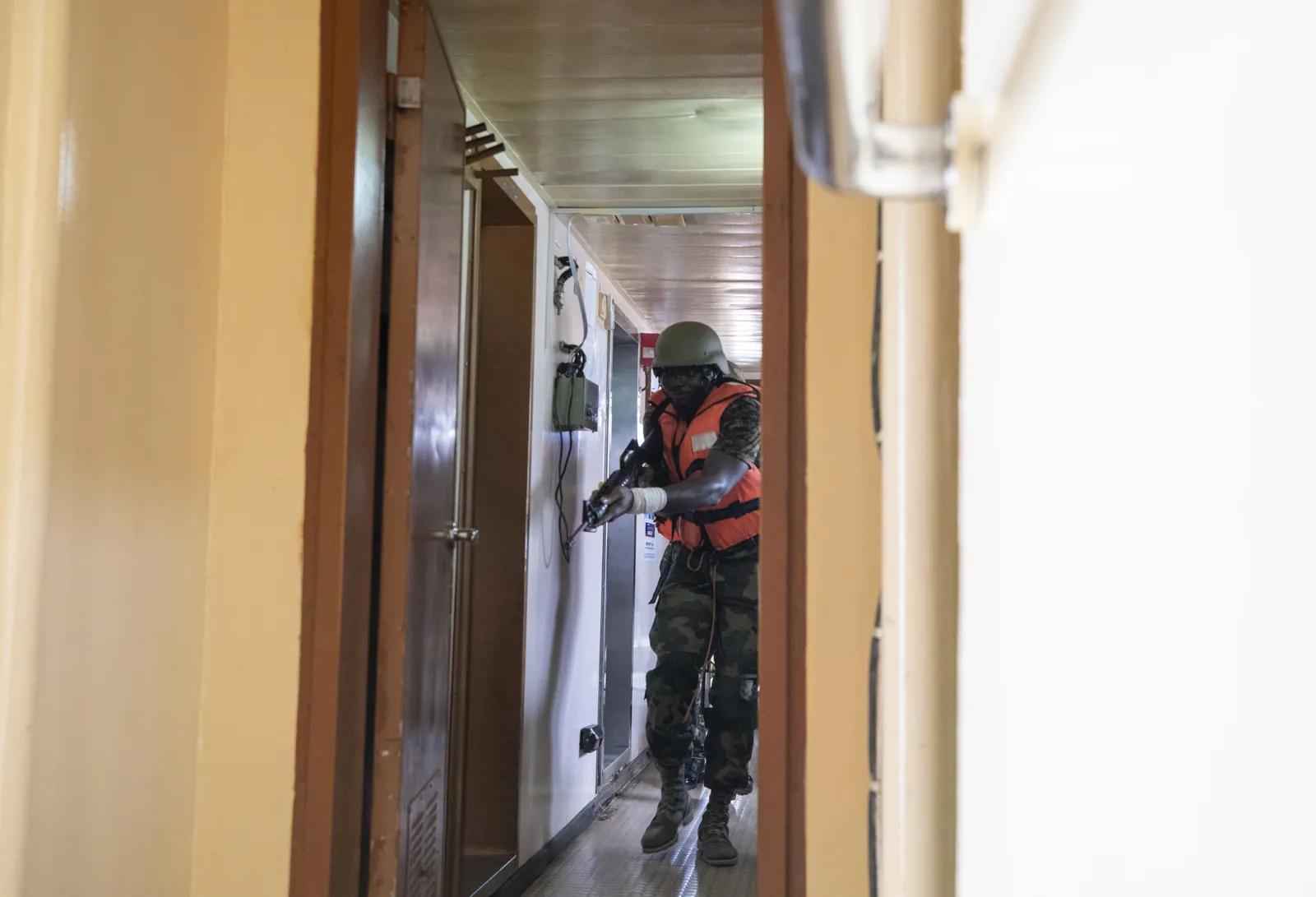
The Navy is charged with protecting some 550 kilometres of coast, the exclusive economic zone and the oil and gas platforms in the Gulf of Guinea. Split into Western (Sekondi), Eastern (Tema) and Training (Sogakope) commands, it fields around 20 platforms, all of them patrol-class: four Chinese-built Snake-class ships, four Albatros- and Gepard-class fast attack craft taken over from the German Navy, two ex-US Coast Guard Balsam-class vessels and one Chamsuri transferred from South Korea. GNS Achimota, commissioned at Sekondi on 23 December 2024, became at 65.4 metres the largest ship in the navy’s history; built in 1999 at the Kurinoura yard in Japan, it had previously served with the Japanese Fisheries Agency.
Two threats define Ghana’s defence policy today. The first is the northern border: the spread of jihadist movements from Burkina Faso towards the coastal states of West Africa has made a permanent military presence in the Upper East and Northern regions unavoidable. The second is maritime security: the Gulf of Guinea has for years been among the world’s most piracy-prone waters, and Ghana’s offshore oil production sits directly inside that risk. The programme President John Mahama announced in his State of the Nation Address on 27 February 2026 was framed around these two headings: 12,000 recruits over four years, new barracks at Ajumako and Dambai, a forward operating base at Ezinlibo on the Western Maritime Corridor, the purchase of four helicopters and one jet, the renegotiation of a supplier credit signed in August 2020 for 19 armoured personnel carriers, and a shopping list that includes offshore patrol vessels, armoured vehicles, protective equipment, ammunition, unmanned aerial vehicles and communications systems.
The country is diversifying its defence partnerships at the same time. In March 2026 Ghana became the first African state to sign a Security and Defence Partnership with the European Union. Accra hosted the African Land Forces Summit (ALFS 2025) in April 2025, a leg of exercise African Lion 25 was run at Kumbungu in May 2025, and in May 2024 Takoradi hosted Obangame Express, the largest maritime security exercise in the Gulf of Guinea. The Ghanaian military also remains one of the steadiest contributors to United Nations missions, from UNIFIL in Lebanon to deployments in South Sudan and Abyei.
The defence budget varies widely by source. Global Firepower 2026 puts it at roughly $954 million, while independent compilations show a $290-360 million band for recent years. Ghana’s own 2026 budget documents give a defence allocation of 10.77 billion cedis. The gap stems largely from exchange rates, the scope of budget lines and whether pension payments are included; the figures should therefore be read as indicators of direction rather than absolutes.
Land Forces Inventory
| System type | Est. quantity |
|---|---|
| Main battle tanks | None; Ghana has never operated a tank since independence |
| Armoured fighting vehicles (Ratel-90, Ratel-20) | ≈ 39 (24 Ratel-90 + 15 Ratel-20); South African-sourced, the most heavily armed land vehicles in the inventory |
| Armoured reconnaissance vehicles (Mowag Piranha I, EE-9 Cascavel) | ≈ 66 (63 Piranha I, four with a 25 mm gun, plus 3 Cascavel) |
| Armoured personnel carriers (Otokar Cobra / Cobra II) | 73; Turkish-sourced, the second-largest armoured class in the inventory |
| Armoured personnel carriers (WZ-523, Terrex AV-81, Guarani, BTR-70) | ≈ 132 (82 WZ-523 + 19 Terrex/Sentinel II + 11 Guarani + 20 BTR-70) |
| Mine-resistant vehicles (STREIT Typhoon, Casspir) | ≈ 54 (50 Typhoon + 4 Casspir) |
| Tactical support vehicles (MXT-MV Husky, Tactica, Maverick, Sherpa Light) | ≈ 112 (70 Husky + 20 Tactica + 20 Maverick + 2 Sherpa) |
| Towed howitzers (D-30 122 mm) | 6; the self-propelled howitzer column is empty |
| Rocket artillery (Type 63, PHL-81) | 6 (3 Type 63 + 3 PHL-81); all Chinese-sourced |
| Mortars (Krh/40 81 mm) | ≈ 28; Finnish-sourced |
| Total armoured vehicles (GFP 2026, broad definition) | ≈ 3,648, of which 2,189 are counted as ready |
Air Force Inventory
| Platform | Est. quantity |
|---|---|
| Total military aircraft | ≈ 18; Global Firepower lists 10 as airworthy |
| Fighters and attack aircraft | None; the Ghana Air Force has no combat jet squadron |
| Jet trainers (Hongdu K-8 Karakorum) | 4; the only jet platform that can be armed, Chinese-sourced |
| Transport aircraft (CASA C-295) | 2; a Dassault Falcon 6X is also on order |
| Reconnaissance and training aircraft (Diamond DA42 / DA40) | ≈ 5 |
| Helicopters (total) | ≈ 9 (5 Mi-17/171 + 2-3 Harbin Z-9 + 1 Bell 412) |
| Attack helicopters | None in the inventory; one Mi-35 is on order |
| Helicopters on order (Airbus) | 4; a contract of 15 January 2026 covers 2 H175M plus 1 ACH175 and 1 ACH160 |
| Unmanned aerial vehicles | No operational platform in the inventory; drones feature on the procurement list announced in February 2026 |
| Air bases | Accra, Takoradi and Tamale |
Missile and Air-Defence Systems
| System | Type / Note |
|---|---|
| Long-range air-defence missiles | None in the inventory |
| Medium-range air-defence missiles | None in the inventory |
| Man-portable missiles (FN-6) | ≈ 100; Chinese-sourced, the newest layer of the air defence |
| Man-portable missiles (9K32 Strela-2) | ≈ 200; a 1960s-generation Soviet design |
| Anti-aircraft guns (ZPU-2, ZPU-4, ZU-23-2) | ≈ 10 pieces; this gun layer is the backbone of the air defence |
| Ballistic and cruise missiles | None in the inventory |
| Anti-ship and coastal defence missiles | None in the inventory |
Naval Power
| Class / Type | Est. quantity |
|---|---|
| Total naval platforms | ≈ 20 (Global Firepower 2026); all patrol-class |
| Largest ship (GNS Achimota, 65.4 m) | 1; a fisheries patrol vessel built in Japan in 1999, commissioned at Sekondi on 23 December 2024 |
| Patrol ships (Snake class) | 4; Chinese-built 46.8-metre craft, February 2012 |
| Fast attack craft (Albatros and Gepard classes) | 4; transferred from the German Navy (2010 and 2012) |
| Patrol ships (Balsam class, Chamsuri) | 3; ex-US Coast Guard (2001) and South Korean (2011) craft |
| Corvettes, frigates, submarines | None; the acquisition of offshore patrol vessels has been described as being at an advanced stage |
| Personnel and commands | ≈ 1,200-2,000; Western (Sekondi), Eastern (Tema) and Training (Sogakope) commands |
The Turkey Angle: Turkish Defence Industry
Unlike many countries in this series, Ghana is one where a Turkish defence product is actually in service. Open-source inventory compilations list 73 Otokar Cobra and Cobra II armoured vehicles with the Ghana Army. That makes it the second most numerous armoured class in the inventory after the 82 Chinese-built WZ-523s — meaning the Turkish vehicle is not a symbolic presence in the Ghanaian military but one of the load-bearing elements of its force structure.
The vehicles first appeared publicly during the Eagle Eye counter-terrorism exercise in Accra on 9 November 2019. Two Cobra IIs and two Cobras supported elements of the counter-terrorism 64th Infantry Regiment, the 153 Armoured Regiment and the Military Police. The Cobra IIs were armed with 12.7 mm FN M2 heavy machine guns and the Cobras with 7.62 mm FN MAGs; one vehicle carried an electro-optical sensor mounted at the rear of the hull. United Nations conventional arms records show Turkey exporting wheeled armoured personnel carriers to Ghana in 2018, with deliveries apparently continuing in stages from that date.
The diplomatic ground is far older. Turkey’s embassy in Accra opened in 1964, was closed in 1981 on cost grounds and was reactivated on 1 February 2010; Ghana opened its own embassy in Ankara in 2012. President Recep Tayyip Erdoğan paid an official visit to Ghana on 29 February – 1 March 2016, giving the bilateral relationship fresh momentum. Ghana’s foreign minister came to Turkey in January 2020, and the Turkish foreign minister made a first visit to Accra on 25-27 October 2022. The fifth session of the Joint Economic Commission was held in Turkey on 15-16 June 2022. The most recent contact came on 15 February 2026, when Ghana’s interior minister met his Turkish counterpart in Ankara on internal security, migration management and emergency response systems.
The economic base is not negligible either. In 2019 Ghana became Turkey’s third-largest trading partner in sub-Saharan Africa; bilateral trade reached $771 million in 2020 and stood at roughly $574 million in 2024 (Turkish exports ≈ $401 million, imports ≈ $173 million). The two sides aim to pass $1 billion by 2027. The new terminal of Kotoka International Airport in Accra was built by a Turkish contractor and was named the best terminal in West Africa. On the training side, Ghana is listed in open-source compilations among the African states holding military training cooperation agreements with Turkey.
One point is worth leaving explicit: there is no publicly announced comprehensive defence-industry framework agreement between Turkey and Ghana. What exists today is therefore not a broad procurement programme flowing from a framework, but a verifiable commercial relationship realised on a specific platform and open to expansion. For the Turkish defence industry the meaning is simple: the door is not closed — the product is already in the inventory and the user experience already exists.
Map the gaps in the inventory and they line up with the areas where the Turkish defence industry is strong. Air defence has no missile layer at all; the inventory amounts to anti-aircraft guns plus 1960s-generation Strela-2 and Chinese FN-6 shoulder-launched missiles. Roketsan’s SUNGUR is the direct counterpart of those ageing shoulder-launched rounds, while ASELSAN’s KORKUT is the modern equivalent of the gun layer. The combat jet column is empty and the air force has been looking for a light attack aircraft for a decade; TUSAŞ’s HÜRKUŞ-C and HÜRJET are positioned to enter as a new option in a Super Tucano-versus-L-39NG competition that has gone unresolved for years. There is no attack helicopter in the inventory at all, and the T129 ATAK is one of the known alternatives for that column. On unmanned aerial vehicles — explicitly named on the February 2026 shopping list — the Bayraktar TB2 and TUSAŞ ANKA are already in use with more than one country in West Africa. At sea, the patrol and offshore vessel classes exported by Turkish shipyards offer a precedent for the OPV requirement. In armoured vehicles the case is even more direct: the supplier credit for 19 armoured personnel carriers signed in August 2020 and now under renegotiation is a column in which Otokar, Nurol Makina and BMC are the natural interlocutors for a force that already runs 73 Cobras.
In short, Ghana is for the Turkish defence industry neither an untouched market nor a completed reference, but something in between — a file whose first step has already been taken. The modernisation programme that has accelerated over the past two years, the deliberate choice to diversify supply and the clearly defined gaps in the inventory all indicate that the file is not closed.
Frequently Asked Questions
How many tanks does Ghana have? None at all. Ghana is one of the few countries that has never held a main battle tank since independence; the tank column in Global Firepower’s 2026 list is zero. The ceiling of land firepower consists of 24 Ratel-90 armoured fighting vehicles with 90 mm guns, six D-30 towed howitzers and six rocket launchers. The wheeled armoured fleet, by contrast, is broad: 3,648 armoured vehicles are recorded under the broad definition, led by 82 WZ-523s, 73 Otokar Cobra/Cobra IIs, 70 Huskies, 63 Piranha Is and 50 Typhoons.
What combat aircraft does Ghana have? The Ghana Air Force has no fighter or attack aircraft. The only jet platform that can be armed is a set of four Chinese-built K-8 Karakorum trainers. The rest of the fleet consists of two CASA C-295 transports, Diamond DA42/DA40 reconnaissance and training aircraft, five Mi-17/171s, one Bell 412 and Harbin Z-9 helicopters. Of 18 aircraft in total, only 10 are counted as airworthy. The country has been interested in the A-29 Super Tucano light attack aircraft since 2015, but no contract has been signed.
Does Ghana have a navy? It does, but it is entirely patrol-class. The Ghana Navy, which protects roughly 550 kilometres of coast and the offshore oil platforms, fields around 20 platforms; there is no corvette, frigate or submarine. The core of the fleet is four Chinese-built Snake-class patrol ships, four fast attack craft taken over from Germany and ex-US and South Korean vessels. GNS Achimota, commissioned on 23 December 2024 at 65.4 metres, is the largest ship in the navy’s history. The acquisition of offshore patrol vessels has been described as being at an advanced stage.
What is Ghana’s air defence like? Ghana’s air defence has no missile layer. The inventory consists of ZPU-2, ZPU-4 and ZU-23-2 anti-aircraft guns together with roughly 100 Chinese FN-6 and 200 Soviet-generation 9K32 Strela-2 shoulder-launched missiles. The medium- and long-range air defence, ballistic missile, cruise missile and anti-ship missile columns are all empty. This is the most conspicuous structural gap in the inventory.
What has Ghana bought from the Turkish defence industry? According to open-source inventory compilations the Ghana Army holds 73 Otokar Cobra and Cobra II armoured vehicles, its second most numerous armoured class. The vehicles first appeared in public at the Eagle Eye counter-terrorism exercise in Accra on 9 November 2019, operated by elements of the 64th Infantry Regiment and the 153 Armoured Regiment. United Nations records show Turkey exporting wheeled armoured personnel carriers to Ghana in 2018. There is, however, no publicly announced comprehensive defence-industry framework agreement between the two countries.
Bottom Line
Ghana’s inventory reflects a choice not often seen in Africa: mobility instead of heavy platforms. A military with no tank, no fighter and no missile-based air defence looks weak on paper; yet the structure fits fairly well what the Ghanaian armed forces have actually done for sixty years — peacekeeping, internal security, border patrol and maritime protection. The problem is that the job has changed. Jihadist expansion from the Sahel in the north and the maritime security risk in the Gulf of Guinea to the south have imposed two new burdens that a light, wheeled force cannot carry. The gaps in the inventory cluster around exactly those two headings: no unmanned aerial vehicle for reconnaissance and surveillance, no missile layer in air defence, a light attack aircraft search unresolved for a decade, and a navy struggling to monitor the exclusive economic zone without offshore patrol vessels. The Z-9 crash of 6 August 2025, which also killed the defence minister, showed that fleet age is no longer an administrative matter but a political one. The programme announced in February 2026 — 12,000 recruits, new barracks, the Ezinlibo forward operating base, four helicopters and one jet, offshore patrol vessels and unmanned aerial vehicles — shows those gaps have been acknowledged. The Turkish defence industry does not look at this picture from outside: with 73 Otokar Cobras, the second-largest armoured class in the inventory is already Turkish-built and user experience has existed since 2019. What comes next will be determined by whether Ghana can finance its modernisation programme, and whether it carries its relationship with a supplier it already uses beyond the armoured-vehicle column — into air defence, unmanned systems and naval platforms.