France Picks 3 Finalists for Its DANAE Armed USV Program

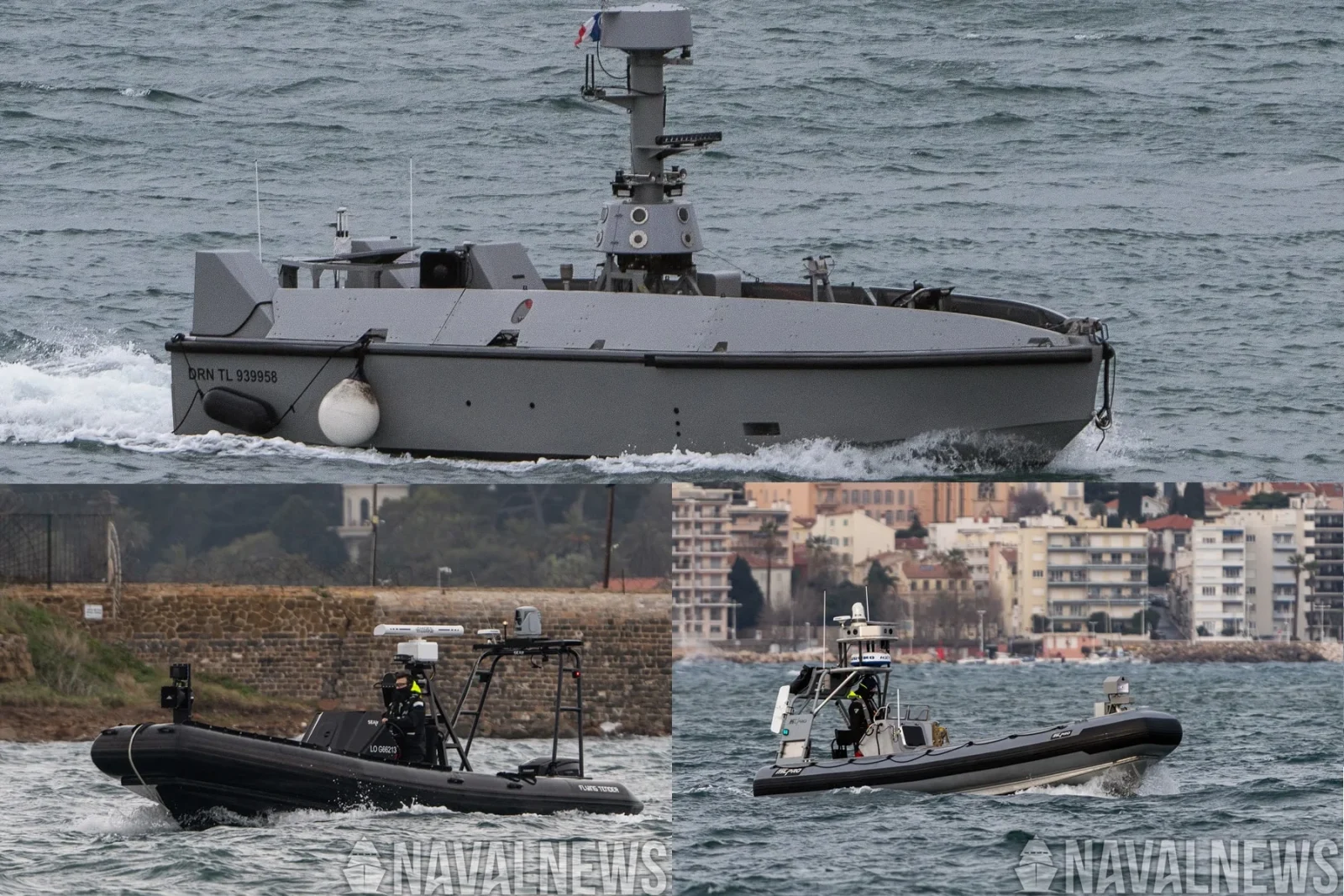
France’s Defence Innovation Agency (AID) and the French Navy have selected three industry partners to advance to the second phase of DANAE, the country’s armed unmanned surface vessel (USV) program. According to Naval News’s report of October 12, 2026, the SEAir & ORCAS Group team, SeaOwl, and a SIREHNA-Couach-Naval Group partnership were chosen to build larger prototypes in the program’s next phase.
DANAE aims to rapidly field a fleet of armed, autonomous USVs capable of protecting ports, both military and civilian, and escorting high-value units or warships. The program began in January 2026 with trials off Saint-Mandrier, near Toulon, where seven different drone solutions were tested for seakeeping, endurance and decision-making autonomy. The field was narrowed to three teams following that initial evaluation.
Of the three partners, SEAir & ORCAS Group offers a hydrofoil-based “flying USV” concept. The multi-role platform emphasizes speed, stealth, endurance and sensor-weapon stability in rough seas, and its compact design allows it to be deployed directly from frigates. SeaOwl, meanwhile, presents a system called NEMEZIS, built on the EDO 4G MN boat with a dual-mode architecture capable of both crewed and autonomous operation; an advanced sensor suite and a non-lethal deterrence turret are meant to support round-the-clock patrol, surveillance and escort duties with a single operator.
The third team, a partnership of SIREHNA, Couach and Naval Group, is competing with Seaquest S, a 9-meter, modular midsize USV designed from the outset to be unmanned. Seaquest S can integrate with existing combat systems, operate in difficult sea conditions, and be deployed either alone or in swarms. The platform was first unveiled at Euronaval 2024 and is now being advanced toward an armed, fully autonomous configuration under DANAE.
Jean-François Thomas, AID’s innovation acceleration director and the DANAE project lead, told Naval News the three partners offered the most mature solutions aligned with the Navy’s requirements. Prototype development is being supported by the technical naval expertise of the French defense procurement agency, DGA. According to Thomas, the design’s core principle is that the authority to fire and control over weapons systems remain with a human operator under all circumstances; the technical priorities are listed as autonomous navigation, energy management, autonomous threat classification and decision-making autonomy.
Under the program’s timeline, the second phase began in September 2026 and will run 12 to 18 months, continuing through the end of 2027. During this period, the three partners are being funded to build and test larger prototypes. At the end of the phase, a single winner is expected to be awarded a contract to equip the French Navy with a “series production” USV; the final decision is expected by the end of 2027, preceded by a more extensive sea-trial phase than the one held in January 2026.
Viewed alongside DGA’s separate tender for long-range, ship-deployable USVs for ISR missions, DANAE suggests the French Navy is moving step by step toward a “hybrid fleet” model. The program’s goal of integrating armed, autonomous USVs into port protection and warship escort stands out as a concrete sign of how naval USV use in Ukraine has influenced the procurement priorities of European navies.
The design philosophies of the three finalists differ notably. SEAir’s hydrofoil-based approach prioritizes speed and agility, SeaOwl’s dual-mode manned-autonomous NEMEZIS emphasizes operational flexibility and a gradual transition to autonomy, and Naval Group’s Seaquest S focuses on native unmanned design and seamless integration with existing combat systems. That diversity suggests DGA has not yet settled on a single technical approach, preferring instead to let different engineering solutions compete in the field to identify the most mature option.
France’s progress with this program is coinciding, not coincidentally, with recent naval USV use in the Black Sea and Red Sea. Ukraine’s use of unmanned surface vessels against the Russian Navy has shown how low-cost, numerous platforms can play a deterrent role against larger ships; DANAE’s focus on port protection and escort can be read as one example of those lessons feeding into procurement planning across NATO’s European navies.
Sources
- Naval News, “French MoD Selects Top Contenders for DANAE Armed Surface Drone Project,” 12.10.2026 — Details on the program’s scope, the three selected partners, the timeline and Jean-François Thomas’s remarks are drawn from this report.