China Shows ‘New Generation’ Infantry Fighting Vehicles as Beijing Tightens Exports of Drone Engines and Autopilots

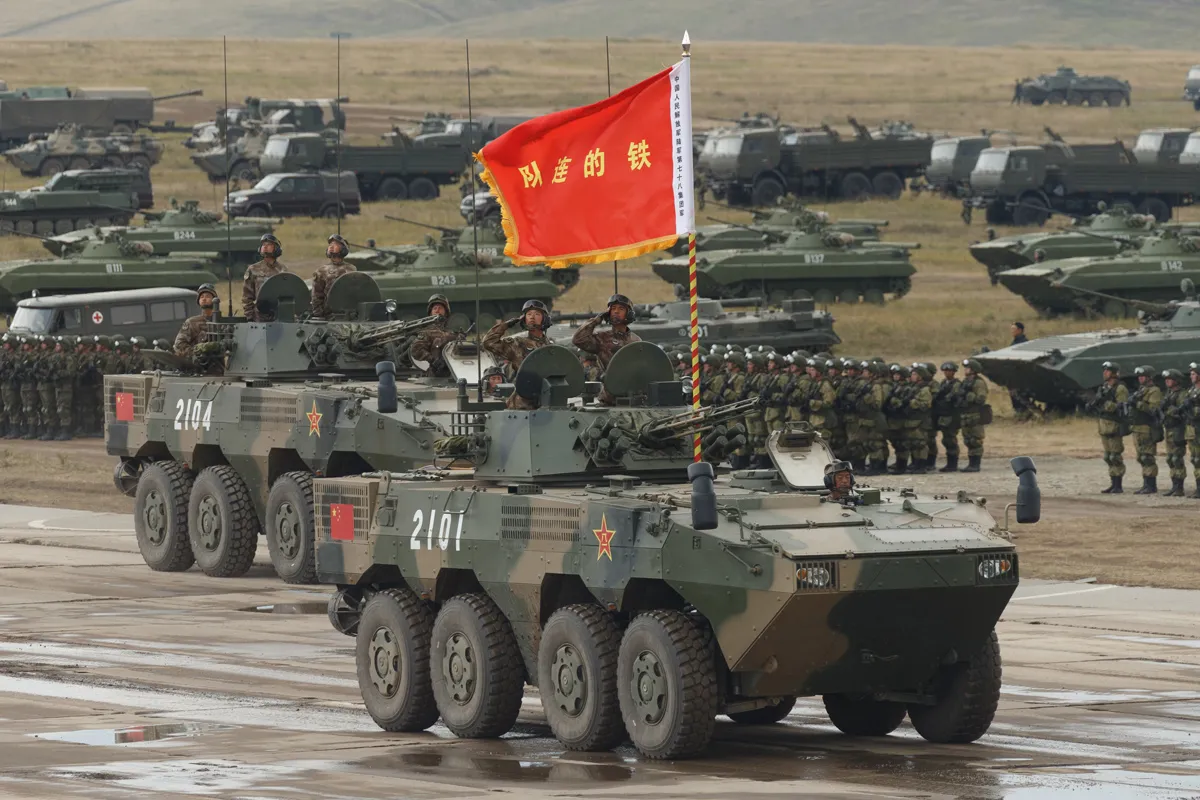
China has given its first look at what state media call “new generation” infantry fighting vehicles, while separate export rules that took effect on November 18 now require licences for a wide range of drone engines, autopilots and radio equipment. Taken together, the two developments show Beijing modernising its own mechanised forces while tightening its grip on components that drone makers around the world, including in Ukraine, Europe and the United States, depend on.
The vehicles
State broadcaster CCTV aired footage on November 20 showing personnel of the PLA’s 83rd Group Army training on several new eight-wheeled vehicles. Janes, in a special report, describes an unmanned turret, improved crew protection, a mine-resistant hull, amphibious capability and vehicle-mounted anti-tank guided missiles. The Global Times, citing Chinese experts, said the design appears to be an upgraded version of the Type 08 (ZBL-09) family that has formed the backbone of China’s medium brigades for more than a decade.
The designation is not settled. Other reporting associates the PLA’s newest 8×8 with the Type 19 name, and Janes separately covered a laser-equipped Type 19 variant on November 18. Beijing has not published official specifications. What is clear is the direction: remote turrets that keep the crew inside the armoured hull, better blast protection drawn from lessons in Ukraine and the Middle East, and organic anti-armour missiles that let a mechanised infantry section engage tanks without waiting for support.
The export controls
China’s Ministry of Commerce announced revised drone export controls on October 19, effective November 18. According to Quwa, Army Recognition and the South China Morning Post, the licensing list now covers:
- Autopilots specially designed for unmanned aircraft, plus related software and technology
- Aircraft engines above 16 kilowatts, piston or rotary engines designed for flight above 15,420 metres, and turbojets with at least 400 newtons of thrust
- Radio equipment allowing one ground station to control more than ten aircraft
- Larger brushless motors, electronic speed controllers and carbon-fibre propellers
- Drones with ranges of 300 kilometres or more
At the same time, Beijing raised thresholds for low-sensitivity civilian drones and simplified registration for some eligible models, so the rules are not a blanket ban.
Who feels it
Analysts quoted by Army Recognition say Ukraine is the most exposed. Its drone industry relies heavily on Chinese motors, controllers and radio modules, and licensing could add inspections, delays and costs. European and American makers of small drones and loitering munitions face similar supply-chain risks, which is pushing governments to fund domestic production of motors and electronics. Turkey’s drone industry, built around domestically developed engines and avionics, is comparatively insulated, which strengthens its position in export markets.
Analysis: leverage in a drone age
Beijing has used export licensing before, on drone engines and lasers in 2023 and on critical minerals since. The pattern is consistent: controls are framed as non-proliferation measures but give China discretion over who receives strategic components. Combined with the PLA’s own investment in modern armour and unmanned systems, the effect is to widen the gap between countries that can source drone parts freely and those that must ask Beijing for permission.
FAQ
When did the new Chinese drone export rules take effect?
On November 18, 2026, after being announced on October 19.
What is the new Chinese IFV called?
There is no official designation; Chinese experts call it an upgraded Type 08, while other reports use Type 19.