Altınay Defence Areas of Activity: The Five Core Areas and Nine Solution Domains


Altınay Savunma Teknolojileri A.Ş. (Altınay Defence) organises its work around five core areas of activity: motion control systems, unmanned systems, stealth (low-observability) systems, weapon systems, and ammunition-disposal & production systems. Founded in 2014 within the Altınay Teknoloji Grubu and headquartered at Teknopark İstanbul in Kurtköy, the company backs these activities with nine solution/capability domains spanning land, sea, air, space and unmanned platforms.
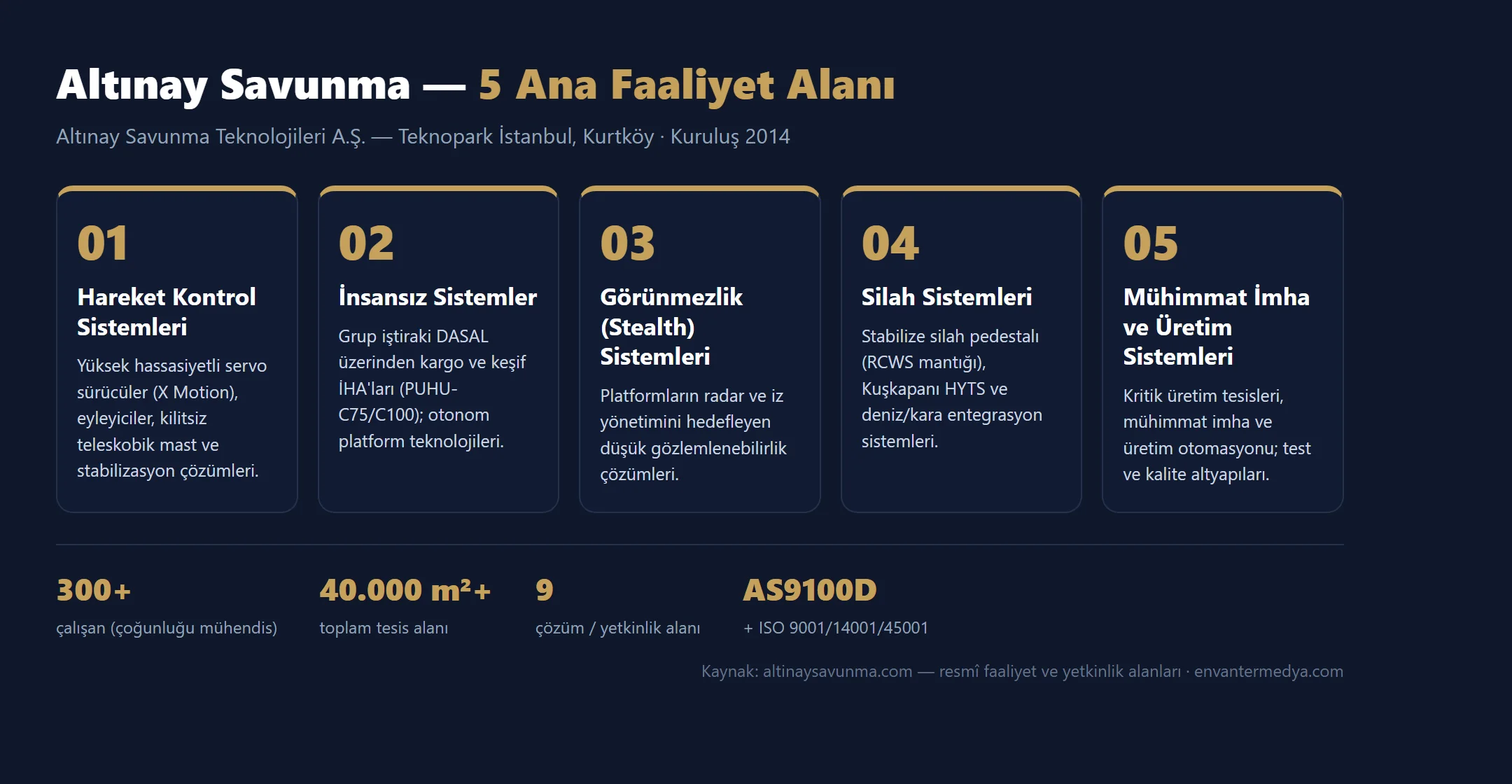
What are Altınay Defence’s areas of activity?
In its official corporate profile, Altınay defines its work across five main areas. Together they describe both the company’s product family and its engineering competence, reaching from high-precision motion control to unmanned aircraft, from low-observability (stealth) solutions to weapon systems and critical production/ammunition-disposal infrastructure. Each area is covered below.

1) Motion Control Systems
Motion control is Altınay’s core competence. It covers high-precision servo drives (X Motion), actuators, keyless screw-driven telescopic mast systems and stabilisation solutions. This technology is used on both land and naval platforms for target tracking, camera/sensor stabilisation and precise positioning, and it forms the technical foundation of the other four activity areas.
2) Unmanned Systems
Unmanned systems are the group’s fastest-growing leg, run largely through the aviation subsidiary DASAL Aviation Technologies. DASAL develops reconnaissance and cargo UAVs, most notably the PUHU-C75 and PUHU-C100 cargo drones. Autonomous navigation, payload integration and ground-control software are part of this area. The PUHU family is officially a DASAL product within the Altınay Teknoloji Grubu.
3) Stealth (Low-Observability) Systems
The stealth area covers low-observability solutions aimed at improving a platform’s radar and signature management. It brings together design and material approaches that reduce the probability of detection. Seen alongside motion control and weapon systems, Altınay’s stealth work supports an integrated platform-level survivability approach.
4) Weapon Systems
The weapon-systems area holds the company’s most visible products: a stabilised weapon pedestal built on remote-controlled weapon-station (RCWS) logic, the Kuşkapanı Helicopter Capture and Transfer System (HYTS) that secures helicopter landings on naval platforms, and land/sea integration solutions. Kuşkapanı, developed with STM, entered service on a Turkish national frigate and became a symbol of indigenisation against embargoes.
5) Ammunition-Disposal & Production Systems
The fifth area covers critical production facilities, ammunition disposal, production automation and test/quality infrastructure. Here Altınay can design turnkey special production lines and facility solutions for the defence industry. Certifications such as AS9100D, ISO 9001/14001/45001 and national/NATO classified-facility security clearances underpin this production discipline.
Activity areas vs. solution/capability domains
Beyond the five activity areas, Altınay also defines nine solution/capability domains that show where those activities are applied: Land, Naval, Air, Unmanned, Energy, Test, Space & Satellite, Ammunition-Disposal & Critical Production, and Production Technologies. In short, activity areas describe “what it does”, while solution domains describe “on which platform it applies it”.
| Activity area | Scope | Flagship product/solution |
|---|---|---|
| Motion Control | Servo, actuator, stabilisation, mast | X Motion servo, keyless telescopic mast |
| Unmanned Systems | Cargo/recon UAV, autonomy (DASAL) | PUHU-C75 / PUHU-C100 |
| Stealth | Low observability, signature management | Platform stealth solutions |
| Weapon Systems | Stabilised pedestal, naval integration | Weapon pedestal, Kuşkapanı HYTS |
| Ammunition-Disposal & Production | Critical production, automation, test | Disposal/production lines, test infra |
| Altınay Defence — Areas of Activity Fact Box | |
|---|---|
| Core activity areas | 5 (Motion Control, Unmanned, Stealth, Weapon, Ammunition-Disposal/Production) |
| Solution / capability domains | 9 (Land, Naval, Air, Unmanned, Energy, Test, Space-Satellite, Ammo-Disposal, Production) |
| Flagship products | Kuşkapanı HYTS · X Motion servo · Telescopic mast · Weapon pedestal · Venüs-4 |
| Subsidiaries | DASAL Aviation (PUHU-C75/C100) · TAAC Aviation |
| Headquarters | Teknopark İstanbul, Kurtköy |
| Employees | 300+ (mostly engineers) |
| Certifications | AS9100D · ISO 9001/14001/45001 · national/NATO facility clearance |
| Founded | 2014 · Altınay Teknoloji Grubu |
Frequently Asked Questions
How many activity areas does Altınay Defence have?
Five: motion control systems, unmanned systems, stealth (low-observability) systems, weapon systems, and ammunition-disposal & production systems.
Which fields does Altınay work in?
Alongside the five activity areas, Altınay applies its solutions across nine domains: land, naval, air, unmanned, energy, test, space & satellite, ammunition-disposal/critical production, and production technologies.
What are motion control systems?
Altınay’s core competence: high-precision servo drives (X Motion), actuators, keyless telescopic masts and stabilisation solutions.
Does Altınay make unmanned systems?
Yes, mostly via its subsidiary DASAL; the PUHU-C75 and PUHU-C100 cargo UAVs are the flagship products of this area.
What are stealth systems for?
They improve a platform’s radar and signature management to reduce the probability of detection.
What are Altınay’s weapon systems?
A stabilised weapon pedestal, the Kuşkapanı Helicopter Capture and Transfer System (HYTS), and land/sea integration solutions.
What is the difference between an activity area and a solution domain?
Activity areas describe what the company does (five headings); solution/capability domains describe on which platform it applies them (nine headings).
Sources
- Altınay Defence official corporate and product pages (activity/solution areas), altinaysavunma.com
- DASAL Aviation Technologies product pages (PUHU-C75/C100)
- envantermedya archive — Altınay product and corporate coverage