Canada’s First F-35 Flies — No Official Statement Yet

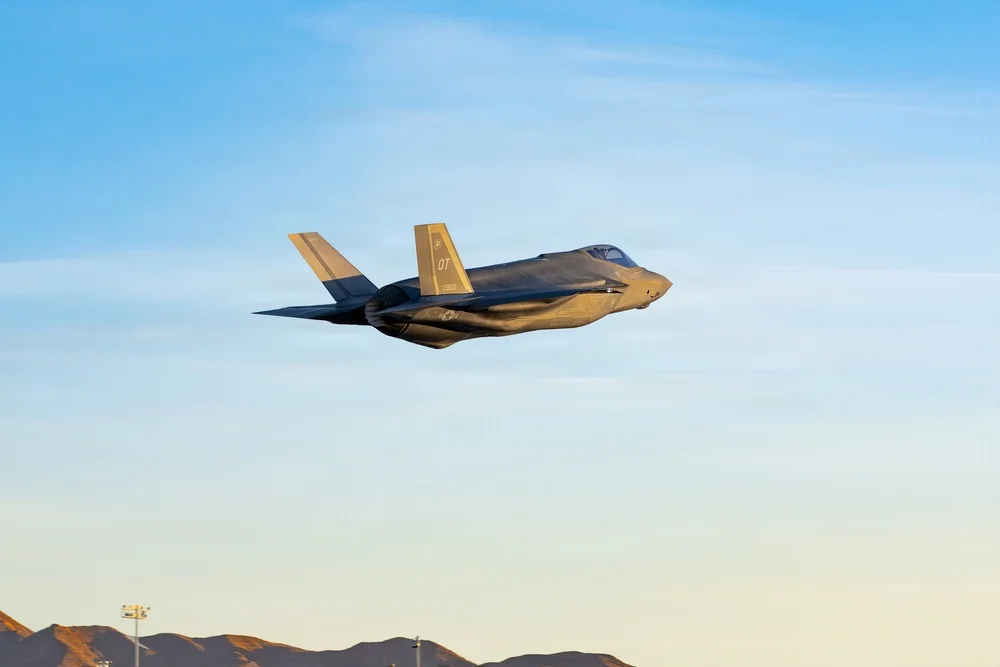
The first F-35A built for Canada flew for the first time at Lockheed Martin’s Fort Worth plant on 23 September. The aircraft, production number AR-1, will be designated CF-35A once delivered — but neither Lockheed Martin, the Royal Canadian Air Force nor the Canadian government has issued an official statement confirming the flight.
A flight nobody has officially confirmed
Production number AR-1 — the first of the 88 F-35As Canada ordered under a roughly $19 billion agreement signed in 2023 — took off from Lockheed Martin’s Fort Worth facility in Texas on 23 September. Once handed over to Canada, the aircraft will carry the designation CF-35A. What stands out at this stage is not the flight itself, which is a routine step in a production program, but the absence of any confirmation around it: no statement has come from Lockheed Martin, the Royal Canadian Air Force (RCAF) or the Canadian government. In comparable programs, a manufacturer’s first flight is typically marked with a press release, and the buying country’s air force often follows with its own social media post; the silence from both channels here stands out against that pattern.
That silence does not sit outside the program’s technical schedule — first deliveries to Canada are still expected in 2028, and test flights ahead of delivery are standard practice for any production aircraft. Every F-35 built at Fort Worth goes through a series of acceptance flights before handover, checks that validate flight control behavior, engine performance and avionics integration. What makes the flight notable is that it falls in the middle of an unresolved question about how many aircraft Canada will actually buy.
16 confirmed, 14 in doubt, out of 88
Canada’s 2023 agreement covers 88 F-35As in total, but only 16 of those are firmly committed. Long-lead items are being funded for the remaining 14, yet the final order quantity for that batch has not been confirmed. Prime Minister Mark Carney requested a review of the purchase in March 2025, and the outcome of that review has not been made public. Reports suggest the government is weighing whether to reduce the total order below 88 aircraft.
Against that backdrop, AR-1’s first flight is a concrete sign that the program is moving forward, but the lack of an official statement leaves open how far that signal can be read as a commitment. Confirmation of the final order size still depends on a statement from the RCAF or Canada’s Department of National Defence. The uncertainty matters beyond Ottawa’s own budget planning — it also reaches the suppliers and subcontractors managing long-lead-time components who need clarity on final quantities to plan their own production rates.
Why the silence matters
In defence procurement, the first flight of a production aircraft is typically announced by the manufacturer or the buying country as a routine milestone. Coverage of this flight surfacing without confirmation from either side could mean the communications timeline simply has not caught up, or that Ottawa prefers to keep a low profile until the order-size question is resolved. Neither explanation can be verified at this point, and only an official statement from one of the parties will settle which reading is correct.
A long-running procurement debate
Canada’s F-35 purchase sits inside a procurement debate that has run for years, surviving multiple reviews, a cancellation and a relaunch under different governments. The Carney government’s March 2025 review request is the latest chapter in that history, and the absence of a published outcome leaves uncertainty hanging over industry and supply-chain partners waiting on a final number. At a time when Ottawa is reassessing broader defence spending priorities, revisiting a commitment as large and long-dated as the F-35 order fits into a wider conversation about Canada’s overall procurement strategy.
Where Turkey fits
Canada’s uncertain order size is a reminder of how exposed even allied F-35 purchases can be to domestic political review. Turkey’s own fifth-generation fighter program, KAAN, developed by Turkish Aerospace, does not carry that kind of external procurement risk; first serial-production deliveries to the Turkish Air Force are targeted from 2028. The Canadian case illustrates that large F-35 orders, even among close allies, can be revised through internal political processes — a point worth setting alongside the supply security that comes with developing a domestic platform, where a country’s own fleet-renewal timeline does not depend on another government’s production decisions.
Sources
- Defence Blog, “Canada’s first F-35 conducts maiden flight,” 24 September 2026
- Government of Canada — 2023 F-35A procurement agreement announcements (archive)