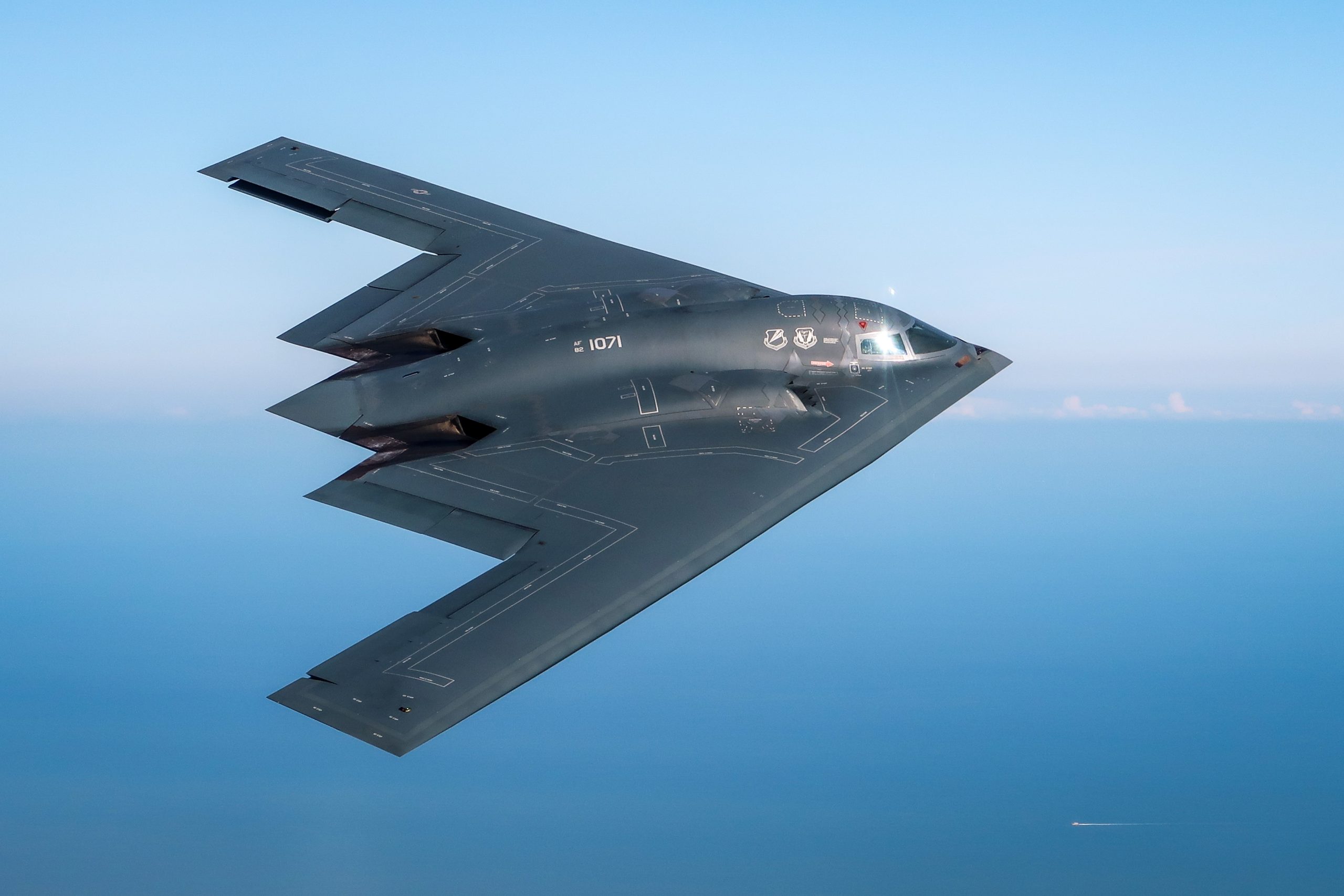
The B-2 Spirit, developed by Northrop Grumman, is the world’s first operational stealth strategic bomber. Thanks to its tailless flying-wing shape, radar-absorbent materials and low-signature management, it can penetrate the densest air defenses to deliver both nuclear and conventional weapons. With intercontinental range and the ability to carry the 13.6-tonne GBU-57 bunker-buster, the B-2 is a key element of U.S. strategic deterrence. This file covers the aircraft’s specifications, production story, cost debate and combat history, neutrally.
Contents: Overview · Specifications · Flying wing & stealth · Weapons · Cost debate · Combat history · Future with the B-21 · FAQ
Overview: why the B-2 matters
The B-2 emerged in the late Cold War from the need for a nuclear bomber able to cross Soviet air defenses without being caught on radar. It first flew in 1989 and entered U.S. Air Force service in 1997.
Its design rests on one idea: get in unseen, strike, get out unseen. The flying-wing shape and radar-absorbent coatings cut the aircraft’s radar cross-section to the order of a small bird, making it a first-night striker against the most defended targets.
Specifications
Attribute
Value
Manufacturer
Northrop Grumman (Boeing subcontractor)
Type
Two-crew stealth strategic bomber
Engines
4× General Electric F118-GE-100 (non-afterburning)
Max speed
~Mach 0.95 (high subsonic)
Range
~6,000 nm (11,000 km) unrefueled; intercontinental with refueling
Ceiling
~50,000 ft (15,200 m)
Payload
~40,000 lb (18,000 kg) internal
Number built
21 (one lost in a 2008 Guam crash)
Flying wing and stealth: the defining architecture
The B-2 has no vertical tail; the whole airframe is a single wing. That shape removes the sharp surfaces that would reflect radar back to its source, making the aircraft extremely faint on radar.
Stealth is more than shaping: radar-absorbent materials, buried engine inlets and infrared-signature reduction all work together. This low signature lets the aircraft push deep inside modern air-defense networks.
Weapons
The B-2 carries weapons in two internal bays. In the nuclear role it carries B61 and B83 free-fall bombs; in the conventional role, JDAM guided bombs. Its most striking capability is being one of the few platforms able to carry the 13.6-tonne GBU-57 MOP bunker-buster.
The cost debate
The B-2 is one of the most expensive aircraft in history. Because the program was capped at just 21 aircraft, the program unit cost including R&D exceeded roughly $2 billion per aircraft. That makes it an elite, scarce capability rather than an everyday one.
The flyaway cost is read differently and is much lower. Package cost (R&D + production) and unit production cost must be assessed separately; without that distinction the figures can mislead.
Combat history
The B-2 first saw combat in the 1999 Kosovo campaign, then served over Afghanistan, Iraq and in the 2011 Libya operation. It is known for flying many missions from its home base in the U.S. and back, thanks to its long range.
In June 2025, B-2s used GBU-57 MOP bombs in strikes on Iran’s underground nuclear facilities, demonstrating the aircraft’s bunker-busting capability in practice and again highlighting the platform’s strategic role.
Future with the B-21 Raider
The B-2 will gradually give way to the next-generation B-21 Raider. Also built by Northrop Grumman, the B-21 is designed for lower cost and a larger fleet; but the B-2 remains the backbone of the strategic strike force until the B-21 reaches full capacity.
Aircraft
Country
Architecture
Max speed
Payload
Primary munitions
B-2 Spirit
USA
Uçan kanat / stealth
~Mach 0.95
~18.000 kg
B61/B83, GBU-57 MOP, JDAM
B-21 Raider
USA
Yeni nesil stealth
Ses altı
Gizli
Nükleer + konvansiyonel
B-52H
USA
Stealth değil
~Mach 0.86
~31.500 kg
Seyir füzeleri, JDAM
Tu-160
Russia
Değişken kanat, süpersonik
~Mach 2.05
~40.000 kg
Kh-55/Kh-101 seyir füzeleri
Frequently Asked Questions
How many B-2s were built?
A total of 21 aircraft. One was lost in a 2008 crash on Guam, reducing the fleet to 20.
Why is the B-2 so expensive?
Because the program was capped at 21 aircraft, the R&D cost spread over very few airframes, pushing the program unit cost to about $2 billion per aircraft. The flyaway cost is lower.
What weapons does the B-2 carry?
B61/B83 bombs in the nuclear role, JDAMs conventionally, and the 13.6-tonne GBU-57 MOP bunker-buster.
What will replace the B-2?
Northrop Grumman’s next-generation B-21 Raider is being developed to gradually replace the B-2.