Taiwan Begins Testing Its First U.S.-Supplied MQ-9B SkyGuardian
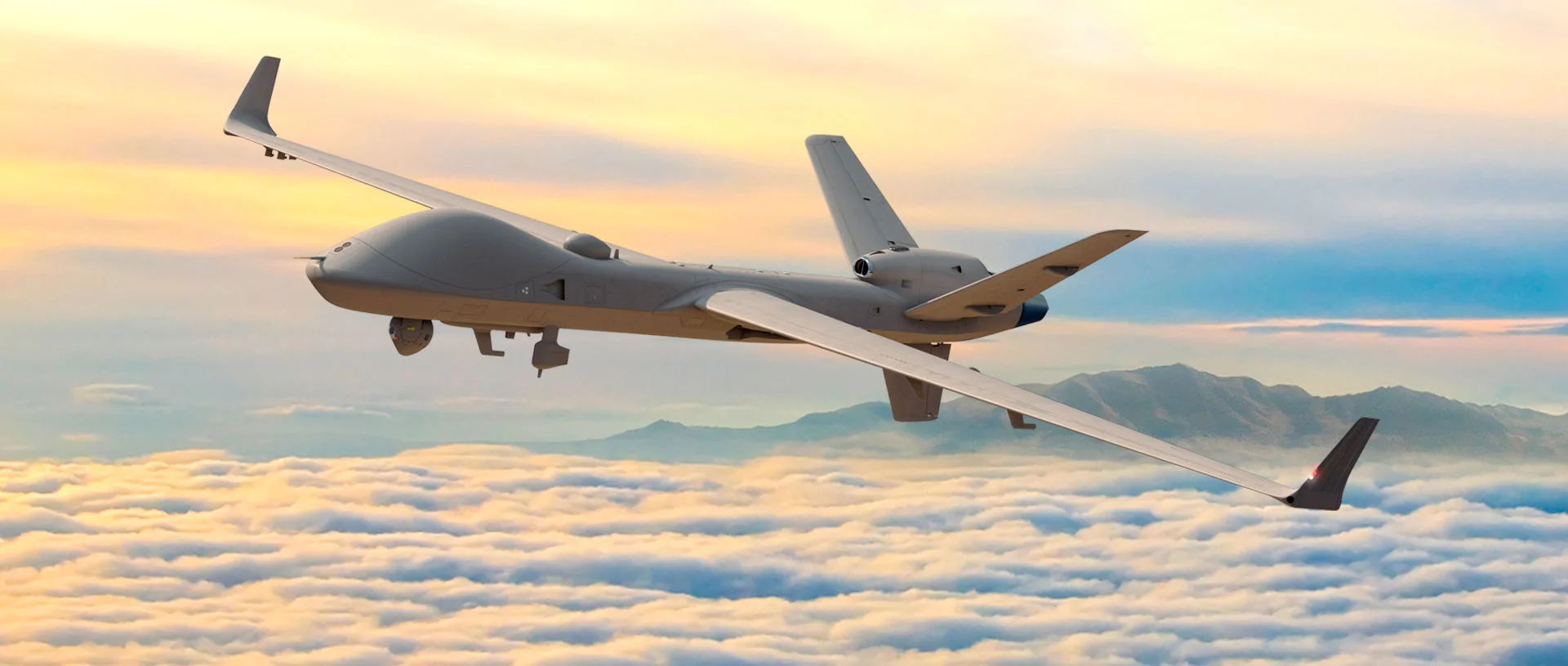
Taiwan has started assembly and pre-flight test activity on the first batch of four MQ-9B SkyGuardian unmanned aerial vehicles procured from the United States under Foreign Military Sales (FMS). According to a source speaking to the Taiwanese press, manufacturer General Atomics Aeronautical Systems and Taiwan’s military are working together to ready the aircraft for flight trials, with the systems entering operational service once those phases are complete.
The process gained momentum with a handover ceremony held on U.S. soil on 17 March 2026. Taiwan’s Deputy Defence Minister Hsu Szu-chien and Taiwan’s representative in Washington, Alexander Yui, attended the event. After the ceremony, the first two aircraft remained in the United States for a period of testing before being shipped to Taiwan. Taiwanese sources say assembly work is continuing on the island, with flight trials to follow.
A two-phase delivery
Taiwan’s MQ-9B acquisition rests on the FMS contract signed with General Atomics. The deal covers four aircraft alongside ground control stations and a support package. Delivery is planned in two phases: the first two aircraft in 2026 and the remaining two during 2027. Taipei has said it has earmarked 21.7 billion New Taiwan dollars (around 687 million U.S. dollars) for the programme as a whole — aircraft, ground stations and associated equipment — over the 2022-2029 period.
Carrying out part of the assembly and integration on the island under the manufacturer’s supervision is meant to let Taiwanese personnel learn the system from the ground up and build maintenance proficiency early. The approach matters for logistical independence on an island where access to outside technical support for long-range unmanned platforms could be constrained in a combat scenario.
Medium altitude, long endurance
The MQ-9B SkyGuardian is a medium-altitude long-endurance (MALE) class drone — built to loiter at relatively high altitude for extended periods and survey wide areas. General Atomics’ official figures put the aircraft’s wingspan at around 24 metres, with the ability to stay airborne for more than 40 hours in favourable conditions. More cautious numbers circulate in the Taiwanese press: roughly 28 hours of mission time with a light load, about 14 hours fully loaded, and a range of some 6,000 kilometres. The gap stems from the way endurance shifts markedly with the sensor and munitions payload carried.
The system’s surveillance capability rests on electro-optical/infrared (EO/IR — a daylight camera and night-time thermal vision combined) sensors and a multi-mode radar. One of the key features that sets SkyGuardian apart from the earlier MQ-9 family is the collision-avoidance system the manufacturer calls “Detect and Avoid.” It is designed to let the unmanned aircraft fly safely in airspace dense with civilian traffic, sharing the same corridors as passenger aircraft; in airspace as narrow and congested as Taiwan’s, that capability buys operational flexibility.
Surveillance first, strike second
Taiwanese officials and local media stress that the platform’s priority mission is monitoring Chinese military activity in and around the Taiwan Strait — intelligence, surveillance and reconnaissance (ISR). While SkyGuardian can carry laser-guided munitions, Taiwan appears to be positioning this first fleet as a persistent situational-awareness asset rather than a strike force. The aircraft’s ability to share imagery and data gathered via satellite communications in real time strengthens the early-warning leg of the island’s defence.
A fleet of four is a limited number for round-the-clock patrol, so the SkyGuardians are expected to provide a high-value, long-range surveillance layer rather than meeting the whole of Taiwan’s broad unmanned needs. Taiwan is also pressing ahead with its own indigenous drone programmes; running an imported MALE-class platform alongside domestic development mirrors the path taken by other countries that in recent years have tried to reduce reliance on foreign suppliers for medium- and high-altitude unmanned systems.
| Specification | MQ-9B SkyGuardian |
|---|---|
| Manufacturer | General Atomics Aeronautical Systems (USA) |
| Class | Medium-altitude long-endurance (MALE) UAV |
| Wingspan | ~24 m (manufacturer figure) |
| Endurance | 40+ hours (manufacturer); ~28 hrs light / ~14 hrs full load (Taiwanese press) |
| Sensors | EO/IR camera, multi-mode radar |
| Standout feature | Detect and Avoid (civil airspace integration) |
| Taiwan procurement | 4 aircraft, FMS, two phases 2026-2027 |
Open-source verification notes
- The information that testing is under way in Taiwan rests on an unnamed source in the 21-22 June 2026 reports by Focus Taiwan and the Taipei Times; it has not been confirmed in the form of a direct official statement from the manufacturer or the defence ministry.
- Two different sets of figures exist for endurance: the General Atomics official page gives 40+ hours, while the Taiwanese press reports ~28/14 hours depending on load. Both values are therefore given with attribution to their source.
- The 17 March 2026 handover ceremony and its attendees (Hsu Szu-chien, Alexander Yui) are confirmed in multiple independent sources.
- The wingspan, sensor and Detect and Avoid details in the technical table are drawn from General Atomics’ official MQ-9B page.
Sources
- Focus Taiwan (CNA), “Testing of MQ-9B ‘SkyGuardian’ drone underway in Taiwan: Source”, 21 June 2026
- Taipei Times, “First batch of SkyGuardian drones arrives in Taiwan”, 22 June 2026
- USNI News, “Taiwan Receives First U.S. MQ-9 SkyGuardian Drones”, 23 March 2026
- General Atomics Aeronautical Systems, official MQ-9B SkyGuardian product page