L-SPIKE 4X: Laser-Guided Rocket Conversion Kit for 70mm Munitions — Technical Analysis and Turkish Cirit Comparison

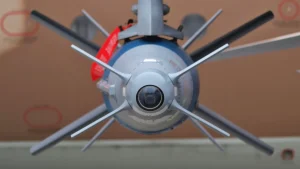
L-SPIKE 4X is a laser guidance and wing conversion kit developed by Rafael Advanced Defense Systems that transforms standard 70 mm (2.75 inch) unguided Hydra/SNEB-class rockets into precision-guided munitions with a circular error probable (CEP) below three metres. Rather than requiring investment in an entirely new weapon system, L-SPIKE 4X applies semi-active laser (SAL) terminal guidance to an existing inventory rocket, delivering precision strike at a fraction of the cost of purpose-built guided munitions. The “4X” designation refers to a four-round configuration within a single pod.
Conceptual Basis: Conversion Kit Logic
The 70 mm unguided rocket is the most widely fielded helicopter direct-fire munition in military history. Its combination of low cost, adequate explosive payload, and mature logistics supply chain made it the global standard for rotary-wing close air support since the 1960s. Its limitation is accuracy: unguided, ballistic rockets require the launching platform to be close to the target, increasing platform exposure, and produce meaningful dispersion at range — limiting their utility against point targets in complex environments.
L-SPIKE 4X addresses this without retiring the rocket. By adding a laser seeker and folding wings to the front of a standard 70 mm round, the kit converts the rocket into a SAL-guided munition with sub-3-metre terminal accuracy. The launcher pod remains compatible with existing Hydra 70 infrastructure; integration is minimal.
Technical Specifications
| Parameter | Value |
|---|---|
| Developer | Rafael Advanced Defense Systems (Israel) |
| Type | 70 mm laser guidance and wing conversion kit |
| Compatible rocket | Hydra 70 / SNEB and compatible 70 mm unguided rockets |
| Guidance | Semi-active laser (SAL) seeker |
| CEP | <3 metres |
| Range | ~10 km (platform and altitude dependent) |
| Warhead | Original Hydra warhead options (HEAT, fragmentation, thermobaric) |
| Pod configuration | 4 guided rockets per pod (4X) |
| Platforms | AH-64, AH-1Z, UH-60, A-29, T-129-class helicopters; fixed-wing compatible |
| Laser designation | Platform Litening pod, ground-based LTDT, or other designating unit |
| Integration | Compatible with existing Hydra 70 pods; minimal modification |
How SAL Guidance Works
L-SPIKE 4X uses semi-active laser homing:
- The target is marked by a laser designator — either the firing platform’s own Litening pod, a different airborne platform, or ground-based laser designation.
- The rocket is fired; it follows a ballistic trajectory in the initial phase.
- In the terminal phase, the laser seeker detects the laser spot reflected from the target and steers the rocket onto it.
- CEP <3 metres is achieved.
The flexible designation architecture is operationally significant: the firing helicopter can delegate designation to another aircraft, a ground team, or a UAV, freeing the attack platform from maintaining its own laser lock on the target throughout the engagement.
Turkish Counterpart: Cirit
| Attribute | L-SPIKE 4X | Cirit (Roketsan) |
|---|---|---|
| Type | 70 mm laser guidance conversion kit | Purpose-designed 70 mm laser-guided rocket |
| Guidance | SAL | SAL |
| CEP | <3 m | <1–3 m (disclosed) |
| Range | ~10 km | ~8–10 km |
| Platform | Helicopters and fixed-wing | T-129 ATAK, Sikorsky S-70, TB2 (test), F-16 |
| Combat data | Limited open-source data | Libya, Syria, Ukraine (via T-129 and TB2) |
| Export | Subject to Rafael export policy | Pakistan (via T-129); other discussions |
Turkey’s Cirit is the closest domestic counterpart and, in several respects, a stronger competitive position: purpose-designed rather than a conversion kit, extensive combat data across multiple conflicts, and integration across Turkey’s primary rotary-wing platforms. For Turkey, this is one of the defense industry segments where domestic capability is not only present but operationally mature.
Competitor Systems
| System | Country | Type | Key Difference |
|---|---|---|---|
| APKWS | USA / BAE Systems | 70 mm laser-guided | Widely fielded NATO standard; extensive US inventory |
| DAGR | USA / Lockheed Martin | 70 mm laser-guided | Hellfire-laser compatible; similar concept |
| HYDRA 70 + LOGIR | USA / General Dynamics | 70 mm electro-optical | EO guidance; GPS augmented; different seeker technology |
Envanter Medya Analysis
L-SPIKE 4X represents a pragmatic approach to precision munitions: don’t retire the existing inventory, upgrade it. For operators with large Hydra 70 stocks — a category that includes most NATO members and many US-equipped partners — the ability to convert unguided rockets to sub-3-metre precision at relatively low incremental cost is attractive from both a budget and a logistics perspective.
The limitation is the laser designation dependency. Semi-active laser guidance is a mature, reliable technology, but it requires a designating unit throughout the terminal engagement phase. For platforms operating without a Litening pod or ground-based designation support, L-SPIKE 4X’s utility is constrained. This is why Litening — the next product in this series — is operationally linked to L-SPIKE 4X: the two systems are most effective when deployed together.
For Turkey: Cirit’s comparison in this category reflects one of the clearest cases in this entire Rafael product series where Turkey’s domestic capability is the stronger position. Cirit is a purpose-designed system with validated multi-conflict combat data, integrated across Turkey’s primary attack helicopter and UAV platforms. It is not a conversion kit catching up to a Rafael standard — it is the domestic standard in its own right.