The Seams, Not the Systems: Air-Defence C2 Integration in the Gulf


Executive Summary
The hardest problem in Gulf air defence is not acquiring interceptors; it is integrating them. Gulf states have assembled layered inventories — Patriot and THAAD at the upper tiers, a growing field of medium- and short-range systems beneath, and an expanding counter-drone layer — often from different suppliers with incompatible command architectures. The result is capable individual systems that do not always share a single, coherent air picture. This analysis examines the command-and-control (C2) integration challenge, the trade-offs between US-pattern integration and multi-vendor sovereignty, and the practical paths available to Gulf planners, and argues that battle-management architecture, not the next interceptor, is now the highest-leverage investment.
Operational Context
The threat that defines the requirement — saturating salvos of cruise missiles, ballistic missiles and drones arriving on compressed timelines — is precisely the case where fragmented C2 fails. Defeating a coordinated, multi-axis, multi-altitude attack demands a single integrated air picture, automated threat evaluation and weapon assignment across layers, and the ability to hand a track from one system’s sensors to another’s effectors. Where each layer operates as a stovepipe, gaps open at the seams: duplicated engagements against some targets, leakage of others, and interceptor wastage that the economics cannot sustain.
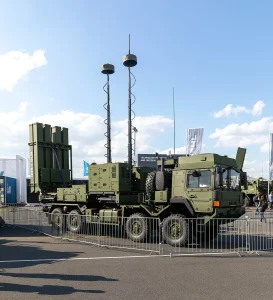
Gulf inventories make this acute. A typical regional air-defence enterprise may combine US upper-tier systems, European or Asian medium-range systems, and a mix of short-range and counter-drone effectors. Each arrived with its own command system, data formats and release conditions. Knitting them into one battle-management layer is constrained both technically — interface and data-standard incompatibility — and politically, by the conditions suppliers, especially the US, attach to integrating their systems with non-origin equipment.
Comparative Analysis
The US-pattern path. Integrating around a US command backbone and Link-16, with systems such as IBCS as the connective layer, offers the deepest interoperability with the upper-tier assets Gulf states already field, and access to a mature, combat-developed architecture. The cost is dependence: configuration control, release authority over what may be integrated, and the conditions attached to connecting non-US systems. For a buyer whose upper tier is already US, this path is the lowest technical risk but the highest in sovereignty terms.
The multi-vendor sovereign path. Building a national battle-management layer that ingests tracks from multiple systems — including US, European, Asian and indigenous effectors — offers independence and the ability to standardise across a mixed fleet. Several suppliers, including Turkish, European and other vendors, market open C2 architectures intended to do exactly this. The cost is integration risk: certifying interfaces, achieving the latency and reliability a live engagement demands, and doing so without the depth of combat development behind the US architecture. The claims made for openness should be tested against live, multi-system engagement trials, not accepted on specification.
The hybrid reality. In practice most Gulf enterprises will be hybrids: a US-pattern upper tier integrated to its own standard, with a national or third-party battle-management layer fusing the lower tiers and feeding, rather than replacing, the upper-tier picture. This pragmatic architecture preserves the proven upper-tier integration while building sovereign control over the layers where most of the saturation fight is actually fought. It is also the most demanding to engineer, because it must bridge two integration philosophies.
| Architecture | Interoperability | Sovereignty | Integration risk |
|---|---|---|---|
| US-pattern backbone | High (with US assets) | Low | Low |
| National / open C2 | Potentially broad | High | High (unproven at scale) |
| Hybrid (fused lower tier) | Broad if engineered well | Medium-high | Medium-high |
Procurement Considerations
Gulf planners should reframe the next major air-defence decision around C2 rather than effectors. First, specify the architecture before the interceptor: an additional battery integrated into a fragmented picture adds less capability than the same spend on the battle-management layer that ties existing systems together. Second, secure integration rights contractually: the authority and technical access to connect a buyer’s chosen systems, without per-integration vendor veto, is the single most valuable term in any air-defence contract. Third, demand multi-system live trials: openness and interoperability must be proven in engagement-representative conditions across actual fielded systems, not asserted. Fourth, weigh release conditions explicitly: the political terms attached to US integration are as decisive as any technical interface.
Outlook
The decisive Gulf air-defence investment of the coming decade is architectural, not material. The region already fields capable interceptors across every tier; what determines whether they defeat a saturating, multi-axis attack is the C2 layer that fuses them into one picture and assigns the right effector to each threat. The choice between a US-pattern backbone, a sovereign open architecture and a hybrid is genuinely consequential, trading interoperability, independence and integration risk against one another, and no option is free of cost. For procurement officers, the recommendation is to treat battle-management integration as the primary requirement, secure integration rights as a contractual priority, and subject every claim of openness to live, multi-system trials before committing — because the seams between systems, not the systems themselves, are where a layered defence will succeed or fail.