France Names Three Finalists for DANAE Armed USV Program: A Combat Drone Boat Fleet Targeted for 2027

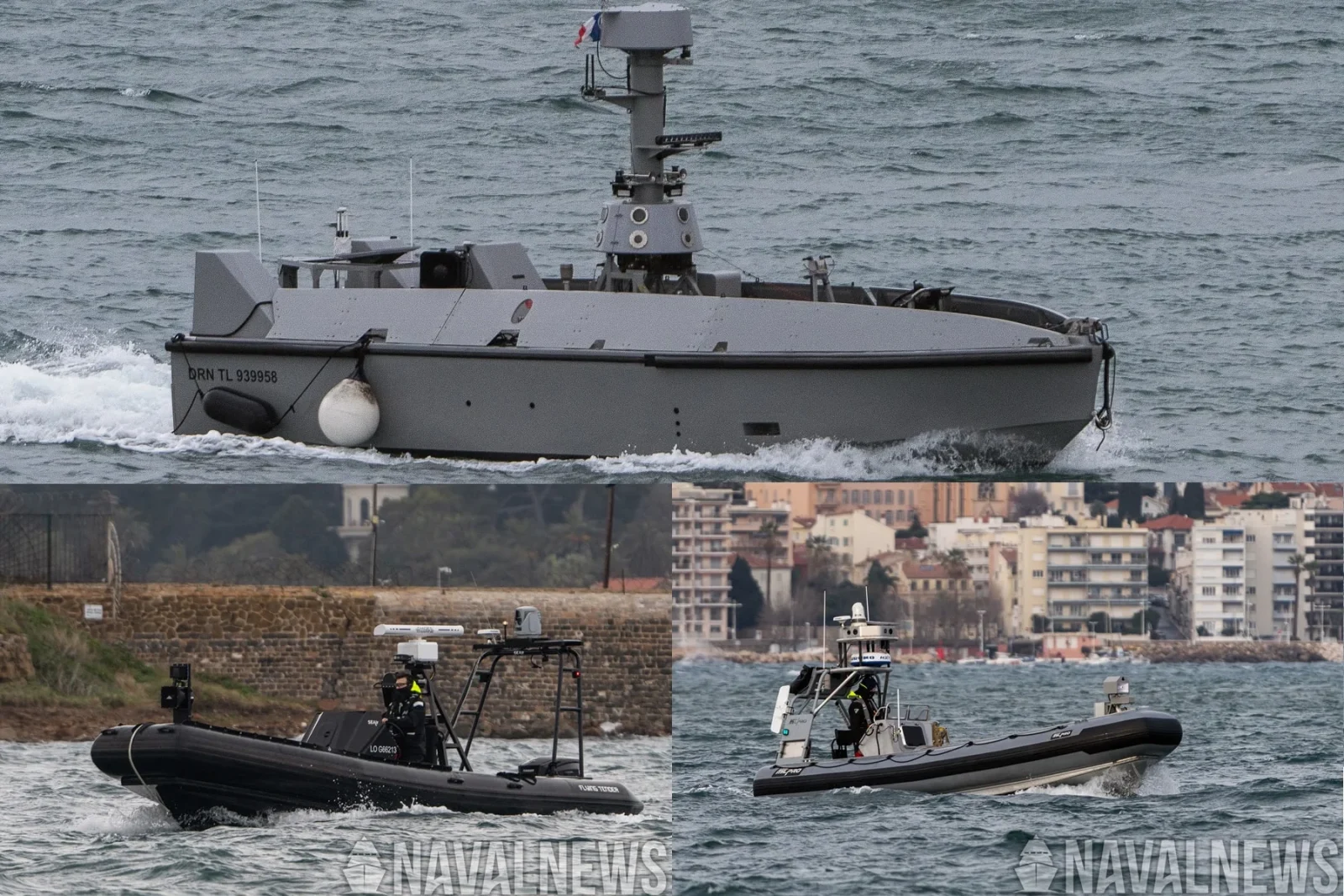
France’s Defense Innovation Agency (AID) and the French Navy have narrowed the DANAE armed unmanned surface vessel (USV) program to three finalist teams: SEAir & ORCAS Group, SeaOwl, and the SIREHNA-Couach-Naval Group partnership. The selection follows a first round of sea trials conducted off Toulon and Saint-Mandrier in January 2026, when seven candidate platforms were put through their paces in wave conditions of up to three meters. The program’s second phase, which began in September 2026, is scheduled to run through the end of 2027 and is expected to produce a single winner for a serial production contract.
Three Contenders, Three Design Approaches
Each finalist brings a distinct architecture to the competition. SEAir & ORCAS Group’s “Flying USV” relies on hydrofoil technology, resulting in a compact craft designed for deployment from frigates. SeaOwl’s NEMEZIS system is built on the EDO 4G MN hull and can operate in both crewed and autonomous modes, pairing an advanced sensor suite with a turret capable of delivering non-lethal deterrent effects. The SIREHNA-Couach-Naval Group team is proposing the Seaquest S, a nine-meter modular USV able to operate either independently or as part of a coordinated swarm. All three designs were among the platforms evaluated during the January 2026 trials.
A Two-Phase Mission Profile
DANAE is structured around two sequential mission sets. The first phase centers on non-lethal effectors intended for port and naval base protection, allowing the Navy to field a defensive capability without immediately crossing into armed engagement. The second phase introduces lethal weapons for escort missions, extending the role of these USVs to accompanying surface combatants. Across both phases, autonomy is applied to navigation, energy management, threat classification and decision support, but the authority to open fire remains with a human operator at all times.
From Prototype to Production Decision
The program is run under the DGA (Direction Générale de l’Armement) framework, with AID and the Navy jointly steering requirements. During the current phase, each of the three teams receives roughly twelve months of funding to build and test a larger-scale prototype, within a phase that is expected to last twelve to eighteen months overall. By the end of 2027, the Navy intends to select one winning design and award it a serial production contract, moving DANAE from demonstrator status into an operational fleet.
Part of a Broader Naval Drone Push
DANAE places France among the European navies working to integrate armed USVs into the core structure of their fleets rather than treating them as niche experimental assets. Ukraine’s tactical successes with unmanned surface vessels in the Black Sea have been widely cited as accelerating this shift across European navies. Within NATO, DANAE’s decision-making architecture—autonomy handling navigation and threat assessment while a human retains firing authority—offers a useful comparison point against Turkey’s own armed USV program, ULAQ, which has accumulated operational experience in a similar mission space.