Poland’s Tank Fleet Set to Hit 1,600 by 2032, Outpacing Four NATO Allies Combined

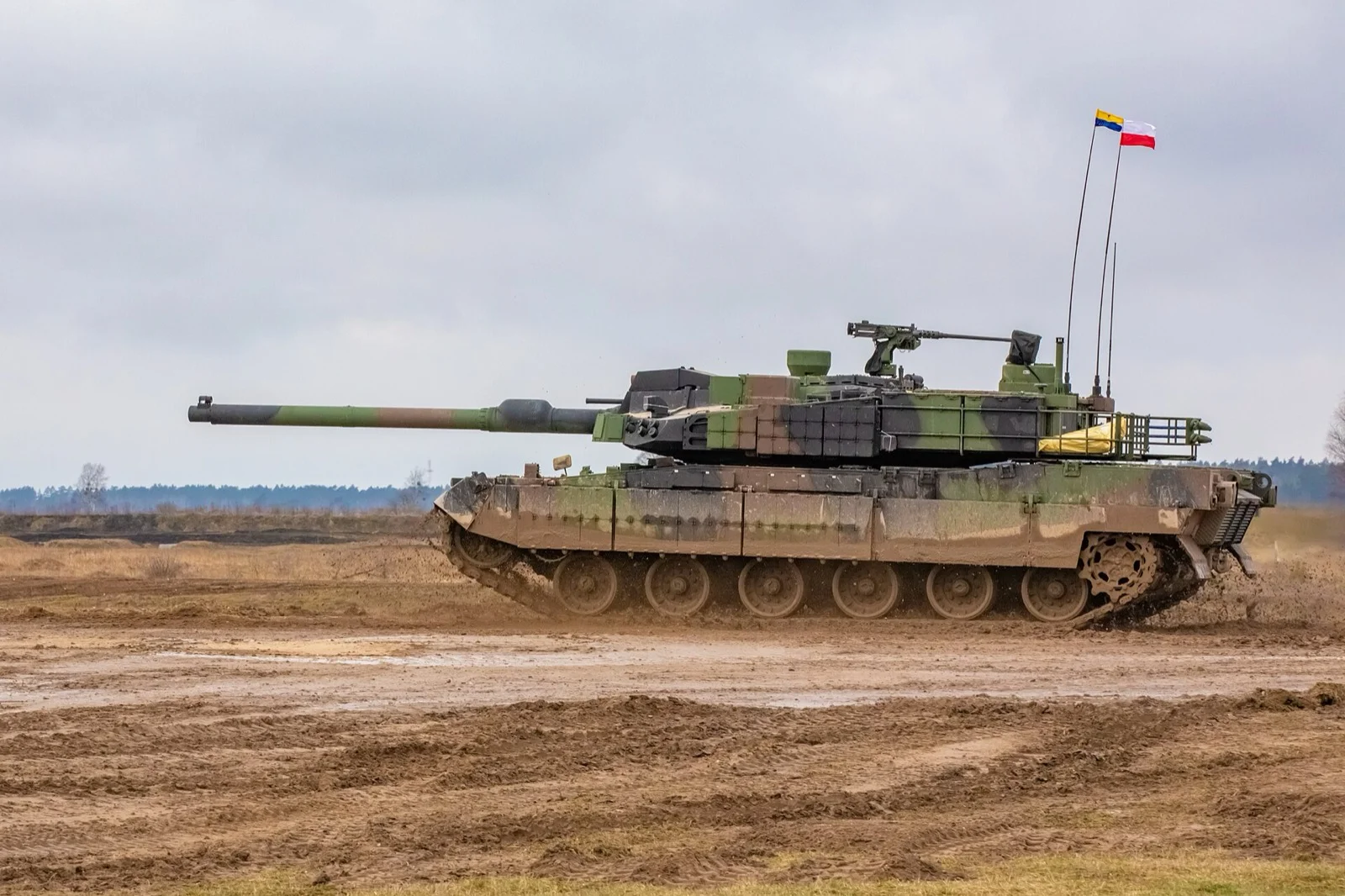
Poland is on course to field roughly 1,600 main battle tanks by 2032, according to a new analysis by the Paris-based French Institute of International Relations (IFRI). Even the interim milestone the Polish army expects to reach by 2030, close to 1,100 platforms, would already exceed the combined tank inventories of Germany, France, Italy and the United Kingdom.
A Fleet Built on Three Platform Families
Warsaw’s current armored force rests on three distinct platforms: the American M1 Abrams, the South Korean K2 Black Panther and the German-made Leopard 2 family. The mix reflects years of rapid, diversified procurement rather than a single modernization program, and it is this breadth, combined with sheer volume, that IFRI researchers describe as unusual for a European army in 2026.
Record Defense Spending Underpins the Buildup
The expansion is backed by one of the highest defense budgets, relative to GDP, inside NATO. Poland’s 2026 budget allocates 4.8 percent of GDP to defense, a figure independently confirmed by multiple sources, including Notes from Poland’s review of official NATO figures published in September 2025. That places Warsaw well above the alliance average, at a time when NATO itself is working toward a 2035 target of 5 percent of GDP.
“Conventional Deterrence,” Not Just Numbers
Amélie Zima, who heads IFRI’s program on European and transatlantic security, frames the buildup in strategic rather than purely numerical terms. The goal, she argues, is to deter Russia “from attacking with such a large force” in the first place, making the issue one of conventional deterrence rather than simply amassing hardware. IFRI’s broader assessment calls Poland’s trajectory “particularly ambitious,” noting that it runs counter to the consolidation and fleet-reduction trend seen across much of the rest of Europe since the end of the Cold War.
The Drone Problem Active Protection Has Yet to Solve
Yet analysts caution that scale alone does not guarantee survivability. Stanisław Koziej, former head of Poland’s National Security Bureau, argued in a September 2025 interview with the Polish outlet WNP that the war in Ukraine “marked the end of the era of passive armor.” In his assessment, a tank without an active protection system is now “as vulnerable as an infantryman without body armor,” a direct reference to the proliferation of first-person-view (FPV) suicide drones on the battlefield. Poland’s response so far is limited to the K2PL variant, which is planned to receive the Israeli-made Trophy active protection system. However, no clear timeline has been set for extending that capability across the rest of the growing fleet, leaving a gap between the program’s ambitions in raw numbers and its readiness against the drone threat that has reshaped armored warfare since 2022.
A New Reference Point for NATO’s Burden-Sharing Debate
Poland’s build-out also feeds directly into NATO’s broader debate over burden-sharing. With the alliance targeting 5 percent of GDP on defense by 2035, Warsaw’s current 4.8 percent and its tank numbers offer a concrete benchmark for other members, including Turkey, another NATO state with substantial land forces, as it supplies a data point for comparing force structures and spending commitments across the alliance’s eastern and southern flanks.