Croatia’s Military Strength: How Many Tanks, Aircraft and Ships Are in the Inventory? (2026)

Croatia’s military inventory shows how a country that joined NATO in 2009 and the European Union in 2013 is moving from a Soviet-era legacy to Western platforms. Croatia ranks 73rd of 145 countries in Global Firepower’s 2026 index with a PwrIndx of 1.5432, fielding 55 tanks, 67 military aircraft and 30 naval platforms. The past two years have been the fastest change in that picture since independence: 12 Rafale F3-Rs replaced the MiG-21 fleet, six Bayraktar TB2s bought from Turkey became operational in September 2025, Bradleys taken over from the United States passed to the army, compulsory basic military training resumed in 2026 and a €1.945 billion procurement package was approved in November 2025. This article examines Croatia’s land, air, missile and naval inventory item by item, using open sources.
At a Glance
- Active personnel: Global Firepower gives 14,325 active, 20,100 reserve and 2,000 paramilitary; official figures for 2024 are 13,814 active and 17,352 reserve. Compulsory basic military training resumed in 2026
- Main battle tanks: 55 (Global Firepower, 44 ready), the core being 45 M-84A4 Snajpers. Forty-four Leopard 2A8s are on order, with deliveries expected between 2028 and 2030
- Military aircraft: 67 (Global Firepower, 50 ready): 12 Rafale F3-R fighters, 37 helicopters and 26 trainers. Attack aircraft and attack helicopters 0
- Key Turkish platform: 6 Bayraktar TB2s; contract of 21 November 2024 (€67.01 million excluding VAT), declared operational with the 125th Combat-Reconnaissance Squadron on 2 September 2025
- Naval power: 30 platforms (Global Firepower), 11 of them patrol vessels; frigates, corvettes and submarines 0. The strike element is the Kralj-class missile boats carrying RBS-15B anti-ship missiles
- GFP ranking and budget: 73rd of 145 countries with a PwrIndx of 1.5432. Global Firepower gives a budget of $2.744 billion; defence spending is 2.08 per cent of GDP, with a 5 per cent target for 2035
Note: The inventory figures below are approximate values drawn from open sources such as Global Firepower, the IISS Military Balance and SIPRI.
About the Croatia Armed Forces
The Croatian Armed Forces consist of three services: the Army (HKoV), the Navy (HRM) and the Air Force (HRZ). Official figures for 2024 record 13,814 active and 17,352 reserve personnel, while Global Firepower’s 2026 tally gives 14,325 active, 20,100 reserve and 2,000 paramilitary. The commander-in-chief is President Zoran Milanović, the defence minister is Deputy Prime Minister Ivan Anušić and the chief of the general staff is General Tihomir Kundid. The country joined NATO in 2009 and the European Union in 2013, and its defence planning is shaped by both frameworks.
The clearest structural change of 2026 is the return of conscription. On 24 October 2025 the Croatian parliament amended the Defence Act by 84 votes, restoring the basic military training suspended in 2008. The training lasts two months and is conducted at the Knin, Slunj and Požega barracks, covering personal weapons handling, the use of unmanned aircraft, first aid and basic defence skills. The allowance is €1,100 a month, the period counts towards work history, and those objecting on religious or moral grounds are directed to civilian service. The first 1,200 call-ups went to men born in 2007, medical examinations began in January 2026, the first intake entered barracks on 9 March 2026 and completed training on 9 May 2026. The second intake was raised to 900 and the third to 1,000, with an annual target of about 4,000 recruits across five cohorts.
On the procurement side, 2024-2026 has been the busiest period since independence. The last of the 12 second-hand Rafale F3-R fighters bought from France was delivered in May 2025 and the Soviet-built MiG-21 fleet was retired. Of the 89 M2A2 Bradley ODS infantry fighting vehicles taken over from the United States, 62 have been allocated to frontline units, with refurbishment carried out in Croatia. The six Bayraktar TB2s acquired from Turkey were declared operational with the 125th Combat-Reconnaissance Squadron on 2 September 2025. Delivery of the Mistral 3 short-range air-defence missiles bought from France’s MBDA was completed at the end of 2025. Eight HIMARS and eight UH-60M Black Hawks are on order from the United States, and delivery of both has been agreed to be brought forward to late 2027 or early 2028.
In November 2025 the parliamentary defence committee approved a four-item procurement package worth about €1.945 billion: 44 Leopard 2A8 main battle tanks from Germany, 18 Caesar Mk2 self-propelled howitzers from France, a new air-defence system and 420 Tatra T-815-7 heavy off-road trucks. The tanks, howitzers and trucks are financed through the European Union’s SAFE loan instrument, while the air-defence system comes directly from the defence ministry budget. Leopard 2A8 deliveries are expected between 2028 and 2030; once complete, Croatia’s armoured backbone will have moved from the Yugoslav-era M-84 to a Western standard.
The budget also sets the limit of that package. The 2025 defence budget was €1.931 billion and defence spending stands at 2.08 per cent of GDP, just above NATO’s 2 per cent floor. Global Firepower gives the budget as $2.744 billion. Croatia supports NATO’s 5 per cent target for 2035, of which 3.5 per cent would go to military spending proper and 1.5 per cent to broader security investment. A theme Minister Anušić repeats often is strengthening the domestic industry: Đuro Đaković (armoured vehicles and Patria AMV assembly), HS Produkt (infantry weapons), Brodosplit (patrol vessels) and, in unmanned systems, the Osijek-based ORQA form the country’s industrial backbone.
Operationally Croatia is a comparatively small but continuously deployed military. Figures for 2026 record 496 personnel with KFOR in Kosovo, 198 in Hungary, 58 in Poland and 2 in Lithuania with NATO’s forward-deployed battle groups, plus 20 in Iraq, 13 with UNMOGIP, 10 with MINURSO in Western Sahara and 4 in Bulgaria. The PzH 2000 battery sent to the battle group in Poland is the most visible contribution of Croatian artillery within NATO. Croatia has also provided more than €300 million in military aid to Ukraine since 2022.
Land Forces Inventory
| System type | Est. quantity |
|---|---|
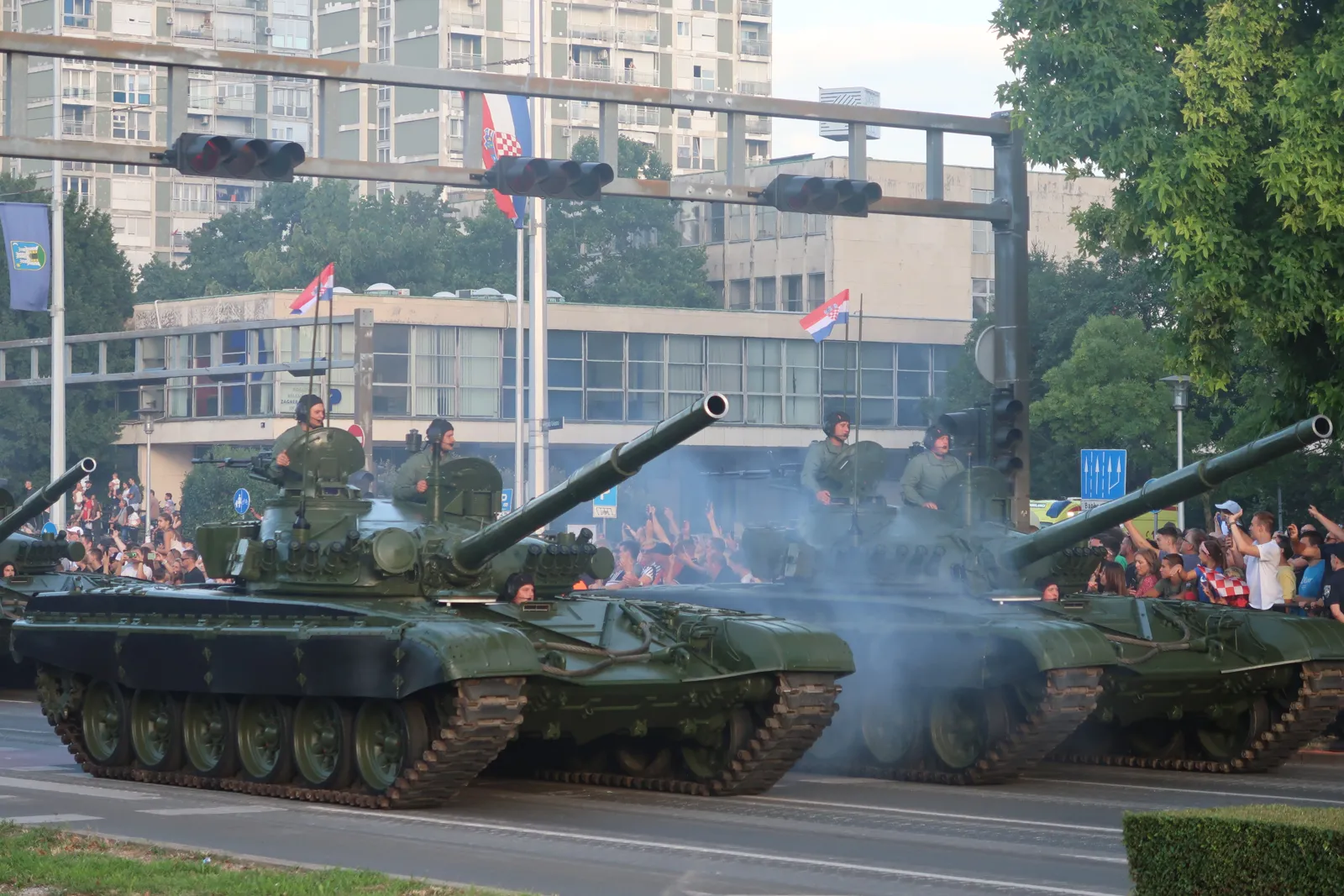
| Main battle tanks (M-84A4 Snajper) | 45; the Croatian-modernised version of the M-84 inherited from the Yugoslav period. Global Firepower gives a total tank count of 55, of which 44 are ready |
| Main battle tanks (Leopard 2A8) | 44 on order; the German procurement is the largest item in the roughly €1.945 billion package approved by the parliamentary defence committee in November 2025, with deliveries expected between 2028 and 2030. Leopard 2A4 HRV tanks leased for training are also in use |
| Infantry fighting vehicles (M2A2 Bradley ODS) | 89 taken over from the United States: 62 for frontline units, 5 for training and 22 for the spare parts pool. Refurbishment is carried out in Croatia and the fleet is planned to pass fully to the army during 2026 |
| Infantry fighting vehicles (BVP M-80A) | 74; the Yugoslav-built tracked vehicle, gradually moving to a second-line role as the Bradleys arrive |
| Wheeled armour (Patria AMV) | 126; the Finnish design assembled in Croatia. Eight are BOV-P30s with a 30 mm turret, the remainder personnel carrier versions with 12.7 mm guns and Mk19 grenade launchers plus ambulance and recovery variants. Global Firepower gives 4,874 armoured vehicles under a broad definition |
| Self-propelled howitzers (PzH 2000 and Caesar Mk2) | 16 PzH 2000s (Germany) in service and 18 Caesar Mk2s (France) on order. Global Firepower gives a self-propelled artillery count of 25 |
| Towed howitzers | 54 D-30s (122 mm, modified in Croatia) and 8 2S1 Gvozdikas; Global Firepower gives a towed artillery count of 42 |
| Multiple rocket launchers | 30 APR-40s and 6 M-92 Vulkans (both 122 mm); Global Firepower gives a total of 42. Eight HIMARS are on order from the United States at €262.196 million excluding VAT, with delivery agreed to be brought forward to late 2027 or early 2028 |
| Anti-tank weapons | 8 Spike LR2 launchers with 200 missiles on Patria AMVs and 1,703 BGM-71 TOW-2 missiles on the Bradleys; Soviet-era Fagot, Konkurs and Metis systems remain in reserve |
| Tactical vehicles and logistics | 420 Tatra T-815-7 heavy off-road trucks are on order, the mobility item within the €1.945 billion package, most of which is financed through the EU SAFE loan instrument |
| Combat organisation | The core of the army is the Guards Mechanised Brigade together with artillery-rocket and engineer regiments. The two-month basic military training resumed in 2026 is conducted at the Knin, Slunj and Požega barracks |
Air Force Inventory
| Platform | Est. quantity |
|---|---|
| Total military aircraft | 67 (Global Firepower, 50 ready): fighters 12, attack aircraft 0, trainers 26, helicopters 37, attack helicopters 0 |
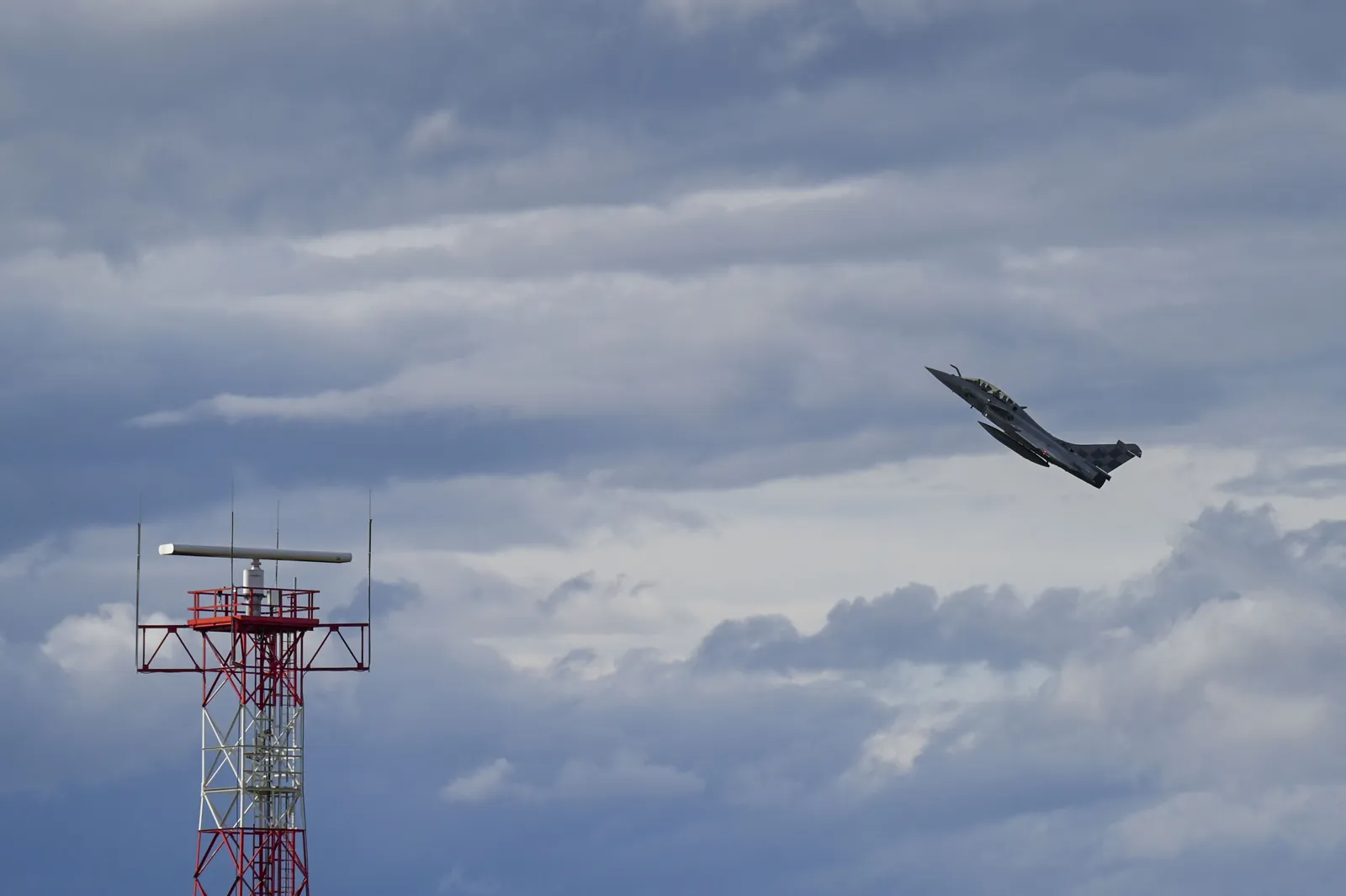
| Fighter aircraft (Rafale F3-R) | 12; six single-seat C and six two-seat B aircraft. The last of these second-hand French aircraft was delivered in May 2025, replacing the MiG-21 fleet. They serve with the 191st Fighter Squadron at 91st Air Base Pleso near Zagreb and are planned to be upgraded to F4 standard between 2027 and 2032 |
| Armed unmanned aircraft (Bayraktar TB2) | 6, acquired from Turkey under a contract signed on 21 November 2024 and all delivered in 2025. They were declared operational with the 125th Combat-Reconnaissance Squadron on 2 September 2025, with crews trained in Turkey between April and August 2025. They are armed with laser-guided munitions |
| Trainer aircraft | 14 Pilatus PC-9Ms and 4 Zlin Z 242Ls; the PC-9Ms can also be used for reconnaissance and light close air support. Global Firepower gives a trainer count of 26 |
| Transport and multirole helicopters | 10 Mi-171Shs (from Russia in 2007-2008) and 4 UH-60M Black Hawks; eight more Black Hawks are on order and delivery has been agreed with the United States to be brought forward to late 2027 or early 2028 |
| Light and scout helicopters | 15 OH-58D(R) Kiowa Warriors (16 received from the United States, one lost) and 8 Bell 206B-3 trainers. There is no attack helicopter in the inventory |
| Aerial firefighting fleet | 6 Canadair CL-415s and 6 Air Tractor AT-802s; this is Croatia’s most visible military capability during Mediterranean wildfire seasons and it also supports neighbouring countries |
| Bases and organisation | 91st Air Base Pleso (Zagreb) hosts the Rafale squadron and the Black Hawks, while 93rd Air Base Zemunik (Zadar) hosts the transport, training and firefighting squadrons |
Missile and Air-Defence Systems
| System | Type / Note |
|---|---|
| Ballistic and cruise missiles | None; Croatia has no ground-launched ballistic or cruise missiles. Long-range strike capability will be established with the eight HIMARS on order |
| Anti-ship missiles (RBS-15B) | 47 missiles in total, launched from the Kralj-class missile boats and from three mobile coastal launchers mounted on Tatra trucks. This is Croatia’s longest-range strike system |
| Short-range air defence (Mistral 3) | Acquired under a contract of about €72 million signed with France’s MBDA in December 2022, with delivery announced as complete by the end of 2025. The third-generation infrared-seeker system with a range of more than 6 km replaces the ageing Soviet-era shoulder-launched missiles |
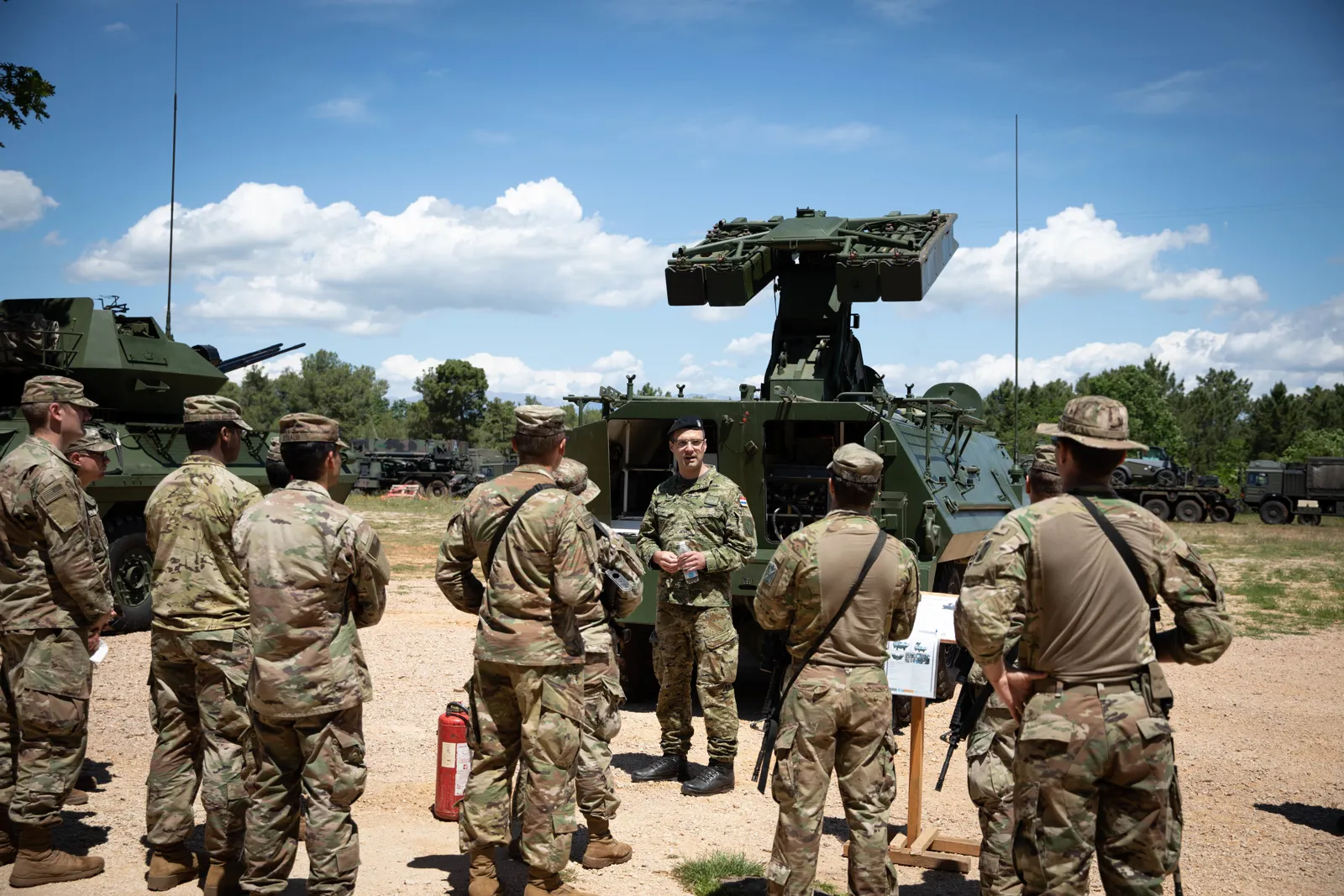
| Short-range air defence (Strijela-10CROA1) | The Croatian-developed self-propelled version of the Soviet 9K35 Strela-10, forming the backbone of the Air Defence Regiment. Igla-1 shoulder-launched missiles and BOV-3 triple 20 mm anti-aircraft systems are also in the inventory |
| Medium and long-range air defence | None in the inventory; the package approved by the parliamentary defence committee in November 2025 includes the procurement of a new air-defence system, financed directly from the defence ministry budget rather than the SAFE loan. Airspace security also rests on NATO integrated air and missile defence |
| Guided anti-tank missiles | Spike LR2 (8 launchers on Patria AMVs with 200 missiles) and BGM-71 TOW-2 (1,703 missiles on the Bradleys); Soviet-era Fagot, Konkurs and Metis systems are in reserve |
Naval Power
| Class / Type | Est. quantity |
|---|---|
| Total platforms | 30 (Global Firepower), 11 of them patrol vessels and 1 a mine warfare ship. Aircraft carriers, submarines, destroyers, frigates and corvettes 0 |
| Personnel and base | About 1,363 personnel as of 2026, with the main base at Lora Naval Base in Split. The navy also carries out the coast guard mission |
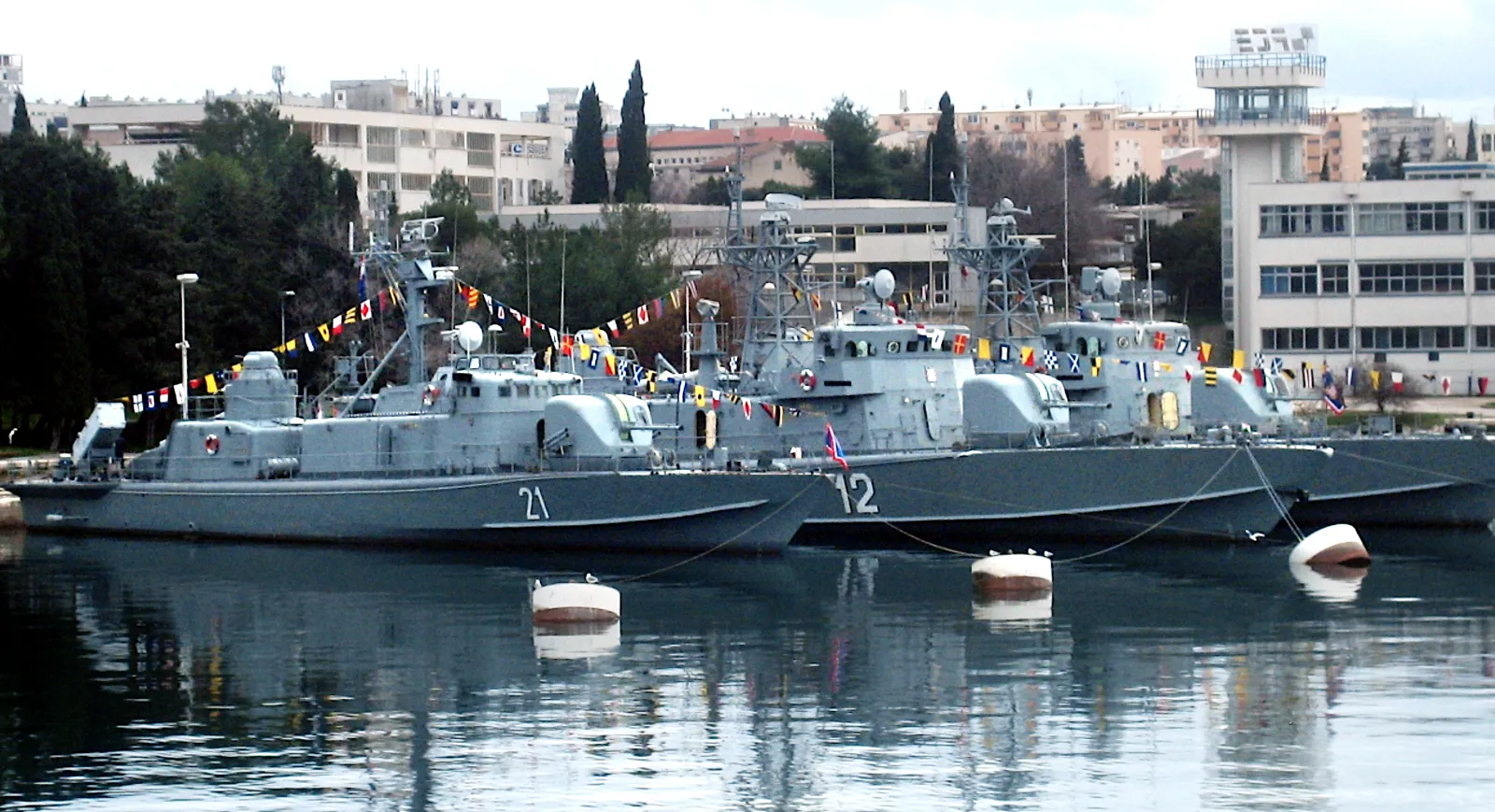
| Missile boats (Kralj class) | RTOP-11 Kralj Petar Krešimir IV (1992) and RTOP-12 Kralj Dmitar Zvonimir (2001); these two craft, armed with RBS-15B anti-ship missiles, form the navy’s strike element. RTOP-21 Šibenik also serves in the same group |
| Missile boats (Helsinki class) | RTOP-41 Vukovar and RTOP-42 Dubrovnik, acquired from Finland in 2008 |
| Coastal patrol boats (Omiš class) | A domestic 43.5 m, 220-tonne design; the first vessel OOB-31 Omiš entered service in December 2018 and OOB-32 Umag in 2025, with three more under construction. A 30 mm remote-controlled weapon station from Turkey’s ASELSAN was fitted to OOB-31 |
| Mine warfare and landing | 2 Cetina-class minelayer-landing ships and the LM-51 Korčula minehunter, built in 2006 |
| Support and training ships | The BŠ-72 Andrija Mohorovičić training ship (1972) and the BS-73 Faust Vrančić salvage ship (1976) |
| Coastal defence | Three mobile RBS-15 launchers mounted on Tatra trucks, the basic element of deterrence along a coastline formed by more than 1,200 Adriatic islands and islets |
The Turkey Angle: Turkish Defence Industry
Croatia has one of the most concrete links to the Turkish defence industry among the countries examined in this series: its inventory already contains a fleet of Turkish-built armed unmanned aircraft and a Turkish-built weapon station. The contract was signed at the defence ministry in Zagreb on 21 November 2024, when Deputy Prime Minister and Defence Minister Ivan Anušić and a Baykar executive agreed on six armed Bayraktar TB2s for €67.01 million excluding VAT. Beyond the aircraft, the package covers fixed and mobile ground control stations, munitions, personnel training and maintenance support through the warranty period.
Deliveries were completed in 2025. The systems were tested at the “Pukovnik Marko Živković” barracks in Velika Gorica and crews were trained in Turkey between April and August 2025. On 2 September 2025 the Bayraktar TB2s were declared operational with the 125th Combat-Reconnaissance Squadron at Pleso. The aircraft can carry laser-guided munitions with a range of up to 15 kilometres, and maintenance support is provided by Baykar during and after the warranty period. This is the first armed unmanned aircraft capability in the history of the Croatian Air Force.
The second concrete item is ASELSAN. A 30 mm remote-controlled weapon station from ASELSAN was fitted to OOB-31 Omiš, one of the Croatian Navy’s domestically designed Omiš-class coastal patrol boats; the system uses the US-built MK44 Bushmaster cannon. ASELSAN electro-optical systems are also used on the Bayraktar TB2s. The third item is industrial cooperation: at the SAHA EXPO exhibition in Istanbul in 2024, Baykar signed an agreement with the Osijek-based Croatian company ORQA covering the integration of Croatian-built FPV unmanned aircraft with the Bayraktar platform, the development of joint operational concepts and technological cooperation. It was signed by Baykar general manager Haluk Bayraktar and ORQA director Ivan Jelušić, witnessed by Brigadier General Davor Tretinjak, head of the defence ministry’s armament and equipment sector, and Croatia’s ambassador to Turkey Hrvoje Cvijanović.
Institutional contact has accelerated as well. Anušić and General Kundid visited Turkey on 18-20 February 2025 and met Minister of National Defence Yaşar Güler in Ankara; the delegation toured the ASELSAN and MKE plants as well as the Special Forces Command and the Unmanned Systems Command. During the visit Anušić said the defence industry in Croatia had to be strengthened and that Turkish investment could help, noting that the establishment of an ammunition plant had come up. Even so, there is no publicly announced comprehensive defence industry framework agreement between the two countries; cooperation currently runs through direct contracts and company-level memoranda.
The political ground has long been in place. Turkey was among the first countries to recognise Croatia’s independence on 6 February 1992; diplomatic relations were established on 26 August 1992 and embassies opened on both sides in 1993, the Turkish mission in Zagreb having operated as a consulate since 1969 in the Yugoslav period. Turkey supported Croatia’s NATO membership, and the Turkey-Bosnia and Herzegovina-Croatia Trilateral Consultation Mechanism established in January 2010 has met ten times at foreign minister level. The Turkish president visited Croatia on 7-8 September 2022, meeting President Milanović and Prime Minister Plenković; the Recep Tayyip Erdoğan Islamic Culture Centre in Sisak was opened during the same visit. Croatian Foreign Minister Gordan Grlić Radman made a working visit to Turkey on 6 March 2025, and the Turkish foreign minister attended the Three Seas Initiative Summit in Dubrovnik on 28 April 2026. Trade reached $984.5 million in 2025 (Turkish exports $770.5 million, imports $214 million), and about 70 Turkish firms operate in Croatia in tourism, construction, banking and renewable energy.
Frequently Asked Questions
How many tanks does Croatia have? Global Firepower’s 2026 tally gives Croatia 55 tanks, of which 44 are ready. The core is 45 M-84A4 Snajpers, the Croatian-modernised version of the M-84 inherited from the Yugoslav period, alongside Leopard 2A4 HRV tanks leased for training. That picture will change in the coming years: the package approved by the parliamentary defence committee in November 2025 includes 44 Leopard 2A8 main battle tanks from Germany, with deliveries expected between 2028 and 2030. Among infantry fighting vehicles, 62 of the 89 M2A2 Bradley ODS taken over from the United States have gone to frontline units, and 74 BVP M-80As and 126 Croatian-assembled Patria AMVs are in the inventory.
What fighter aircraft does Croatia operate? The only fighter type in the Croatian Air Force is the Rafale F3-R: twelve aircraft, six single-seat C and six two-seat B. The last of these second-hand French aircraft was delivered in May 2025, replacing the Soviet-built MiG-21 fleet. They are based with the 191st Fighter Squadron at 91st Air Base Pleso near Zagreb and are planned to be upgraded to F4 standard between 2027 and 2032. There are no attack aircraft and no attack helicopters; the rest of the fleet comprises 14 PC-9M trainers, 10 Mi-171Shs, 4 UH-60M Black Hawks, 15 OH-58D Kiowa Warriors and, for firefighting, 6 Canadair CL-415s and 6 Air Tractor AT-802s.
Does Croatia operate Bayraktar TB2s? Yes. On 21 November 2024 Croatia signed a contract in Zagreb with the Turkish company Baykar for six armed Bayraktar TB2s at €67.01 million excluding VAT, signed by Deputy Prime Minister and Defence Minister Ivan Anušić. All systems were delivered during 2025, tested at the “Pukovnik Marko Živković” barracks in Velika Gorica and declared operational with the 125th Combat-Reconnaissance Squadron at Pleso on 2 September 2025. Crews were trained in Turkey between April and August 2025. The aircraft can carry laser-guided munitions with a range of up to 15 kilometres. This is the first armed unmanned aircraft capability in Croatia’s history.
How strong is the Croatian Navy? Global Firepower counts 30 platforms for the Croatian Navy, 11 of them patrol vessels and one a mine warfare ship. There are no frigates, corvettes, submarines or destroyers. Its strike element is the Kralj-class missile boats armed with RBS-15B anti-ship missiles: RTOP-11 Kralj Petar Krešimir IV (1992) and RTOP-12 Kralj Dmitar Zvonimir (2001), alongside RTOP-41 Vukovar and RTOP-42 Dubrovnik acquired from Finland in 2008. The inventory holds 47 RBS-15B missiles in total, which can also be fired from three mobile coastal launchers mounted on Tatra trucks. Of the domestically designed Omiš-class coastal patrol boats, OOB-31 Omiš entered service in 2018 and OOB-32 Umag in 2025; a 30 mm remote-controlled weapon station from Turkey’s ASELSAN was fitted to OOB-31. The main base is Lora in Split and personnel numbered about 1,363 in 2026.
Is military service compulsory in Croatia? Yes, again from 2026. On 24 October 2025 the Croatian parliament amended the Defence Act by 84 votes, restoring the basic military training suspended in 2008. The training lasts two months at the Knin, Slunj and Požega barracks and covers personal weapons handling, the use of unmanned aircraft, first aid and basic defence skills. The monthly allowance is €1,100 and the period counts towards work history; those objecting on religious or moral grounds are directed to civilian service, and women may volunteer. The first 1,200 call-ups went to men born in 2007, the first intake entered barracks on 9 March 2026 and completed training on 9 May 2026, the second intake was raised to 900 and the third to 1,000, with an annual target of about 4,000 recruits across five cohorts.
Bottom Line
Croatia’s inventory is a clean example of how a small NATO member sets priorities on a limited budget. The country competes on quality rather than platform numbers: with 55 tanks and 67 aircraft it sits mid-table regionally, but the move from the MiG-21 to the Rafale, the takeover of the Bradleys and the Mistral 3 purchase show an inventory shifting from a Soviet-era legacy to a Western standard. The €1.945 billion package approved in November 2025 is the second stage of that shift: 44 Leopard 2A8s, 18 Caesar howitzers, a new air-defence system and 420 Tatra trucks. The weaknesses are equally clear: there is no medium or long-range air-defence layer, no attack helicopter and no frigate or submarine in the navy; defence spending stands at 2.08 per cent of GDP, just above the NATO floor, and financing for the big procurement rests largely on the EU’s SAFE loan. The two-month compulsory basic training resumed in 2026 aims to build a manpower pool of about 4,000 a year. For Turkey, Croatia falls outside the “potential market” description seen so often in this series: here procurement has already happened. Six Bayraktar TB2s created the country’s first armed unmanned aircraft capability, an ASELSAN weapon station is in service on the Croatian Navy’s newest patrol boat, and the Baykar-ORQA agreement is widening the relationship from procurement towards joint production and integration. The one missing link is a comprehensive defence industry framework agreement to institutionalise it.
Related Reading
Sources
- Global Firepower — Croatia
- IISS — The Military Balance
- SIPRI — Arms Transfers Database
- Wikipedia — Armed Forces of Croatia
- Wikipedia — Croatian Air Force
- Wikipedia — Croatian Navy
- Wikipedia — List of equipment of the Croatian Army
- Croatian MoD — Bayraktar TB2 contract (21 November 2024)
- Obris — Bayraktar TB2 in operational service (2 September 2025)
- Obris — Anušić’s visit to Turkey (18-20 February 2025)
- Obris — Baykar-ORQA agreement at SAHA EXPO 2024
- OSW — Croatia reinstates compulsory military service
- Overt Defense — Croatia greenlights €1.95 billion defence projects
- Croatian MoD — HIMARS procurement decision
- Turkish MFA — Turkey-Croatia relations