What is the F-22 Raptor? The U.S. 5th Generation Air Superiority Fighter
Summary Not Found.
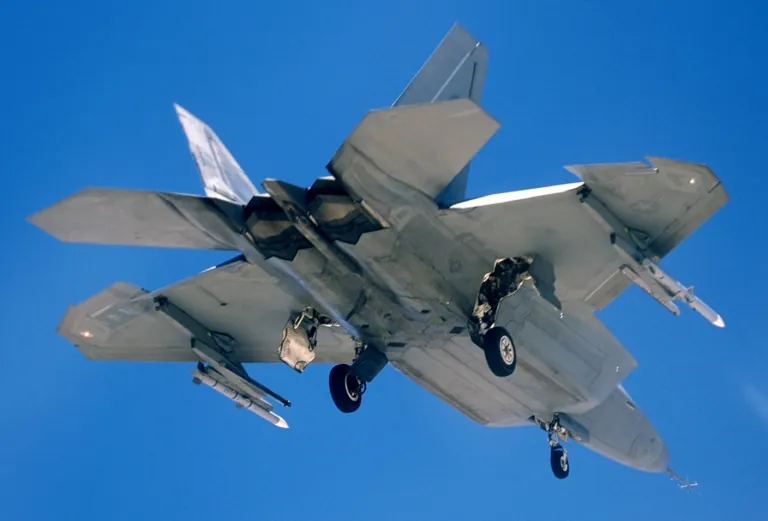
F-22 Raptor: The 5th generation air superiority fighter of the U.S. Air Force. (Representative image)
F-22 Raptor is the world’s first 5th generation fighter jet to enter mass production, developed by Lockheed Martin in partnership with Boeing. Combining low radar cross-section (stealth), supercruise, thrust vectoring supermaneuverability, and advanced sensor fusion in a single platform, the Raptor was primarily designed for air superiority. In this file, we objectively discuss the features of the F-22, its production story, the export ban, and its position against the F-35, Su-57, and J-20.
Contents: Overview · Technical specifications · Stealth and supercruise · Weapon load · Production and export ban · Comparison · FAQ
Overview: Why is the Raptor important?
The F-22 was born as a superiority platform capable of surpassing Soviet air defense and fighters under the ATF (Advanced Tactical Fighter) program in the late Cold War. The YF-22 demonstrator flew in 1990; the production type took to the skies in 1997, and the aircraft entered the U.S. Air Force inventory in 2005.
The design philosophy of the Raptor can be summarized in one sentence: see first, strike first, remain unseen. The low radar cross-section reduces the enemy detection range, while sensor fusion allows the pilot to see a unified air picture on a single screen.
Technical Specifications
Feature
Value
Manufacturer
Lockheed Martin / Boeing
Type
Single-seat, twin-engine air superiority fighter
Engine
2× Pratt & Whitney F119-PW-100 (thrust vectoring)
Maximum Speed
~Mach 2.25 (high altitude)
Supercruise
Above Mach 1.8 (without afterburner)
Ceiling
~19,800 m
Armament
AIM-120 AMRAAM, AIM-9 Sidewinder, 20 mm cannon in internal bays
Production Quantity
195 (8 test + 187 operational)
Stealth and supercruise: two features that make a difference
The F-22 is the first operational fighter capable of sustained supersonic flight (supercruise) without afterburners. This provides both range and an energy advantage against enemy missiles.
Thrust vectoring two-dimensional nozzles give the aircraft extraordinary nose pointing capability (supermaneuverability) even at low speeds. Stealth is achieved not only through the shape of the fuselage but also with radar-absorbing coatings and internal weapons carriage.
Weapon load
The Raptor carries its weapons in internal bays to maintain a low radar profile. The typical air-to-air configuration includes six AIM-120 AMRAAMs and two AIM-9 Sidewinders. Small diameter bombs (SDB) have also been integrated for limited air-to-ground capability.
Production and export ban
The F-22 has not been exported to any country. With the 1998 Obey Amendment, the U.S. Congress legally prohibited the export of the Raptor; therefore, the aircraft is only used by the U.S. Air Force.
Production was ended much earlier than planned, in 2011, with 195 aircraft due to budget constraints. This low number is a key factor that makes the maintenance and modernization of the fleet expensive today.
F-22 vs F-35, Su-57, and J-20
The F-22 is designed for pure air superiority; the F-35, on the other hand, is designed as a multirole (air-ground focused) platform. Therefore, they are not competitors but complementary. The Russian Su-57 and Chinese J-20 are the closest counterparts to the Raptor in the heavy fighter class.
Aircraft
Country
Seat
Engine
Max Speed
Main Air-to-Air Missile
F-22 Raptor
USA
Single
2× F119-PW-100 (TVC)
~Mach 2.25
AIM-120, AIM-9
F-35A
USA
Single
1× F135
~Mach 1.6
AIM-120, AIM-9X
Su-57
Russia
Single
2× AL-41F1 / Izdelie 30
~Mach 2.0
R-77M, R-37M
J-20
China
Single
2× WS-10C / WS-15
~Mach 2.0
PL-15, PL-10
Note: The comparison is based on open source data; actual combat performance varies depending on doctrine, sensor networks, and training.
Frequently Asked Questions
How many F-22s have been produced?
A total of 195 aircraft were produced (8 for testing, 187 operational). Production ended in 2011.
Why is the F-22 not exported?
U.S. laws prohibit the export of the F-22 due to the Obey Amendment of 1998. The aircraft serves only in the U.S. Air Force.
Is the F-22 superior to the F-35?
They are designed for different roles: the F-22 excels in air superiority, while the F-35 is prominent in multi-role missions and network-centric warfare. The comparison depends on the role.
What is the cost of the F-22?
According to sources, the flyaway cost per aircraft is approximately $150 million; the unit cost of the program including R&D is higher. Package and program costs should be read separately.
{“@context”: “https://schema.org”, “@type”: “FAQPage”, “mainEntity”: [{“@type”: “Question”, “name”: “How many F-22s were produced?”, “acceptedAnswer”: {“@type”: “Answer”, “text”: “A total of 195 aircraft were produced (8 for testing, 187 operational). Production ended in 2011.”}}, {“@type”: “Question”, “name”: “Why is the F-22 not exported?”, “acceptedAnswer”: {“@type”: “Answer”, “text”: “The Obey Amendment of 1998 prohibits the export of the F-22 under U.S. law. The aircraft only serves in the U.S. Air Force.”}}, {“@type”: “Question”, “name”: “Which is superior, the F-22 or the F-35?”, “acceptedAnswer”: {“@type”: “Answer”, “text”: “They are designed for different roles: the F-22 excels in air superiority, while the F-35 is prominent in multi-role missions and network-centric warfare. The comparison depends on the role.”}}, {“@type”: “Question”, “name”: “What is the price of the F-22?”, “acceptedAnswer”: {“@type”: “Answer”, “text”: “According to sources, the flyaway cost per aircraft is approximately $150 million; the program unit cost including R&D is higher. Package and program costs should be read separately.”}}]}