What Is an HE Shell? High-Explosive Ammunition Explained

# What Is an HE Shell? High-Explosive Ammunition Explained
Quick answer: An HE (High-Explosive) shell is the most common artillery and tank round. It’s basically a metal pot filled with explosive (typically TNT or RDX-based). When it lands, it explodes — and the metal casing shatters into thousands of high-velocity shrapnel fragments that kill troops and damage soft vehicles in a wide area.
What’s Inside an HE Shell
| Part | Job |
|---|---|
| Casing (steel/cast iron) | Becomes the shrapnel |
| Filler (explosive) | TNT, Composition B, Comp H6, RDX-mix |
| Fuse | Triggers detonation (timed, impact, proximity, etc.) |
| Driving band (copper) | Grips rifling, spins shell for stability |
| Booster | Small explosive that triggers main charge |
A typical 155 mm artillery HE shell weighs about 45 kg and contains 8–10 kg of explosive (TNT or Composition B).
How HE Damages
Two effects, both deadly:
- 1. Blast (overpressure) — destroys nearby structures and ear drums
- 2. Fragmentation (shrapnel) — sprays jagged metal pieces at supersonic speed for tens of meters
For infantry without armor or cover, even a 81 mm mortar HE has a lethal radius of ~30 meters. A 155 mm howitzer shell: 50 meters lethal, 100 meters wounding.
Different Fuse Types
The same HE shell with a different fuse becomes a different weapon:
| Fuse Type | When It Detonates | Best Used For |
|---|---|---|
| Point Detonation | On impact | Hard targets |
| Delay | Slightly after impact | Bunker-busting |
| Proximity (VT) | When close to ground/target | Airburst, anti-aircraft |
| Time | After set seconds | Airburst at known range |
| Smart / Programmable | Programmable burst | Infantry behind cover |
The most lethal vs infantry: proximity-fused airburst about 10 meters above ground. Shrapnel rains down in a 100-meter circle.
HE vs HEAT vs APFSDS
Confusion is common. Here’s the clear chart:
| Round | Designed For | Mechanism |
|---|---|---|
| HE | Infantry, trucks, buildings | Blast + shrapnel everywhere |
| HE-Frag | Same, optimized for shrapnel | Pre-fragmented casing |
| HEAT | Tanks | Focused shaped-charge jet |
| APFSDS | Tanks | High-velocity dart, kinetic |
A modern tank gun fires all of these — different rounds for different missions.
Famous HE Calibers
| Caliber | Common Use | Famous Examples |
|---|---|---|
| 60 mm | Mortars | Light infantry support |
| 81 mm | Mortars | Most NATO mortars |
| 105 mm | Howitzers, old tanks | M119, L7 |
| 120 mm | Mortars, modern tanks | M256, RH-120 |
| 122 mm | Russian artillery | D-30, 2S1 |
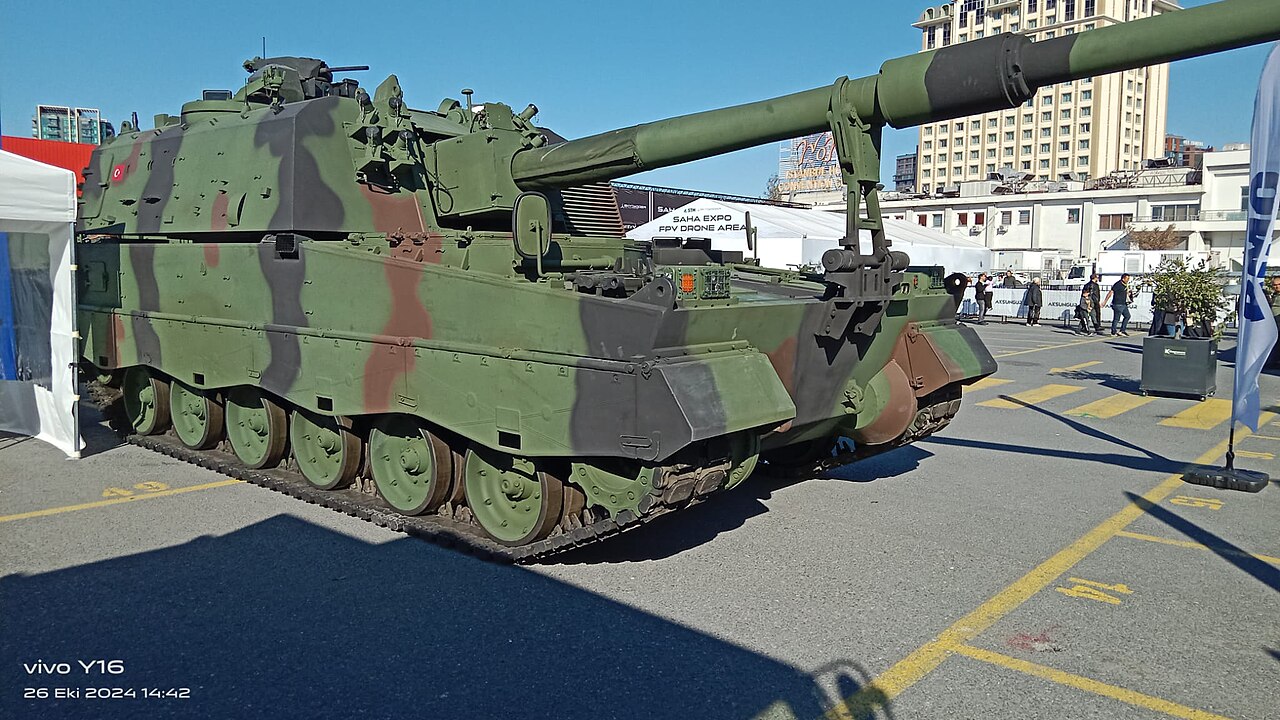
| 155 mm | Standard NATO artillery | M777, K9, T-155 Fırtına, M109 Paladin |
| 152 mm | Russian artillery | Msta-S |
| 203 mm | Heavy artillery | M110, 2S7 Pion |
| 240 mm | Russian mortars | 2S4 Tyulpan |
| 460 mm | Yamato battleship guns (historic) | WW2 era |
Modern Smart HE — Excalibur
Old HE shells were “dumb” — fired in the general direction, hoped for the best. Modern precision-guided artillery uses GPS-corrected HE shells to land within 4 meters of a target.
Famous examples:
- M982 Excalibur (USA) — 50+ km range, GPS-guided
- BONUS / SMART 155 — submunition with thermal sensor
- Vulcano (Italy/Germany) — GPS + IR
- Krasnopol (Russia) — laser-guided
Cluster vs Unitary HE
A “unitary” HE is one big shell that explodes once. A “cluster” shell releases dozens or hundreds of smaller submunitions over a wider area. Cluster munitions are now banned by the 2008 Convention on Cluster Munitions (110+ countries), but some major militaries (USA, Russia, China, Türkiye) didn’t sign.
Both Ukraine and Russia have used cluster munitions extensively in the 2022–2025 war.
HE in Modern Wars
The 2022–2025 Russia–Ukraine war became the largest artillery war since WWII. Estimates suggest Russia fired 20,000+ shells per day at peak; Ukraine 5,000+. The shell shortage forced Western countries to dramatically expand 155 mm production.
This proved that even in the drone and missile age, HE artillery remains the queen of the battlefield.
HE in Aircraft
- Air-dropped bombs: Mk-82 (500 lb), Mk-83 (1,000 lb), Mk-84 (2,000 lb) — basically big HE shells
- Aircraft cannons: 20 mm and 30 mm HE rounds for strafing
- Air-to-ground missiles: HE warheads for soft targets
A Kid-Friendly Analogy
A HEAT round is like a single sharp needle — pierces one thing precisely. An HE shell is like a glass bottle filled with marbles, dropped on the floor — pieces fly everywhere, hitting everything nearby.
For one tank, you want the needle. For ten soldiers in the open, you want the bottle.
Image Suggestions
- 1. Featured: 155mm HE shell on pallet
- 2. Fragmentation pattern of an HE shell (overhead view)
- 3. Different fuses lineup
- 4. Excalibur GPS-guided shell
- 5. Comparison: HE vs HEAT vs APFSDS
Related Articles
- What is artillery?
- What is HEAT ammunition?
- What is APFSDS?
- What is a fuse?
- What is the Excalibur shell?