What Is IFF (Identification Friend or Foe)? Explained Simply

# What Is IFF (Identification Friend or Foe)? Explained Simply
Quick answer: IFF stands for Identification Friend or Foe. It’s the system aircraft and ships use to identify themselves as friendly to other military forces. The basic idea: an “interrogator” sends out a coded radio question. If the target responds correctly, it’s a friend. If it doesn’t respond or responds wrongly, it could be an enemy or a civilian.
The Core Concept
Imagine you’re guarding a fortress at night. Someone walks toward you in the dark. You yell, “What’s the password?”
- They yell back the correct password → friend
- They don’t know the password → enemy or stranger
IFF is exactly this, but with radio waves instead of voices. The “interrogator” is the asker. The “transponder” is the answerer.
How IFF Works (Simplified)
- 1. Radar detects an aircraft 100 km away.
- 2. IFF interrogator sends a coded pulse (Mode X).
- 3. Aircraft’s transponder receives the pulse.
- 4. If friendly, transponder replies with the correct encrypted code.
- 5. Radar display marks the contact as friendly (usually green).
- 6. No reply or wrong reply = mark as unknown (yellow) or hostile (red).
The whole exchange takes milliseconds.
IFF Modes
| Mode | What It Does | Use |
|---|---|---|
| Mode 1 | 2-digit military code | Mission type |
| Mode 2 | 4-digit code | Specific aircraft ID |
| Mode 3/A | 4-digit (civilian SSR) | ATC squawk |
| Mode C | Altitude reporting | Civilian + military |
| Mode 4 | Encrypted (cold-war era) | Old NATO |
| Mode S | Selective interrogation | Modern civilian + military |
| Mode 5 | Modern encrypted secure | Current NATO standard |
Modern military aircraft typically have Modes 3/A, C, S, and 5.
Why IFF Mistakes Happen
Even with IFF, friendly fire and civilian shoot-downs occur. Reasons:
- IFF off (aircraft not transponding)
- IFF broken (equipment failure)
- Wrong code (mismatched encryption)
- Pilot confusion
- Misidentified civilian aircraft (mistaken for military)
Famous IFF Failures
1983 — KAL 007
Soviet Su-15 shot down Korean Air Lines 747 over Sakhalin. The pilot couldn’t identify the airliner as civilian; IFF challenges went unanswered. 269 killed.
1988 — Iran Air 655
USS Vincennes (Aegis cruiser) shot down an Iran Air A300 over the Persian Gulf, mistaking it for an F-14 attack. 290 killed. Bad IFF interpretation and operator stress under fire.
1991 — Gulf War friendly fire
Multiple US/UK friendly fire incidents due to IFF gaps and confusion.
2003 — Iraq War
Patriot batteries shot down a British Tornado and a US F/A-18, partly due to IFF issues.
2014 — MH17
Russian-supplied Buk SAM crew in eastern Ukraine shot down Malaysia Airlines MH17 (Boeing 777). The Buk crew had no proper IFF interface; the airliner had standard civilian transponder but the crew didn’t check. 298 killed.
2020 — PS752
Iranian air defense shot down Ukraine International Airlines flight from Tehran during high-tension period; bad IFF + procedure failure + operator panic. 176 killed.
These tragedies drive IFF improvements.
The IFF Stack — How It’s Layered
Modern identification combines:
- IFF transponder — primary tool
- Mode 5 encryption — current standard
- Data link (Link-16, MIDS) — share friendly positions
- AWACS — coordinate identification
- Flight plan correlation — check against expected civilian traffic
- Visual identification — when possible
- Behavior analysis — pattern recognition
- Radar return analysis — RCS pattern, speed
If multiple sources agree, identification is confident.
How IFF Got Started
WWII was the first time IFF was needed at scale. British scientist Robert Watson-Watt invented early IFF in the 1930s. By WWII, RAF Spitfires had primitive IFF that “shimmered” the radar return when on.
After WWII, NATO and Warsaw Pact developed encrypted IFF systems. Mode 5 (current NATO secure mode) replaced Mode 4 in the 2010s after concerns Mode 4 might be compromised.
Civilian Transponders Are Different
Civilian aircraft have SSR transponders (Secondary Surveillance Radar), which respond to ATC interrogators with:
- Squawk code (4 digits) — assigned by ATC
- Altitude
- Aircraft identification
Civilian transponders are NOT encrypted — anyone with the right equipment can interrogate them. This is good for safety but bad for security.
ADS-B is the new generation — aircraft broadcast their position constantly. Visible on apps like Flightradar24.
Modern Challenges
- Spoofing — fake IFF codes (highly classified countermeasures)
- Civilian-military airspace mixing — busy areas like Eastern Europe
- Drones — small ones don’t have IFF
- Cyber attacks on IFF infrastructure
The trend: more layered, more redundant, more encrypted.
The Türkiye IFF Industry
Türkiye produces its own IFF and transponder technology:
- Aselsan IFF interrogators and transponders
- HAVELSAN integration into command systems
- MAR-D modern airborne radar with IFF integration
- Used in F-16 modernizations, Akinci, ANKA, naval ships
This is critical because IFF technology with encrypted keys must be controlled domestically — you can’t trust foreign-controlled IFF in war.
A Kid-Friendly Analogy
Imagine playing capture-the-flag with two teams. To avoid hitting your own teammates, each player wears a glow-in-the-dark wristband. From far away, you can see the glow — friend. No glow visible? You wait to confirm before tagging.
IFF works the same way, except the “glow” is an encrypted radio signal and the “you” is a multi-million-dollar SAM system.
Image Suggestions
- 1. Featured: Air defense radar screen with friendly (green) / unknown (yellow) / hostile (red) tracks
- 2. IFF interrogator/transponder diagram
- 3. KAL 007 / IR655 timeline incidents memorial
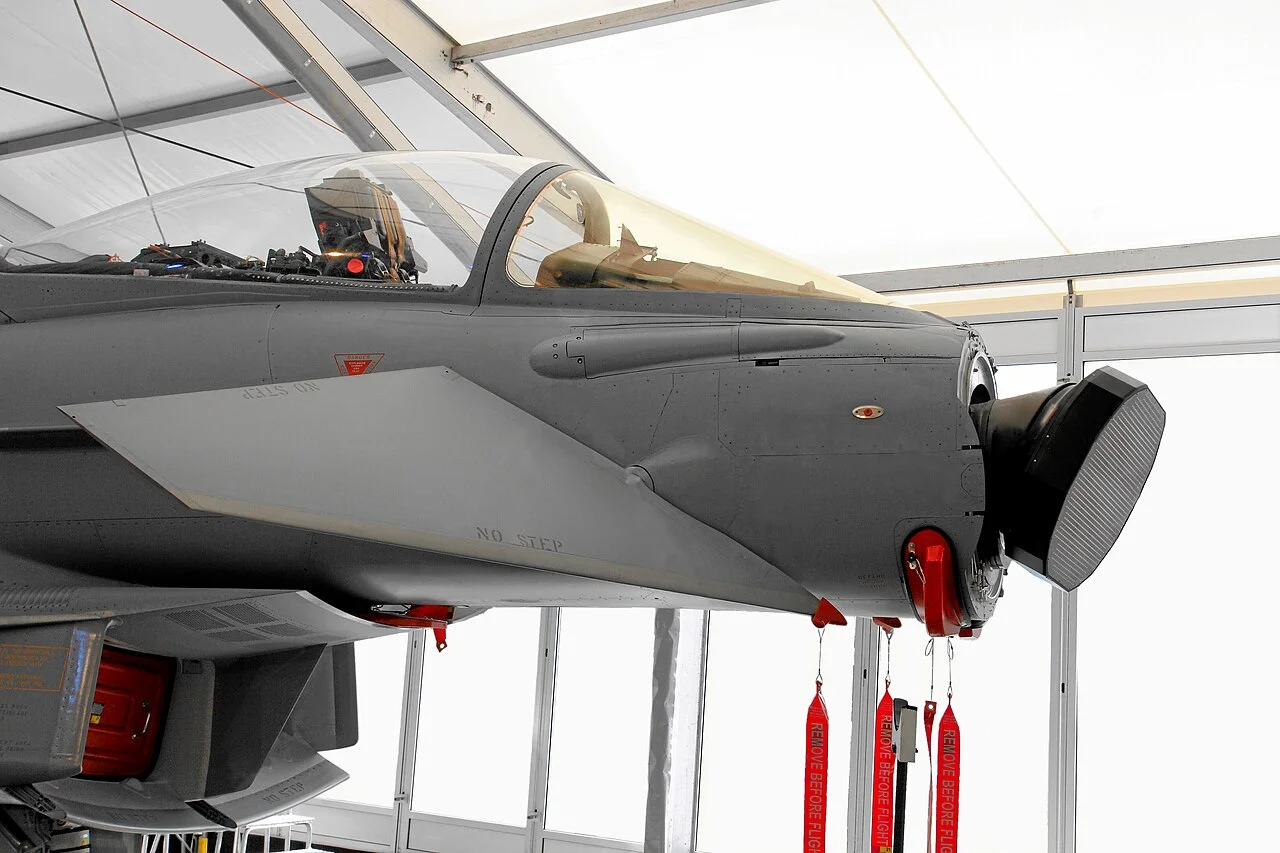
- 4. Mode 5 encrypted transponder hardware
- 5. Link-16 datalink network illustration
Related Articles
- What is air defense?
- What is AWACS?
- What is a transponder?
- What is friendly fire?
- What is Link-16?