US Uses Sea Drones in Combat for the First Time: Corsair Strike on Bandar Abbas

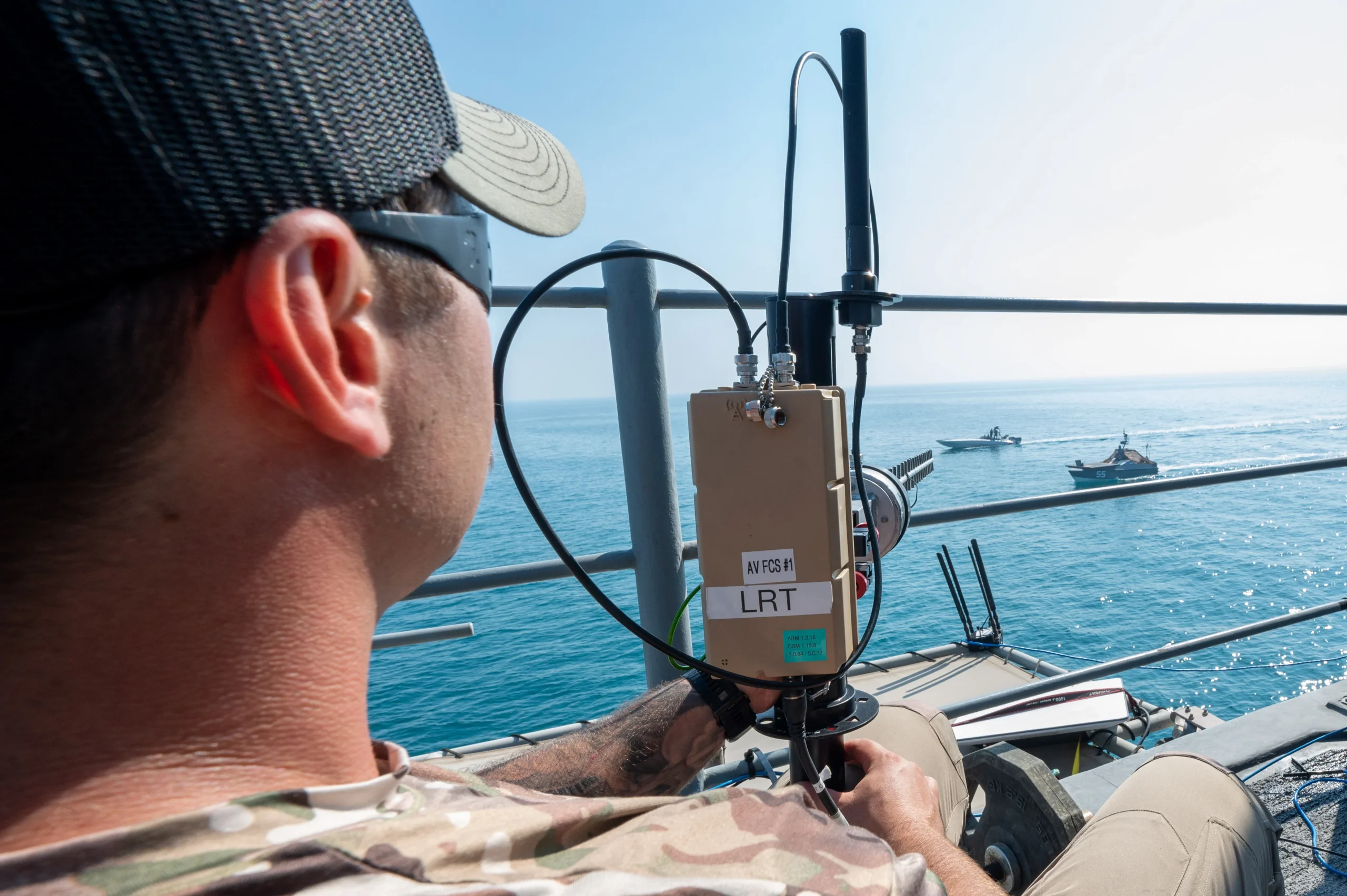
U.S. Central Command (CENTCOM) has confirmed the first-ever combat use of armed unmanned surface vessels (USVs), following a strike on Iran’s Bandar Abbas Naval Base. In the operation carried out on 12 July 2026, three Saronic Corsair one-way attack craft, operated by Task Force 59 under the U.S. 5th Fleet, targeted an Iranian submarine and a port maintenance facility. The command said the strike aimed to degrade Iran’s capacity to threaten commercial shipping in the Strait of Hormuz.
What happened
According to footage released by CENTCOM on 13 July, the three Corsairs made a slow, uncontested approach to a pier at Bandar Abbas where a midget submarine — assessed to be a Ghadir-class boat — was suspended out of the water on a gantry. The explosions that followed sent tall columns of smoke into the air, with the final blast igniting a large fire. The extent of the damage is not clear from the released video.
The operation was part of a wave of offensive strikes launched after renewed tensions between Washington and Tehran over the status of vessels transiting the Strait of Hormuz. CENTCOM stressed that such actions are intended to blunt Iran’s ability to harm international maritime trade.
The Corsair
Developed by Saronic Technologies, the Corsair is a roughly 7.3-metre (24-foot) autonomous surface vessel. According to the manufacturer, it offers a range of more than 1,000 nautical miles, a payload capacity of about 450 kilograms (1,000 pounds) and a top speed of 35 knots. Built around a one-way attack architecture, the system provides a low-cost, uncrewed means of reaching a target — placing it in the same conceptual family as the explosive-laden sea drones Ukraine has used in the Black Sea.
Task Force 59 was established within the U.S. 5th Fleet in 2021 to integrate unmanned systems and artificial intelligence into regional maritime security. Until now the unit had mainly operated reconnaissance and surveillance platforms; the Bandar Abbas strike marks the first time its assets were used in a direct offensive role.
Why it matters
The strike is a threshold moment: the first combat employment of armed unmanned surface vessels by a state navy. Sea drones have been used effectively in recent years — most visibly by Ukraine against warships and ports in the Black Sea — but largely as a form of asymmetric warfare rather than as a doctrinal operation conducted with a regular navy’s inventory assets. Washington’s formal use of a domestically developed system in an offensive strike signals that low-cost autonomous craft are now part of major navies’ striking arm.
The cost-effectiveness equation is striking as well: rather than expend multimillion-dollar cruise missiles, relatively cheap, mass-producible autonomous boats can service fixed or semi-fixed targets inside a harbour — a trend that could reshape deterrence and strike calculations in naval warfare.
Regional and strategic context
The Strait of Hormuz is one of the critical chokepoints of global energy security, carrying a significant share of the world’s seaborne oil. Any military activity around it reverberates directly through energy markets and international shipping. With this year’s U.S.–Iran conflict unable to settle onto a stable ceasefire, both sides continue to trade blows along the Hormuz line.
The entry of unmanned surface vessels as offensive assets adds a new dimension to the escalation risk. For observers in Turkey — whose defence industry is building capability in this field with indigenous USVs such as ULAQ, SANCAR and MARLIN — operational precedents set by major navies are closely watched references for both doctrine and export prospects.
Sources
- U.S. Central Command (CENTCOM) official statement and released video, 13 July 2026.
- Naval News — “CENTCOM Deploys Saronic Corsair USV Against Iranian Submarine At Bandar Abbas.”
- Breaking Defense / USNI News — first combat use and Task Force 59 context.
- Saronic Technologies — Corsair technical specifications.
Representative image; no verified rights-cleared image of the event itself was available.