Ukraine Brings a Ballistic Missile to a Danish Trade Show
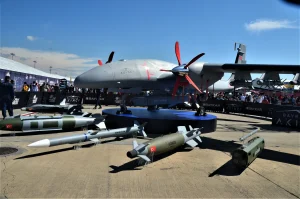
Two years ago Fire Point was a Ukrainian workshop building long-range one-way attack drones. This week it is standing in a Danish exhibition hall with a full-scale mock-up of a ballistic missile. The company brought its FP-9 to DALO Industry Days 2026, held 19-20 August in Herning, Denmark.
What is on the stand
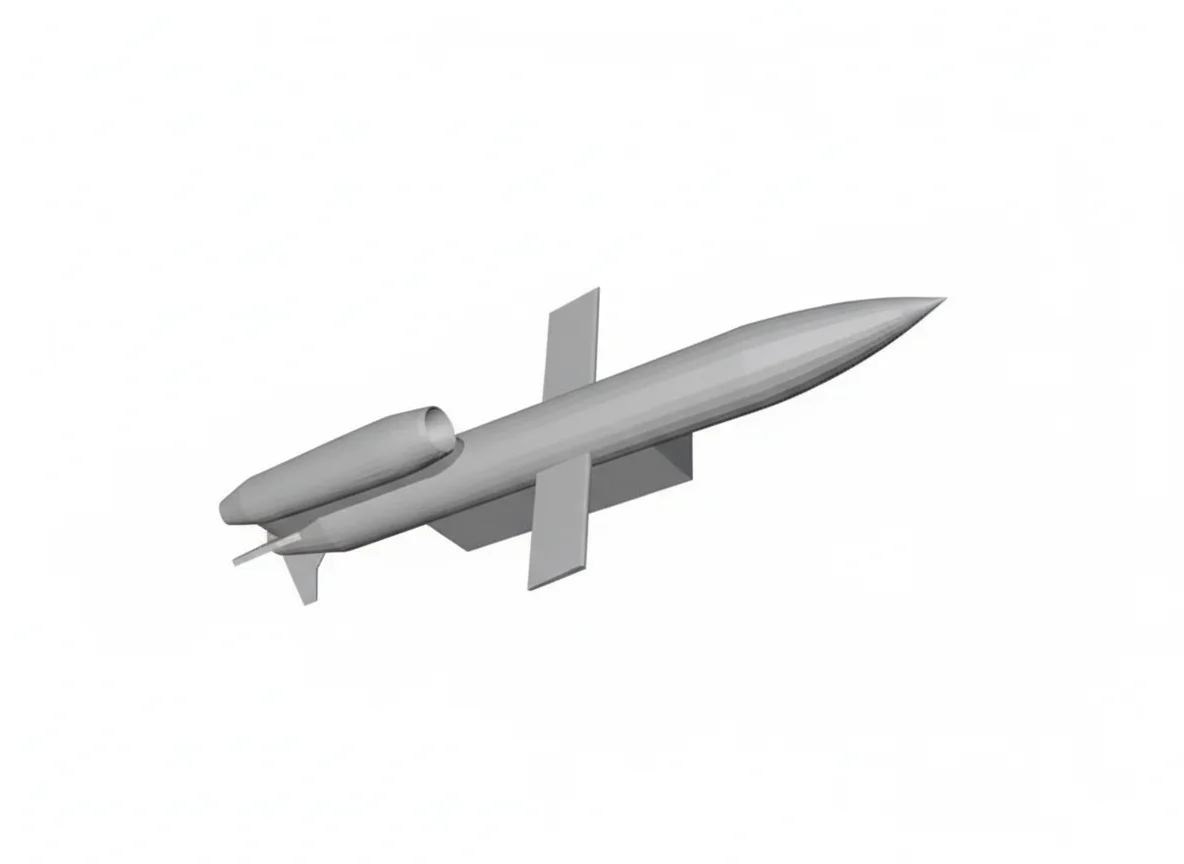
Fire Point is showing full-scale models of four systems: the FP-1 strike drone, the FP-5 Flamingo cruise missile, the FP-7 missile and the FP-9 ballistic missile. Lined up together they describe a company that has moved from a single product to a layered deep-strike portfolio in under two years.
The manufacturer’s stated FP-9 figures: range up to 855 km, speed of 2,200 metres per second, an 800 kg payload, flight altitude to 70 km and accuracy of roughly 20 metres, launched from a mobile ground system. These are company claims and have not been independently verified.
A deep-strike ladder
Put the four systems side by side and the doctrine becomes visible. At the bottom sits FP-1: cheap, mass-produced, slow, designed to occupy air defences and keep low-value targets under continuous pressure. In the middle, FP-5 Flamingo — longer reach, larger warhead, used against fixed but hardened objectives. At the top, FP-7 and FP-9, built to compress the defender’s reaction time.
That ladder is the current logic of deep strike. Rather than defeating an air defence system with one weapon, you exhaust its decision cycles and its interceptor inventory with several operating at different speeds and price points. It is the approach Ukraine has spent two years refining under fire.
The solid-fuel threshold
Fire Point’s co-owner said in July 2026 that the only thing standing between FP-9 and the start of testing was the solid-fuel motor. That the company is exhibiting a mock-up rather than flight data suggests the program still sits at that threshold.
It is the right place to be sceptical. Designing a ballistic missile is difficult; producing consistent solid-propellant motors at rate is harder, and it is where most wartime missile programs actually stall. Propellant casting is unforgiving of variation, and a motor that performs beautifully in a test article and erratically in the fiftieth unit is a program problem, not an engineering footnote.
Reading the numbers
Brochure figures deserve context. A stated 855 km is usually achieved with a reduced payload rather than the maximum warhead; range and mass trade against each other directly. A 2,200 m/s figure likely describes the fastest point on the trajectory rather than terminal velocity. A 20-metre circular error probable assumes satellite guidance that is not being jammed.
None of that invalidates the design. An 800 kg warhead at even loose accuracy is meaningful against unhardened large-area targets — refineries, logistics hubs, airfield infrastructure. It simply means the exhibition hall and the battlefield are still some distance apart.
Why Denmark
The venue is not incidental. Copenhagen pioneered the “Danish model” of funding Ukrainian defence production directly and relocating part of it onto Danish soil, and Fire Point’s Danish manufacturing plans have been discussed in that framework. DALO Industry Days runs under the Danish MoD’s Open for Business initiative, bringing the Danish armed forces, the procurement agency and international industry into one room.
A Ukrainian firm displaying a ballistic missile there is a concrete marker of something larger: an industry forged in wartime improvisation now trying to attach itself to the European supply chain as a supplier rather than a recipient.
Sources
Fire Point exhibition presentation and manufacturer technical claims; DALO Industry Days 2026 organiser information.