Inside France’s 5,300-Tonne Suffren-Class SSN: MdCN Cruise Missiles, F21 Torpedoes and Polar Endurance

With De Grasse entering active service in November 2026, France now has four of its six Suffren-class nuclear-powered attack submarines in the fleet. Built by Naval Group under the Barracuda programme launched in 2006, the class replaces the compact Rubis-class boats of the 1980s and gives the French Navy a much larger, quieter and more versatile platform. This guide explains the main features of the design.
Size and propulsion
A Suffren-class boat displaces about 4,700 tonnes surfaced and 5,300 tonnes submerged, roughly twice the size of a Rubis. It is 99.5 metres long with a hull diameter of 8.8 metres. Power comes from a 150 MW pressurised water reactor derived from French naval reactor technology, giving submerged speeds above 25 knots. Hybrid propulsion allows quiet running at low speed. Patrol endurance is around 75 days, compared with 45 days for the earlier class.
Weapons
The submarine has four 533 mm torpedo tubes and carries up to 20 to 24 weapons depending on the mix. Its armament includes:
- F21 Artemis heavyweight torpedo, the French Navy’s current anti-ship and anti-submarine torpedo.
- Exocet SM39, a submarine-launched anti-ship missile that leaves the tube in a capsule before flying to its target.
- MdCN (Missile de Croisière Naval), a long-range land-attack cruise missile that gives French SSNs a conventional strike role for the first time.
Mines can also be carried in place of other weapons.
| Parameter | Suffren class | Rubis class (for comparison) |
|---|---|---|
| Submerged displacement | ~5,300 t | ~2,600 t |
| Length | 99.5 m | 73.6 m |
| Reactor | 150 MW PWR | 48 MW PWR |
| Weapons capacity | Up to 24 | 14 |
| Patrol endurance | ~75 days | ~45 days |
| Land attack | MdCN cruise missile | No |
Special forces and sensors
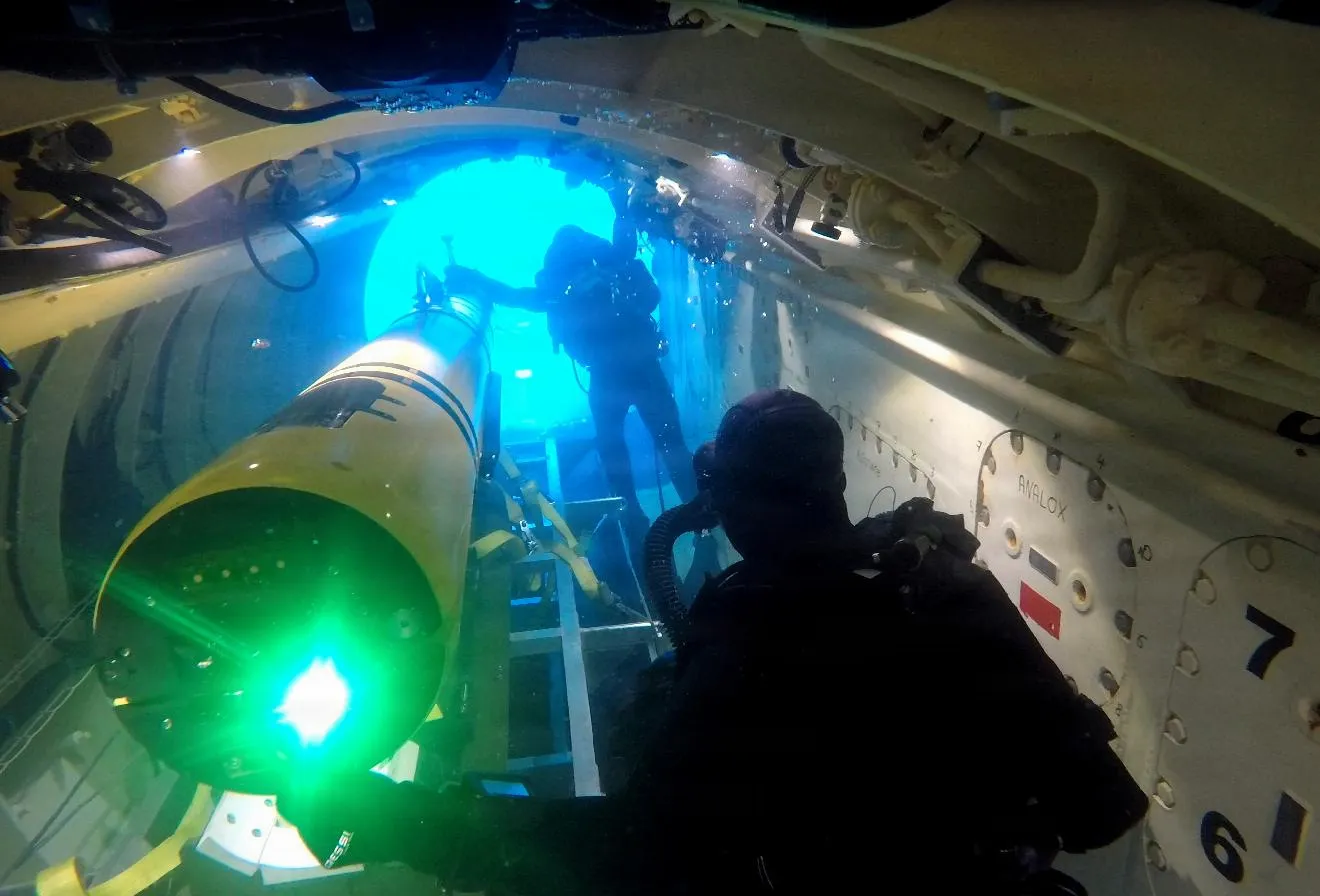
A removable dry-deck shelter can be fitted aft of the sail to launch special forces swimmer delivery vehicles while submerged, and a lock-out chamber supports divers. The boats use the SYCOBS combat management system; De Grasse is the first to receive an upgraded version along with a new electronic warfare suite. Optronic masts replace traditional periscopes, so the control room no longer has to sit directly below the sail.
Polar and warm-water trials
De Grasse spent 149 days in military capability verification, navigating in polar waters off northern Norway and in warmer Atlantic conditions, with calls at Tromsø and Norfolk. The aim was to test endurance, equipment reliability and crew performance in very different climates, reflecting the range of missions France expects, from the Arctic to the Indian Ocean.
Analysis: a mid-sized SSN with a strike role
The Suffren class is smaller than the US Virginia class or the British Astute class but carries a broadly similar mix of capabilities: anti-submarine warfare, intelligence gathering, special operations and long-range land attack. That balance suits a medium power with a global naval presence. The design has also drawn export interest in conventional form, with Naval Group proposing diesel-electric derivatives to several navies. As the last two boats, Rubis and Casabianca, approach delivery by 2029, France will have one of the most modern attack submarine fleets in Europe.
Why is it also called the Barracuda class?
Barracuda is the name of the programme; the boats are named after the lead submarine, Suffren.
Can the Suffren class carry nuclear weapons?
No. France’s nuclear deterrent is carried by its Triomphant-class ballistic missile submarines and aircraft.