ROKETSAN Export Countries: Confirmed Buyers and Systems List

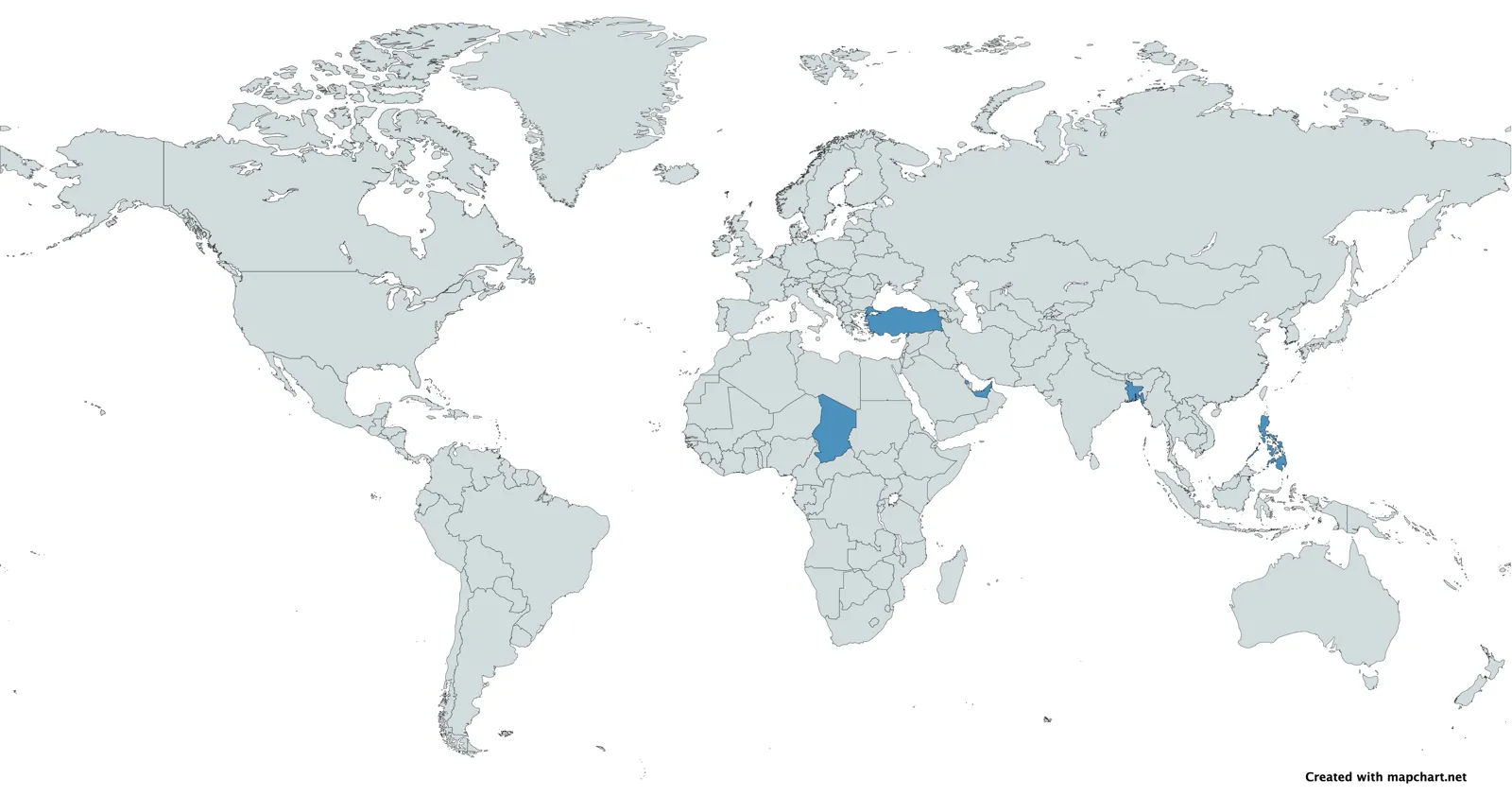
ROKETSAN’s confirmed export customers, based on open-source evidence, include Azerbaijan, the United Arab Emirates, Bangladesh and Malaysia. Sales to Kosovo, Libya and Indonesia are reported but not officially confirmed. The MAM smart munition family is used by more than 16 countries through the Bayraktar TB2 ecosystem. The full customer list has not been officially disclosed.
| ROKETSAN Export Countries — At a Glance | |
|---|---|
| Company | ROKETSAN Roket Sanayii ve Ticaret A.Ş. |
| Headquarters | Ankara (Elmadağ; Lalahan, Kırıkkale) |
| Confirmed buyers (open source) | Azerbaijan, UAE, Bangladesh, Malaysia and others |
| Reported buyers | Kosovo, Libya, Indonesia, Ukraine (system-specific) |
| Most widespread product | MAM family — 16+ countries (TB2/Akıncı ecosystem) |
| Landmark deal | Malaysia: KARAOK, 18 launchers + 108 missiles (delivery 2026) |
| Full list | Not officially disclosed |
| Export target | 50%+ of turnover (medium term) |
Which countries does ROKETSAN export to?
The honest answer comes in two layers. The first layer covers sales confirmed through open sources — delivery ceremonies, military parade footage, export records and buyer-government statements. The second layer covers reported sales: deals covered by the defence press but never officially confirmed by either party. ROKETSAN does not publish a customer list, so any serious country-by-country breakdown must keep these two layers clearly separated.
The clearest case in the confirmed layer is Azerbaijan. The Azerbaijani army has fielded TRG-300 KAPLAN guided missiles since 2016, and the use of TRLG-230 laser-guided rockets from KamAZ-based launchers has been documented in open-source imagery since 2021. CİRİT laser-guided missiles and MAM munitions delivered via Bayraktar TB2 drones round out Azerbaijan’s ROKETSAN portfolio.
The United Arab Emirates was among the first known export customers for CİRİT and also operates the TRG-300. Bangladesh joined the confirmed list with TRG-300 batteries delivered in June 2021 — more than 36 vehicles according to open reporting. Malaysia provides the most concrete recent example: a contract for the KARAOK shoulder-launched anti-tank system covering 18 launchers and 108 missiles, with deliveries scheduled for 2026.
In the reported layer sit the OMTAS anti-tank missile sale to Kosovo, the presence of TRG-300 systems in Libya, and interest from Indonesia and Malaysia in the ATMACA anti-ship missile. These stories appear regularly in defence media, but in the absence of an official contract announcement they are not presented here as confirmed sales.
Why the confirmed-versus-reported distinction matters
Defence export coverage is noisy. A trade-show conversation, a letter of intent or a single-source news item can easily be dressed up as a completed sale. The difference matters both legally and analytically. A confirmed sale rests on verifiable evidence: imagery of delivered hardware, an official statement by the buyer, or an announcement by the manufacturer. A reported sale rests on secondary sources — and there is always a chance the contract was never signed, was cancelled, or changed in scope.
Applied to ROKETSAN, the picture resolves as follows:
- Confirmed: Azerbaijan (TRG-300, TRLG-230, CİRİT, MAM), UAE (CİRİT, TRG-300), Bangladesh (TRG-300), Malaysia (KARAOK contract).
- Open-source user lists: for CİRİT, Albania, Bahrain, Bangladesh, Chad, Spain and the Philippines appear as users; for the MAM family, more than 16 countries operating TB2 drones, including Ukraine, Pakistan and Poland.
- Reported: Kosovo (OMTAS), Libya (TRG-300), Indonesia/Malaysia (ATMACA), Ukraine (TRLG-230).
One further nuance separates direct exports from platform-driven use. The presence of MAM munitions in more than 16 countries is, in most cases, a by-product of Bayraktar TB2 or Akıncı purchases — the munitions travel with the drone package. That confirms a ROKETSAN product is in service in those countries; it does not mean each of them signed a separate export contract with ROKETSAN. Country lists should always be read with this distinction in mind.
The table below summarises country-system pairings compiled from open sources, each with a status label. Confirmed means the sale or use is backed by open-source imagery, a delivery announcement or an official statement; reported means the information appears in defence media but lacks official confirmation. The full customer list has not been officially disclosed.
Export geography, product by product
Looking at the same list through a product lens reveals the character of ROKETSAN’s export business. The most geographically widespread product is the MAM family (MAM-L, MAM-C, MAM-T). These unpowered gliding smart munitions form the standard weapons load of the Bayraktar TB2 and Akıncı, so nearly every country that buys those drones becomes an indirect ROKETSAN customer. Open sources count more than 16 user countries, including Azerbaijan, Ukraine, Pakistan and Poland.
CİRİT, the 2.75-inch laser-guided missile, is the company’s oldest and most mature export item: more than 5,000 rounds delivered, with the UAE joined by Albania, Bahrain, Bangladesh, Chad, Spain and the Philippines in open-source user lists. The TRG-300 KAPLAN guided missile is the locomotive of heavy-system exports, with deliveries to Azerbaijan (2016), Bangladesh (2021) and the UAE; its presence in Libya is reported but not officially confirmed.
On the anti-tank side, KARAOK‘s Malaysian contract is ROKETSAN’s first major export reference for shoulder-launched systems, with integration onto Malaysia’s Cendana 4×4 vehicles also on the agenda. The OMTAS sale to Kosovo remains in the reported category. The TRLG-230 laser-guided rocket is confirmed in Azerbaijani service through imagery, while supplies to Ukraine remain at the reported level. For the ATMACA anti-ship missile, talks with Indonesia, Malaysia and Algeria have surfaced in the press; no definitive contract has been officially announced.
Why is the full list not disclosed?
Defence exporting is as much a diplomatic activity as a commercial one. Turkish missile and munitions exports require state-level licences, and buyer governments frequently prefer to keep procurement decisions out of public view. ROKETSAN, following standard customer-confidentiality practice, publishes no country-by-country sales breakdown. What the public knows is therefore assembled from fragments: delivery imagery, parade appearances, export statistics and statements by buyer governments.
The direction of travel is nonetheless clear. According to General Manager Murat İkinci, the company’s 2025 turnover exceeded 2 billion dollars, its total order book has reached roughly 10 billion dollars with new contracts, and the medium-term goal is to lift exports above 50 percent of turnover. The investment of more than 1 billion dollars in the new Lalahan and Kırıkkale facilities — targeting a roughly fivefold increase in missile production capacity — is largely aimed at serving this growing order pipeline.
The list of countries can be expected to grow in the coming years, but the method of this page will not change: a new country is added to the confirmed list only when open-source evidence or an official announcement emerges. Until then, every new claim is tracked cautiously under the reported label.
The country-system pairings on this page rely solely on information verifiable through open sources. The confirmed label denotes cases backed by delivery imagery, buyer-government statements or official announcements; the reported label denotes information resting only on secondary sources. ROKETSAN’s full customer list has not been officially disclosed, and most MAM users obtain the munitions through drone packages rather than separate ROKETSAN contracts. The table will be updated as new confirmations emerge.
Frequently Asked Questions
Which countries does ROKETSAN export to?
Buyers confirmed through open sources include Azerbaijan (TRG-300, TRLG-230, CİRİT, MAM), the UAE (CİRİT, TRG-300), Bangladesh (TRG-300) and Malaysia (KARAOK). Sales to Kosovo, Libya and Indonesia have been reported but not officially confirmed. The full list has not been officially disclosed.
What is ROKETSAN’s most exported product?
In geographic terms, the MAM smart munition family: it serves in more than 16 countries alongside TB2 and Akıncı drones. In unit terms, the CİRİT laser-guided missile stands out, with more than 5,000 rounds delivered.
What did Malaysia buy from ROKETSAN?
Malaysia signed a contract for the KARAOK shoulder-launched anti-tank system covering 18 launchers and 108 missiles, with deliveries planned for 2026. Malaysian interest in the ATMACA anti-ship missile has also been reported, but no official contract has been announced.
Does Ukraine use ROKETSAN products?
Yes. Ukraine’s use of MAM munitions via its TB2 drones is documented in open-source imagery. Supplies of TRLG-230 laser-guided rockets to Ukraine were reported in 2022-2023, but no official contract details have been disclosed.
Why does ROKETSAN not publish its export list?
Defence exports are subject to state licensing and customer confidentiality, and buyer governments often keep procurement decisions private. The known list is therefore compiled from open sources — delivery imagery, official parades and buyer statements — and may not reflect the complete picture.
What is the difference between a confirmed and a reported sale?
A confirmed sale rests on verifiable evidence such as delivery imagery, an official buyer statement or a manufacturer announcement. A reported sale rests only on defence-media coverage; the contract may never have been signed, may have changed, or may have been cancelled.
Sources
- ROKETSAN official product pages — roketsan.com.tr
- Defense News Top 100, 2025 edition
- Army Recognition, Naval News and SIPRI export and delivery reporting (2016-2026)
- Open-source parade and delivery imagery from Azerbaijan and Bangladesh
- Company and open-source records verified as of 22 July 2026