Mortar Weapon Explained: How It Works, Main Calibres and Its Role in Modern War


The mortar is one of the simplest and most widely used artillery weapons. It fires at a steep, high-angle trajectory, letting crews hit targets behind cover, in trenches or on reverse slopes. In November 2026 mortars were back in the news: the US Army tested a kit that lets drones drop standard mortar rounds, Saab licensed mortar-munition production to Poland, and India’s KSSL unveiled a vehicle-mounted 120mm mortar.
How a mortar works
A classic mortar consists of a smoothbore tube, a baseplate that absorbs recoil, a bipod and a sight. The bomb is dropped into the muzzle, slides down, its primer strikes a firing pin at the base, and the propellant charge launches it at a high elevation. Tail fins stabilise the round in flight. The simple design makes mortars light, cheap and operable by small crews.
Mortar vs gun vs howitzer
Guns fire on a flat trajectory, howitzers can fire both flat and high-angle, while mortars fire almost exclusively high-angle, usually at elevations above 45 degrees. Mortars generally have shorter range than howitzers but are more mobile, faster-firing and cheaper.
Main calibres
- Light (around 60mm) – company-level weapons carried by infantry.
- Medium (81–82mm) – battalion level; 81mm is the NATO standard, 82mm the Soviet and Russian calibre.
- Heavy (120mm) – towed and self-propelled systems approaching light artillery in firepower.
- Super-heavy – such as the Soviet 240mm 2S4 Tyulpan self-propelled mortar.
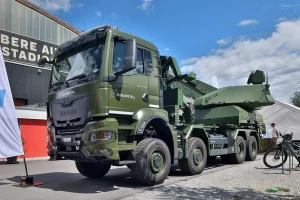
Self-propelled mortars mounted on armoured vehicles or trucks can open fire quickly and relocate immediately to avoid counter-battery fire.
Mortars in the war in Ukraine
In the war in Ukraine, mortars remain a key means of close fire support for infantry, and mortar rounds are also widely dropped from drones. Applying lessons from that war, the US Army developed MALET (Munitions Air-dropped Lethal Effects Tool), a clip-on kit that turns standard 60mm and 81mm mortar rounds into drone-dropped munitions without field modification of their safety mechanisms, Stars and Stripes reported. The Army’s Armaments Center said live 60mm rounds dropped from a moving drone oriented correctly and detonated in the target area, and that the kit can be removed so the round can again be fired from a tube.
New developments
On 20 November 2026 Saab signed a licensing agreement with Poland’s Dezamet, part of PGZ Group, to produce and sell MAPAM mortar munitions in Poland. On 12 November India’s Kalyani Strategic Systems announced progress on the 120mm R.A.M.S, a mortar mounted on a 4×4 vehicle that fires without crews dismounting.
Sources: US Army DEVCOM Armaments Center, Stars and Stripes, Saab, Kalyani Strategic Systems.