Milrem Says Arson at Estonian Plant Has Not Slowed UGV Deliveries
Estonian unmanned ground vehicle manufacturer Milrem Robotics says a fire at its Tallinn premises has not disrupted production or delivery schedules. Chief executive Kuldar Väärsi said the incident would not disturb deliveries this year or next.
The fire broke out overnight between 15 and 16 August 2026 at a building used by the company on Betooni Street in the Lasnamäe district of the Estonian capital. Investigators treated it as possible deliberate arson from the outset, and prosecutors have said preliminary indications point to a fire set on purpose and possibly planned in advance.
Detentions in Latvia
Two suspects were detained in Latvia on Wednesday, 19 August. A third is reported still at large. Estonian authorities are examining possible Russian involvement as one line of inquiry. No formal attribution has been made.
The Baltic states have logged a run of suspicious fires and attempted sabotage against defence plants, logistics hubs and infrastructure over the past two years. Regional governments file these under grey-zone activity: deniable, cheap, and calibrated to stay below the threshold that would trigger a military response.
THeMIS and the Ukraine line
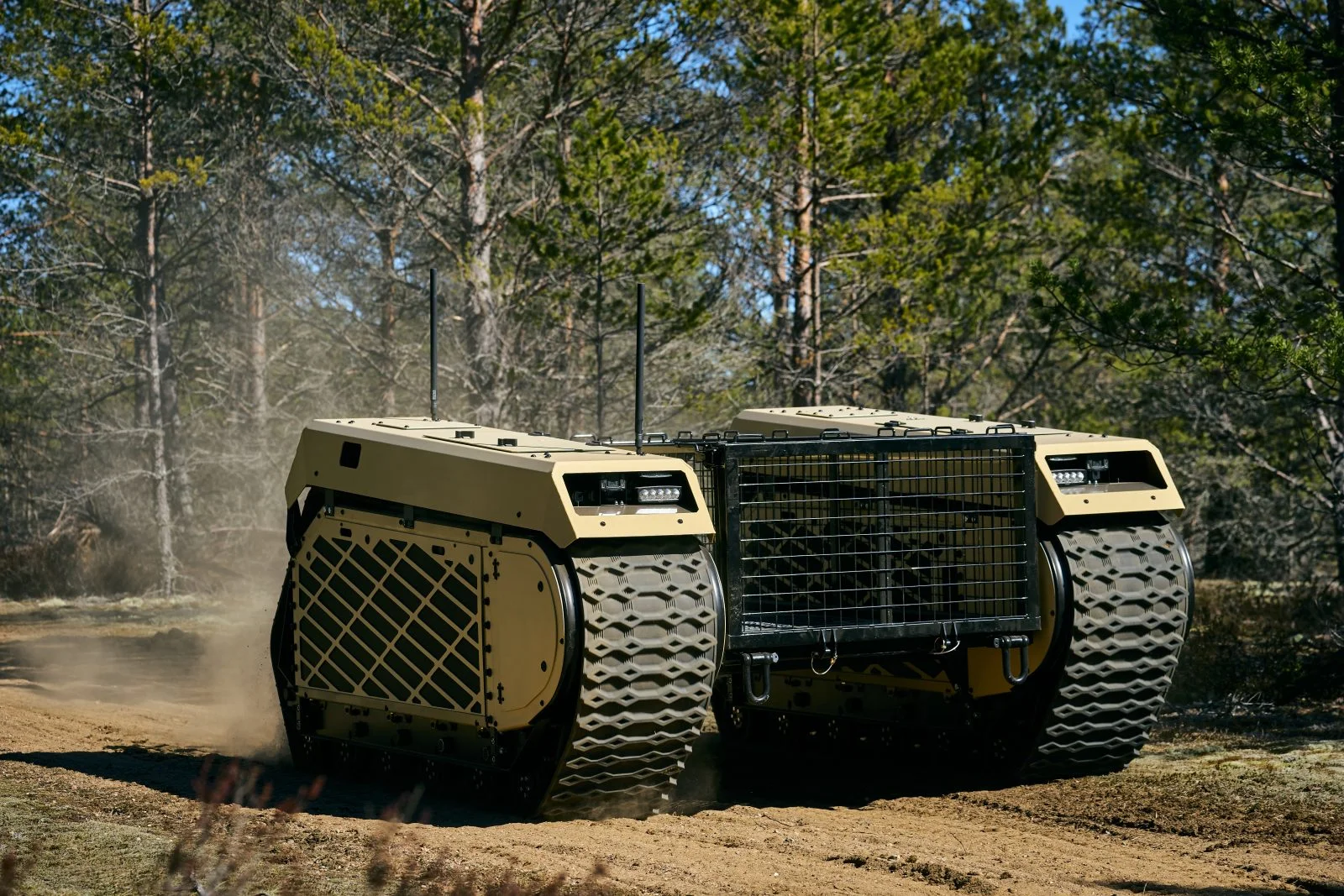
Milrem’s signature product is THeMIS — Tracked Hybrid Modular Infantry System — a tracked unmanned ground vehicle with a hybrid diesel-electric powertrain. The modular deck takes different payloads depending on the job: casualty evacuation, ammunition and supply carriage, route clearance, reconnaissance, or an integrated remote weapon station.
It is one of the few unmanned ground vehicles genuinely in use in Ukraine. The company is working toward more than 200 systems fielded there by the end of the year, and is one of only two foreign suppliers providing active UGVs to Ukrainian forces.
The quieter robotics story
Aerial drones have taken the public share of attention. The ground side has changed more quietly. Hauling ammunition to a position under fire, or pulling a casualty out of one, are among the highest-loss tasks in land warfare, and a tracked robot doing either takes a person out of the beaten zone entirely.
The constraints are equally real. Electronic warfare severs control links. Broken terrain defeats mobility. Unit cost still argues against treating the vehicles as expendable. None of these is solved, which is why fielded numbers remain modest against the scale of the requirement.
Technical profile
THeMIS weighs roughly 1.6 tonnes and carries payloads up to about 1,200 kg. The hybrid powertrain lets it move on electric drive alone, cutting its acoustic signature for reconnaissance and ambush work. Tracks buy soft-ground and broken-terrain performance that wheeled equivalents cannot match.
Modularity is the design thesis. One hull, one training pipeline, one maintenance chain — and a stretcher rack, ammunition bin, mine-detection arm or weapon station bolted on as the mission dictates.
Plant security moves up the agenda
The Milrem fire lands in a period when European manufacturers are rethinking physical site security. Producers in Germany, Sweden, Poland and the Baltics have tightened perimeter measures, and some have deliberately split production across multiple locations. A single-site line is brittle against fire, flood and sabotage alike.
Väärsi’s emphasis on the delivery schedule reads clearly in that light. For customer armies, the number that matters is not the size of the blaze but whether the timeline held. For a customer running the systems on an active front, supply continuity is an operational question, not a commercial one.
Sources
- Milrem Robotics — CEO Kuldar Väärsi remarks, 20 August 2026
- Estonian police and prosecution service statements, 18-19 August 2026