The Lynx Effect: How One IFV Order Book Is Redrawing Europe’s Armoured Map

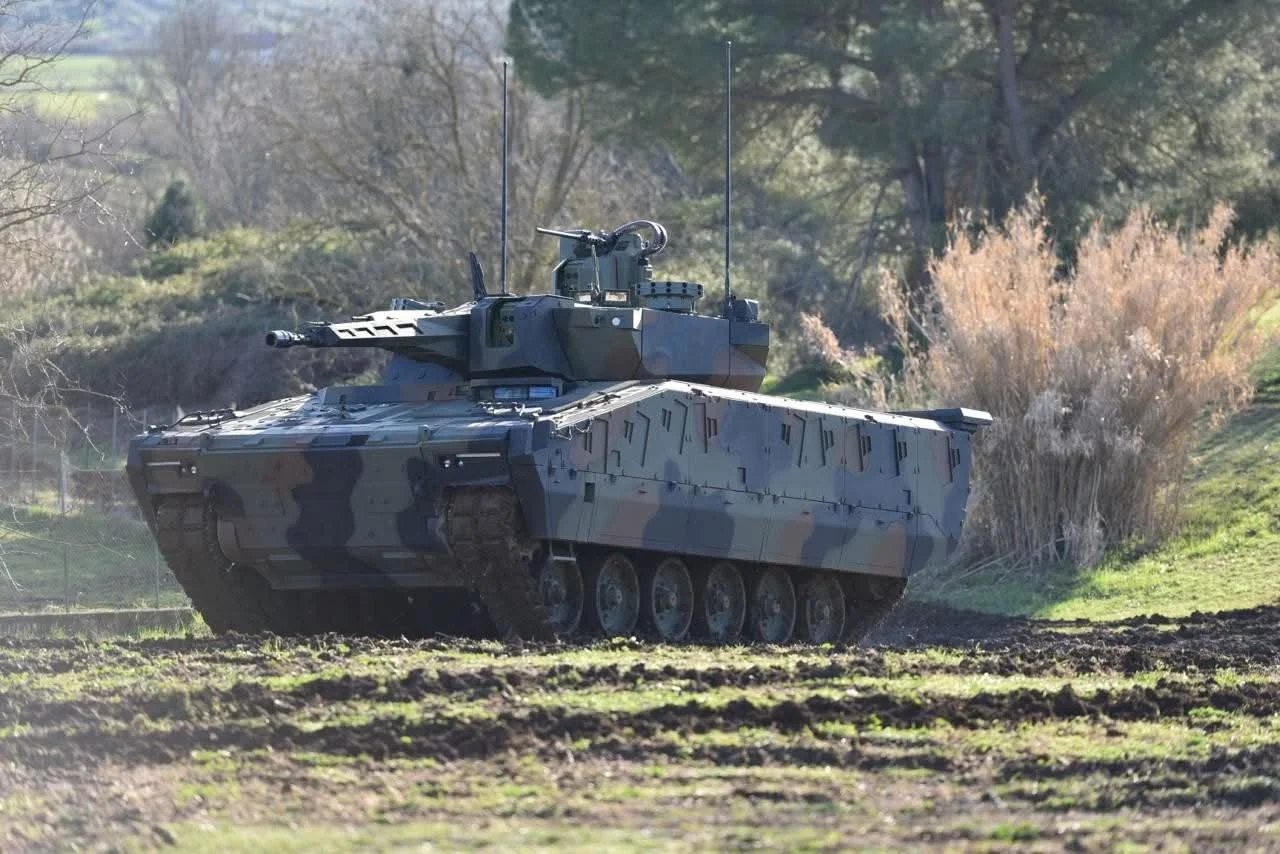
Image: Italian Army / Wikimedia Commons (CC BY 2.5)
Infantry fighting vehicles rarely make headlines — until the order book does. The Rheinmetall Lynx KF41 has assembled, in six years, what no Western IFV managed in thirty: a 218-vehicle anchor customer that co-owns the factory (Hungary), a programme of record stretching to 1,050 hulls (Italy’s AICS), a wartime selection by the army that will actually use it hardest (Ukraine), and a derivative in the final round to replace the US Army’s Bradley (XM30). Add the losses — Australia, Czechia, Slovakia — and you get the most instructive procurement story in European land systems: how Rheinmetall turned a vehicle with zero service history into the continent’s default answer, and where the formula still breaks.
| Manufacturer | Rheinmetall Landsysteme + Rheinmetall Hungary |
| Market segment | Heavy tracked IFV — the BMP/Bradley/Marder replacement wave |
| Order book | Hungary 218 (firm) + Italy 21 of up to 1,050 + Ukraine (selected) |
| US play | Lynx-derived XM30 bid vs GDLS — Bradley replacement |
| Industrial model | Co-owned plants: Zalaegerszeg (HU), LRMV (IT), Ukraine (planned) |
| First combat | Ukraine, from early 2026 — the type’s live trial |
| Key rivals | CV90 MkIV, AS21 Redback, Puma, BMP-3 (volume) |
| Turkish peers | Otokar TULPAR, FNSS KAPLAN-30 |
The Replacement Wave: Why Everyone Is Buying Tracked IFVs at Once
Europe’s mechanised infantry rides museum pieces: BMP-1s and 2s east of the old Iron Curtain, first-generation Marders in legacy NATO stocks, M113s everywhere. The war in Ukraine — where IFVs survive only through protection, sensors and the ability to carry infantry through artillery-swept ground — turned a slow replacement cycle into a stampede. Within four years, Hungary, Czechia, Slovakia, Italy, Greece and Ukraine all moved on tracked IFV decisions, with Poland’s Borsuk and the US XM30 running in parallel.
Three products dominate that stampede: BAE’s CV90 MkIV with its ten-nation user club, Hanwha’s AS21 Redback with Korean pricing and schedule, and the Lynx KF41 — the newest design, with the boldest industrial offer and, until recently, the thinnest references. How those three split the continent is the real story of European land procurement this decade.
The Formula: Sell the Factory, Then the Vehicle
Rheinmetall’s breakthrough was recognising that mid-sized European states no longer buy vehicles — they buy industrial participation. Hungary’s roughly EUR 2 billion contract for 218 Lynx came wrapped around a co-owned plant at Zalaegerszeg, opened in 2023 and now the most modern tracked-vehicle line in Europe; the world’s first Lynx battalion stood up in the Hungarian Army the same year, and a Patria-partnered NEMO 120 mm mortar variant joined the family in 2025.
Italy scaled the formula. The LRMV joint venture with Leonardo — the same vehicle Rheinmetall uses for the KF51 Panther tank — won a first order of 21 Lynx in November 2025 against an AICS programme ceiling of 1,050 vehicles in roughly a EUR 23 billion envelope; the first hull was handed to the Italian Army on 27 January 2026, the scene this article’s cover photo captures. The pending Greek talks (up to 205 vehicles with local assembly) and the planned Ukrainian production line follow the identical playbook: workshare first, platform second.
Ukraine and the XM30: The Two Verdicts That Matter Next
Ukraine’s selection of the Lynx as its future main IFV — confirmed by a first German-funded batch of five vehicles contracted in December 2025 and arriving from early 2026 — gives Rheinmetall something no rival owns: a high-intensity combat trial of a brand-new design, under FPV drones and dense minefields, with the results visible to every procurement office on earth. It is equal parts marketing coup and engineering exam; modular armour packages and the StrikeShield APS option will be graded in public.
The second verdict comes from Washington. American Rheinmetall’s Lynx-derived XM30 bid stands in the final round against General Dynamics to replace the Bradley — a programme whose production volumes would dwarf every European order combined. Winning would make the Lynx family the West’s dominant IFV architecture for a generation; losing would confine it to Europe just as the CV90’s user club keeps growing. No land-systems decision this decade carries higher stakes for Düsseldorf.
Technical Specifications
| Manufacturer | Rheinmetall Landsysteme (Unterlüss) + Rheinmetall Hungary (Zalaegerszeg) |
| Type | Modular tracked infantry fighting vehicle |
| Unveiled | Eurosatory 2018 (KF41); KF31 concept 2016 |
| Turret | Lance 2.0 (manned/unmanned configurations) |
| Main gun | 30 mm MK30-2/ABM with airburst ammunition (35 mm Wotan option) |
| Anti-tank | Spike LR2 — twin launcher (≈5.5 km) |
| Personnel | 3 crew + 8 dismounts |
| Base / max weight | ≈34 t / ≈50 t by mission kit (typical combat ≈44 t) |
| Engine | Liebherr D9620, 850 kW (≈1,140 hp) |
| Top speed / range | ≈70 km/h / ≈500 km |
| Protection | Modular ballistic/mine packages; StrikeShield APS option |
| Variants | IFV, command, recon, NEMO 120 mm mortar, ambulance, recovery, Skyranger AD |
Operators and Contracts
The Lynx KF41 order book — publicly confirmed as of June 2026.
| Country | Status | Scope | Known value |
|---|---|---|---|
| Hungary | Deliveries ongoing (first battalion 2023) | 218 vehicles + variants; 46 built in Germany, 172 in Zalaegerszeg | ≈EUR 2 billion |
| Italy | First order (Nov 2025); first delivery 27 Jan 2026 | AICS: plan up to 1,050 vehicles; initial batch of 21 via LRMV | Programme ≈EUR 23B (total plan) |
| Ukraine | Selected + first contract (Dec 2025) | Chosen as main IFV; first 5 German-funded vehicles, local production planned | Not disclosed |
| USA | Competition (XM30/OMFV) | American Rheinmetall in final round vs GDLS for the Bradley replacement | — |
| Greece | Talks | Framework discussions for up to 205 vehicles + local assembly | — |
In-Depth Analysis
Wins and Losses: Reading the Tender Record
Industrial Base: The Three-Country Network
Strengths in Procurement Terms
One core, eight variants: command, recon, NEMO mortar, ambulance, recovery, Skyranger air defence — fleet logistics collapse into a single automotive baseline.
Firepower headroom: 30 mm airburst today, 35 mm Wotan option tomorrow, Spike LR2 reach always.
The factory offer: co-production as default, proven in two countries and counting.
Family pull-through: Lynx sales open KF51 Panther doors and vice versa — the LRMV package effect.
Weaknesses and Open Risks
Price point: the Hungarian contract implies roughly EUR 9 million per vehicle system-average; Redback undercuts it, CV90 amortises better.
Weight ceiling consequences: at full armour the Lynx pushes 50 tonnes — bridge classes, rail gauges and amphibious options all suffer; the entire swimming-IFV niche is conceded to lighter rivals.
XM30 binary: a GDLS win in the US would cap the family’s ceiling at European scale.
Capacity collision: Panther, Lynx, ammunition and Skyranger compete for the same plants, engineers and political attention.
The Competitive Field, Tender by Tender
AS21 Redback (Hanwha): the schedule-and-price killer with the Australian scalp; Korea’s land-systems surge (K9, K2, Redback) makes it the structural threat.
Puma (PSM): technologically dense, export-dead — a cautionary tale Rheinmetall co-owns.
Borsuk (Poland): the volume wildcard — amphibious, national, and eyeing exports.
BMP-3 (Russia): still the volume seller in the Global South; sanctions are the Lynx’s quiet ally.
ASCOD 2 / Ajax (GDLS): the family the Lynx must beat twice — in Europe’s tenders and in the XM30 final.
Where the Lynx Fits Best
Armies consolidating variant zoos: the one-core-eight-variants offer is strongest where M113-era diversity ruins logistics.
Industrialising buyers: states wanting a defence-industrial base, not just vehicles — the Hungary profile, repeated in Greece and Ukraine.
Poor fits: amphibious doctrines (no swimming), light expeditionary forces (weight), and budget armies (price) — markets the CV90, KAPLAN-30 class and second-hand cascade will keep.
Turkish Counterparts: How They Compare
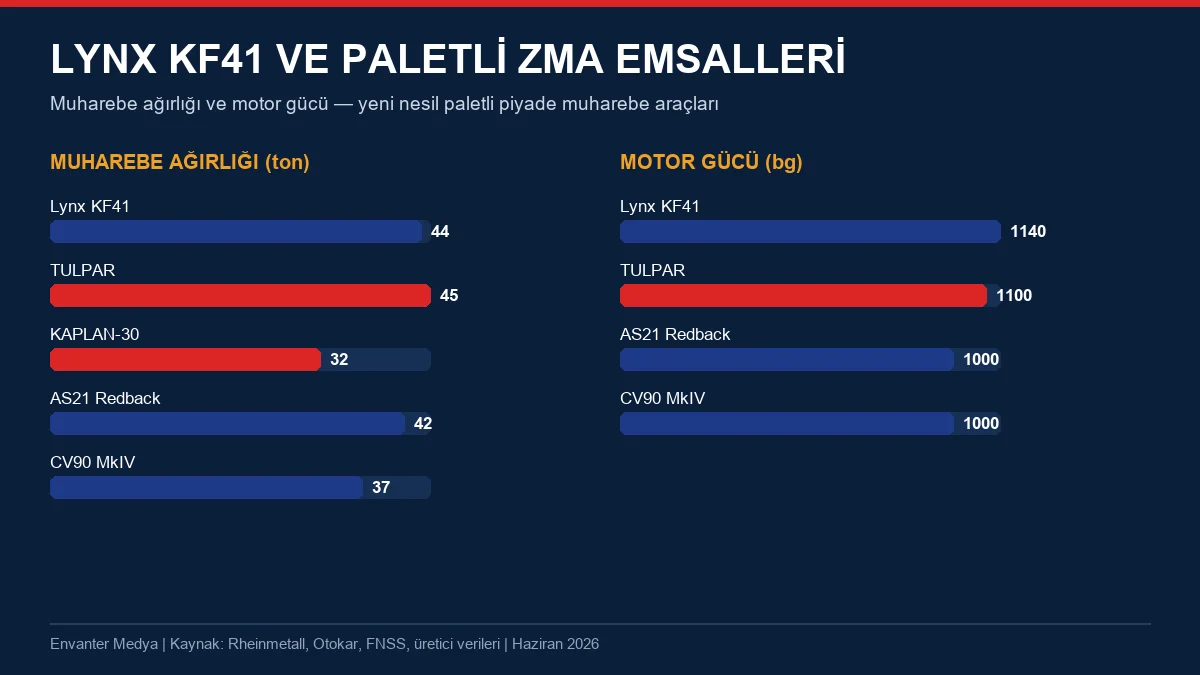
Türkiye’s contenders deserve more attention in this market than they usually get in English-language coverage. Otokar’s TULPAR is a true class peer — a 32-to-45-tonne modular tracked platform with the MIZRAK-30 airburst-capable turret and the same one-chassis-many-variants philosophy, backed by the industrial base of the ALTAY tank programme. FNSS’s KAPLAN-30 takes the segment the Lynx physically cannot enter: a genuinely amphibious 32-tonne IFV sharing its ACV-30 baseline with the KORKUT air-defence vehicle.
What the Turkish pair lack is what Hungary gave the Lynx: a launch order at scale. The Turkish Army’s eventual ACV-15 replacement programme — thousands of ageing hulls — would be precisely that moment. Until then, TULPAR and KAPLAN-30 compete abroad on price and unconditional technology transfer, the same levers Korea used before Australia. In Gulf and Central Asian tenders, the German network and the Turkish challengers are already meeting; the first head-to-head win either way will be a land-systems story in its own right.
| Feature | Lynx KF41 | TULPAR | KAPLAN-30 |
|---|---|---|---|
| Manufacturer | Rheinmetall | Otokar | FNSS |
| Weight | ≈34-50 t (typical 44) | 32-45 t (modular) | ≈32 t |
| Main gun | 30 mm MK30-2/ABM (35 mm opt.) | 30 mm MIZRAK-30 turret | 30 mm unmanned turret |
| Personnel | 3+8 | 3+8 (3+9 by variant) | 3+8 |
| Amphibious | No | No | Yes (swims) |
| Orders | Hungary 218 + Italy 21 (1,050 plan) + Ukraine | Export talks; no serial Turkish order yet | Turkish programmes + export talks |
TULPAR and KAPLAN-30 figures are manufacturer specifications and vary by configuration.
Envanter Medya Assessment
Frequently Asked Questions
Why did the Lynx lose in Australia but win in Italy?
What will Ukraine actually do with its Lynx?
What are the chances in the US XM30 competition?
How does the Lynx compare with the CV90 on hard numbers?
Is there a cheaper path to a Lynx-class capability?
What does a Lynx cost?
The Lynx KF41 turned an IFV into a geopolitical instrument: factories in Hungary and Italy, a combat debut in Ukraine, a beachhead bid in America. Whether the formula completes its sweep depends on the two verdicts ahead — battlefield and Pentagon. Envanter Medya tracks both, along with the Greek talks and the Turkish challengers closing from below.
Sources
- Rheinmetall — Lynx official product page
- The Defense Post — Ukraine to Receive First Lynx KF41 in Early 2026
- Defense News — Rheinmetall’s Lynx could soon see combat in Ukraine
- Army Recognition — Ukraine selects Lynx KF41 as main IFV
- Spartanat — The world’s first Lynx KF41 battalion (Hungary)
- Wikipedia — Lynx (Rheinmetall)