Foreign Investment in the Polish Defense Industry: Opportunities and Restrictions


Poland has become the country with the highest defense spending ratio in NATO by allocating 4.12% of its GDP to defense in 2024. This figure presents enormous opportunities for foreign defense companies and investors; however, foreign investment in the Polish defense industry involves unique restrictions and structural barriers. The fact that PGZ is 100% state-owned prevents foreign capital from directly accessing holding shares. Nevertheless, there are strong collaboration opportunities through subsystem supply, joint ventures, and licensed production models.
Foreign Investment Models: What is Possible, What is Not?
| Model | Status | Example |
|---|---|---|
| Direct purchase of PGZ shares | Not possible (100% state) | — |
| Joint venture with PGZ | Possible; licensed according to the sector | Rheinmetall-HSW support vehicles JV |
| Subsystem/component supply | Possible; significant opportunity | Kongsberg NSM (Miecznik), MBDA CAMM (Narew), Raytheon PAC-3 (Wisła) |
| License production agreement | Possible; example of HSW K9 license | Hanwha K9 → Krab program |
| Technology transfer | Negotiable; limited in strategic sectors | Wisła PAC-3 phase-2 negotiations |
| Investment in a private Polish company | Possible | WB Group, Transbit, Radmor |
Rheinmetall-HSW Model: Anatomy of the Joint Venture
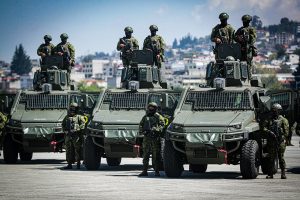
The memorandum of understanding for the support vehicles joint venture signed by Rheinmetall and HSW in 2024 is the most up-to-date example of how foreign investment can enter PGZ. In this model, Rheinmetall brings technology, engineering capacity, and brand; HSW provides the production facility, Polish supply chain connections, and relationship with the Ministry of Defense. The platforms to be obtained are produced for both the Polish and potentially the European market.
Biggest Opportunities: Subsystem Supply
The rapid growth of PGZ means an expansion of the supply chain. There are real business opportunities for foreign suppliers in the fields of 155 mm ammunition, electronic components, optronic systems, software solutions, and platform integration services. Companies supplying energy, optics, and special metals/materials can enter PGZ’s affiliated companies through export or joint production channels.
Collaboration Potential for Turkish Defense Companies with PGZ
| Field | Turkish Company | Possible Collaboration | Barrier |
|---|---|---|---|
| 155 mm ammunition | MKEK, Roketsan | Joint production, ammunition trade | NATO supply priority; Poland prerequisite local |
| Optronics | ASELSAN | Component supply for PCO | PGZ local content policy |
| UAV system | BAYKAR | TB2 export (Poland is already a buyer) | Not competition; buyer-seller already established |
| Armored vehicle | FNSS, OTOKAR | Component for medium-range vehicle | Rosomak and Borsuk prefer local supply |
FAQ
Can foreigners invest in PGZ?
Direct share acquisition is not possible (100% state-owned). It is possible to enter through joint ventures, subsystem supply, and license production models.
In which sectors is Poland open to foreign partners?
Subsystem components, electronics, materials, software, and certain platform technologies. Technology transfer in strategic weapon systems requires Poland’s strong negotiation.
Can the Rheinmetall-HSW model be an example for others?
Yes. This model is the current practice of the foreign OEM meeting with Poland’s production infrastructure. A similar model could also come up for Borsuk IFV components and Narew radar subsystems.
References
- Rheinmetall – HSW joint venture announcement: rheinmetall.com
- EDA Europa – Poland’s defense industry policy
- PGZ – corporate cooperation policy: grupapgz.pl
- sipri.org – Poland’s defense industry structure