$30K Drone, Million-Dollar Missile: Inside the Cost-Exchange Problem

Short answer: No — trading a $3-5 million Patriot PAC-3 MSE interceptor for a $20,000-50,000 Shahed-136/Geran-2 loitering munition is a losing cost equation almost every time, and NATO planners know it. The problem is that a single cheap drone can still hit a power substation, an air base or a city block, so defenders keep firing expensive interceptors anyway when nothing cheaper is in range. That mismatch is now driving a real acquisition push across the US Army and European air forces for interceptors priced under six figures.
What a Shahed/Geran actually costs
Public estimates for the Shahed-136 and its Russian-built Geran-2 variant cluster around $20,000 to $50,000 per unit, with the range reflecting production batch, whether shared infrastructure is counted, and variant (engine type, navigation package, warhead). Some Iranian-sourced claims put domestic production cost as low as $4,000, though no independently verified component breakdown supports that figure. HESA’s Iranian lines and the licensed Geran-2 production run at Russia’s Yelabuga special economic zone in Tatarstan together are assessed to approach 400-500 airframes a month.

What a Patriot interceptor costs
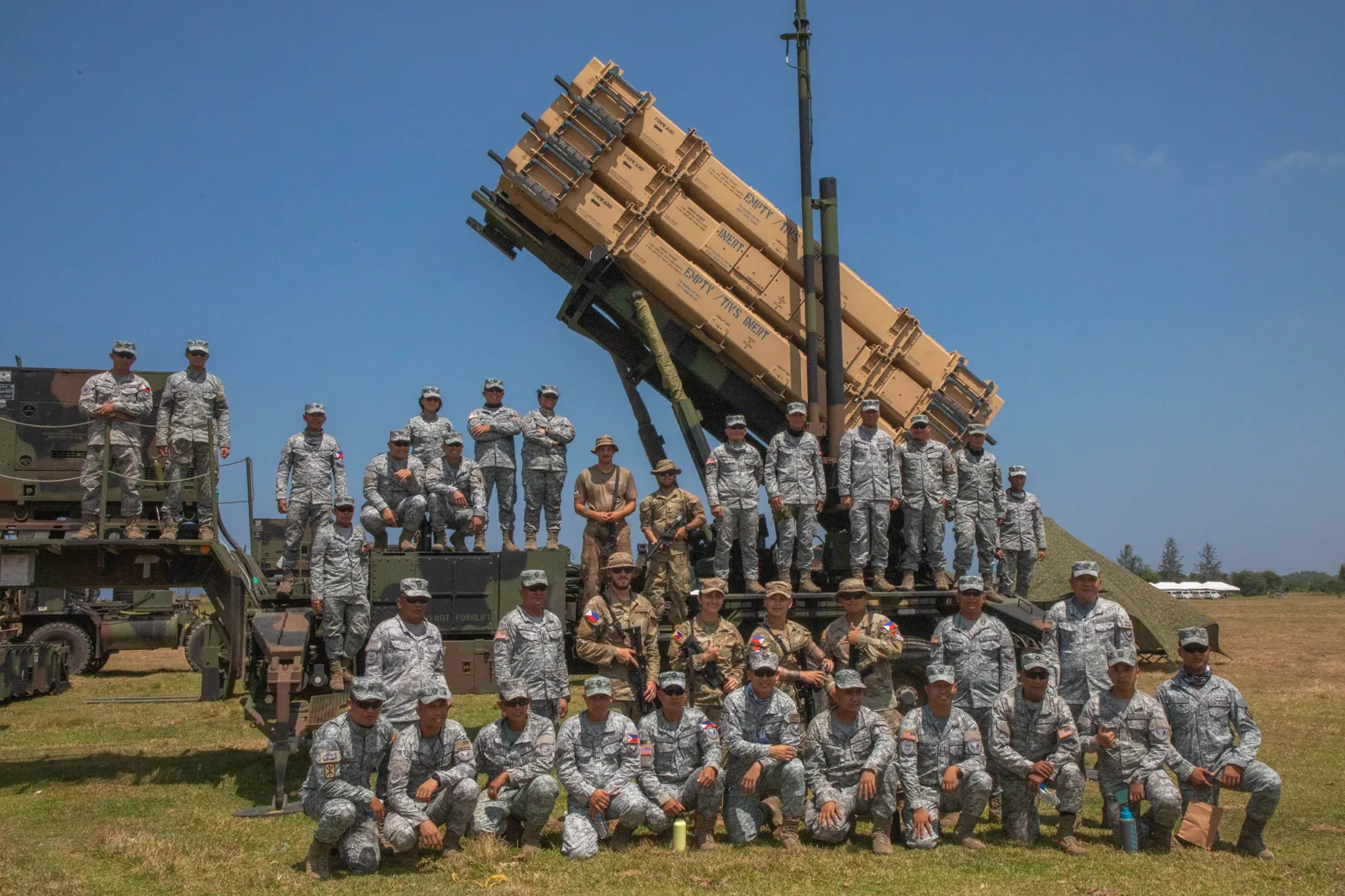
The PAC-3 MSE, the Patriot family’s most widely deployed interceptor, is priced at roughly $5.3 million per round in the Army’s FY2027 budget request, up from figures around $3.87-4.2 million in the FY2025-2026 requests. A standard Patriot battery fields eight launchers, each carrying up to 16 PAC-3 rounds. Lockheed Martin delivered roughly 620 interceptors in 2025 — about 1.7 per day — a rate that analysts say falls far short of wartime consumption; Ukraine’s PAC-3 MSE stock was effectively exhausted by mid-2026, the only interceptor in its inventory capable of catching Russian Iskander-M ballistic missiles in terminal flight.
The cost-exchange ratio
The most commonly cited calculation pits a $35,000 Shahed/Geran against a roughly $4 million Patriot shot, a ratio near 1:114. Using the higher PAC-3 MSE figure ($5.3M) against a cheaper drone estimate ($20,000) pushes that as high as 1:265.
| System | Estimated unit cost | Note |
|---|---|---|
| Shahed-136 / Geran-2 | ~$20,000-50,000 (estimated) | Iranian-sourced claims as low as $4,000, unverified |
| Patriot PAC-3 MSE | ~$3.87-5.3 million | Per US Army FY2025-2027 budget requests |
| Coyote 2C (LIDS) | ~$120,000-125,000 | From a $75M US Army order for 600 units |
| Ukrainian interceptor drones | ~$3,000-5,000 (estimated) | Per Ukrainian sources; now ~70% of all intercepts |
| APKWS laser-guidance kit | ~$15,000-20,000 | A guidance kit added to an existing rocket, not a full missile |
All figures above are estimates; confirmed unit sale prices from manufacturers or defense ministries remain limited and vary by contract terms, delivery year and included logistics/training packages.
Why NATO and the US are chasing cheaper interceptors
In 2026 the US Army opened a formal search for a counter-drone missile priced under $150,000, explicitly aimed at reducing how often ballistic-missile-defense systems like Patriot get “spent” on low-value drone targets. Leading contenders:
- Coyote 2C — part of the LIDS (Low, slow, small-Unmanned Aircraft Integrated Defeat System) architecture, roughly $120,000-125,000 per shot.
- APKWS II laser-guided rocket — a guidance kit fitted to existing 70mm rockets, adapted for air-to-air and ground-to-air drone-hunting; the US Air Force approved a further $145 million contract in 2026.
- Lockheed Martin’s “half-price” Patriot proposal — announced in mid-2026, aimed at improving the exchange ratio against low-value targets.
- Ukraine’s domestic interceptor drones — in the $3,000-5,000 range, now handling roughly 70% of Ukraine’s total intercepts.
The underlying logic across NATO air defense planning: reserve expensive, long-range ballistic-missile interceptors for genuinely high-value threats, and build a cheaper layered defense against mass drone raids.
Frequently Asked Questions
How many interceptors does one Patriot battery carry?
A standard battery has eight launchers, each holding up to 16 PAC-3 MSE rounds — up to 128 interceptors, though actual loadouts vary with threat mix and available inventory.
Why do militaries keep using expensive missiles against cheap drones?
Because the drone’s potential impact — a hit on critical infrastructure, an air base or a populated area — isn’t proportional to its cost. Without a cheaper interceptor on hand or in range, defenders default to their most reliable, and usually most expensive, system.
Is a cheaper interceptor the only fix?
No. Early warning through sensor fusion (radar, RF, electro-optical), electronic warfare to defeat a drone without a kinetic shot, and layered defense architecture all improve the exchange ratio alongside cheaper munitions.
Sources
- The War Zone — “Cheap” Patriot Interceptor Costing Under $1 Million Now Being Sought By Army
- Breaking Defense — Army launches search for counter-drone missile priced under $150K
- Stars and Stripes — Lockheed Martin says it will build new, half-price Patriot missile
- Army Recognition — US Army to Secure Coyote Interceptors in First Long-Term Deal
- Foreign Policy — Russian Ballistic Missile Attack Exposes Critical Shortage in Ukraine’s Interceptors
- National Defense Magazine — Ukraine Flips Cost Imbalance Script With Low-Cost Interceptors
- Wikipedia — HESA Shahed 136
Related Reading
- Countering Kamikaze Drones: A Layered Defense Guide
- Turkish version: 30 Bin Dolarlık İHA’ya Milyon Dolarlık Füze mi?
Updated August 28, 2026. Cost figures in this article are estimates based on public budget documents, industry contract disclosures and open-source analysis; they should not be read as confirmed unit sale prices.